How Long Does a Cedar Roof Last, and What Does It Need?
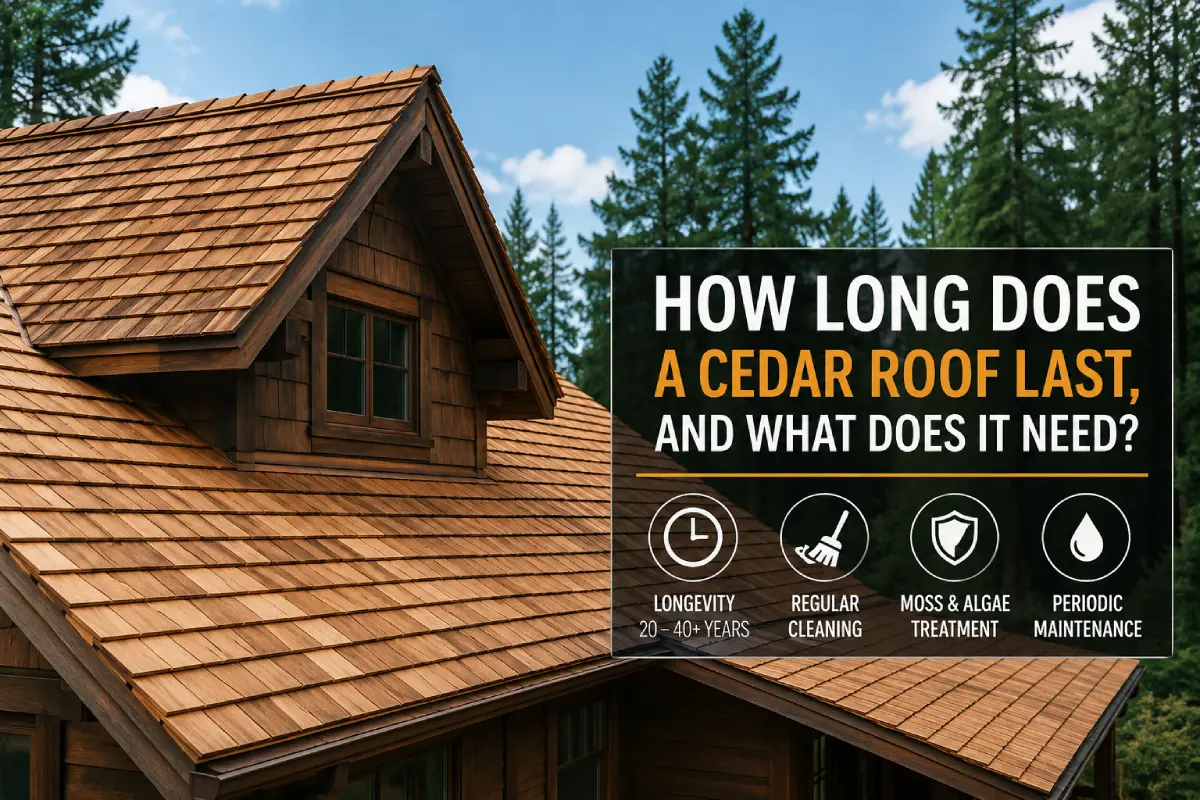
A wood roof is the only common covering that is expected to change appearance over its life and is not considered to be failing when it does. Cedar starts warm brown and weathers to silver gray, and most people who choose it are choosing that. What they are also choosing, whether or not anybody mentions it, is a roof that needs looking after.
Shakes and shingles are not the same thing
The two words get used interchangeably in conversation, and they should not be.
Wood shingles
Wood shingles are sawn on both faces. They are thinner, flatter, and more uniform, and they lie close together for a fairly even surface.
Wood shakes
Wood shakes are split rather than sawn, at least on the face. They are thicker, more irregular, and they throw a much deeper shadow line. That texture is the reason most people choose them, and it is also why a shake roof needs a different underlayment arrangement, because the irregular surface does not seal against itself the way a shingle roof does.
Both are usually Western Red Cedar. Both are graded, and the grade matters a great deal to how long the roof lasts. Under the Cedar Shake & Shingle Bureau’s grading, the top grades (No. 1 Blue Label for shingles, Premium for shakes) are 100 percent heartwood, clear, and edge grain, while lower grades allow more flat grain and imperfections. A quote that says only cedar has left out the part that decides the outcome.
How long a wood roof lasts
Published expectations for cedar generally fall around thirty years for shingles and a little longer for shakes, with treated premium grades quoted higher and lower grades a good deal shorter. The spread on those numbers is wider than for almost any other material, because a wood roof depends more on its conditions than on itself.
Three things move it more than anything else.
- How quickly it dries. Wood that dries after rain lasts. Wood that stays damp does not. A roof in constant shade under overhanging trees will not reach the same age as the same roof in sun and moving air.
- Ventilation underneath. Cedar needs to breathe on both faces. A wood roof laid straight onto a solid unventilated deck has a shorter life than one laid on battens with air behind it.
- Whether anyone maintains it. This is the one people underestimate, and it is covered below.
The general point in what decides how long a roof lasts applies more strongly to wood than to anything else. With asphalt, conditions shift the outcome. With cedar, conditions largely determine the outcome.
The maintenance a wood roof needs
This is the part that decides whether a wood roof is right for you, and it is usually discussed last.
Cedar holds moisture and organic debris, so it grows things. Moss and algae on an asphalt roof are a problem worth dealing with. On a wood roof, they are the mechanism by which it fails, because they trap water against the fibres continuously. Leaves and needles collecting in the courses do the same.
A wood roof therefore needs clearing regularly, needs the growth removed before it establishes, and depending on the product and the climate may need periodic treatment. Split, cupped, or missing pieces need replacing as they appear rather than at the end. None of this is difficult work, but it is recurring work, and a wood roof that gets none of it can fail decades early.
If you would not realistically keep up with that, or pay somebody to, cedar is the wrong material, and it is better to know that at the quote stage. Regular roof inspection matters more here than on any other covering.
Fire, and whether you can have one at all
Wood roofing is combustible, and this is not a theoretical concern. Many jurisdictions restrict or prohibit untreated wood roofing outright, particularly in areas with wildfire exposure, and insurers in those areas may decline coverage or price it very differently.
Check local fire rules first
Pressure-treated products with fire retardant are available and carry classified fire ratings, and in some places those are the only wood roofing permitted. Rules vary enormously by state, province, county, and even by individual development, so this is a question to answer locally and early. It is the one factor that can remove the decision from your hands entirely.
Two state codes show where this is heading. California requires Class A roof assemblies in its designated fire hazard severity zones under Chapter 7A of its building code, and Colorado’s statewide Wildfire Resiliency Code, which local jurisdictions had to begin enforcing by July 1, 2026, requires a Class A roof covering or assembly in its designated wildfire hazard areas. In places like these, a wood roof is only possible if the specific product and assembly achieve that rating and the local authority accepts it.
Where a wood roof makes sense
Cedar suits houses where the look is the point and the setting supports it: reasonable sun, moving air, not buried under trees, in a climate that is not permanently damp, with an owner who accepts the upkeep. On a heritage or period property where the original covering was wood, it is often the only material that looks right.
It suits poorly where the roof sits in permanent shade, where wildfire rules or insurance make it difficult, and where nobody is going to maintain it. In those cases, the honest comparison is against asphalt, or against one of the synthetic shake products that imitate the appearance without the upkeep, which are a legitimate answer to exactly this problem.
What to ask a contractor
Beyond the usual ground covered in the questions worth asking any roofer, a wood roof has its own short list. Which grade of cedar is quoted, and is it treated? Whether the roof is being laid on battens or on a solid deck, and how it is ventilated. What the manufacturer requires by way of maintenance for the warranty to remain valid, because on wood products that requirement is often specific and often ignored.
If the answer to the last one is vague, treat the warranty as decorative.
How a wood roof is laid, and why it matters
Cedar is one of the few coverings where the method underneath changes the lifespan as much as the product itself, so it is worth knowing what you are being quoted.
Traditionally, wood shingles and shakes are laid on spaced battens rather than a solid deck, so that air reaches the underside of every piece. Modern practice often uses a solid deck with a ventilated mat or counter battens laid over it to recreate that air gap. Either can work. What does not work is cedar laid tight onto a solid unventilated deck, because the underside never dries and the roof rots from beneath while the visible face still looks sound.
Spacing matters too. Wood swells when wet, so pieces are laid with a small gap between them. Laid tight, they push against each other as they take up moisture and cup or split. On shake roofs, an interlayment strip is woven between the courses, because the irregular split surface does not seal against itself.
Ask which of these applies to your quote. A contractor who answers precisely has done it before.
Treatments, and what they actually do
Cedar is naturally durable, which is why it is used, but treated products exist for two different reasons, and they are often confused.
- Preservative treatment resists decay and insect attack, extending life in damp conditions.
- Fire retardant treatment is what gives a wood roof a classified fire rating, and in many jurisdictions it is the difference between a permitted roof and a prohibited one.
Neither is permanent in the way people assume. Surface-applied coatings and finishes need reapplying on a cycle, and the manufacturer will state that cycle. Pressure-impregnated treatment lasts far longer but is not eternal either. If a warranty is being offered, the maintenance schedule attached to it is the part to read, because it is usually the clause that ends up voiding the coverage.
Conclusion
A wood roof is a maintenance commitment bought in exchange for an appearance nothing else quite matches. Where the setting suits it and the upkeep actually happens, cedar is a fine roof. Where either of those is missing, it becomes an expensive way to get a short roof life, and a repair or replace decision arrives much sooner than the brochure suggested.