What Should Be in a Roofing Contract?

The quote gets all the attention, and the contract does the work. By the time anything goes wrong, the estimate is irrelevant, and what matters is the document you signed: what it promised, what it left out, and how it handles the parts nobody could know in advance.
A roofing contract does not need to be long. It needs to be specific. Everything below should be on it, and anything that is missing is a question rather than an omission.
Who the parties actually are
The full legal business name, not a trade name painted on a truck. A physical address, not just a cell phone number. The license number where your jurisdiction issues one, and the insurance details.
Check this before signing
Check that the business named on the contract is the one you verified as licensed and insured. These do not always match, and a contract with a different entity on it than the one you checked is worth stopping over.
The scope, in enough detail to argue from
This is where most weak contracts fail. Replace roof is not a scope. What should be written down:
- The material, by manufacturer, product line, and color. Not just architectural shingles.
- Underlayment type, and where ice and water protection goes.
- Whether the old roof is being stripped or covered, and how many existing layers there are. See tear-off versus overlay.
- Which flashing is being replaced and which is being reused. Reusing old flashing on a new roof is a common and rarely disclosed economy.
- What is happening to ventilation: what is being added, or explicitly that the existing arrangement is being retained.
- Gutters, drip edge, valleys, chimney, and skylight details.
- Disposal, and who pays for it.
The unknowns, and how they will be priced
Some things genuinely cannot be known until the roof is open. A good contract does not pretend otherwise; it sets the price in advance.
The important one is decking: a written rate per sheet or per square foot, applied to whatever is found. Without that rate, the number gets set at the moment your roof is open and your leverage is at its lowest.
The contract should also say how any other change is handled: that additional work requires a written change order signed by you before it proceeds. Verbal changes on a roof are how disputes start.
Money: how much, and when
The total price, what it includes, and whether it includes tax and permit fees.
Then the payment schedule, which is the part worth thinking hardest about. A deposit is normal, though some states cap it; California, for example, limits a home improvement down payment to $1,000 or 10 percent of the contract, whichever is less. A deposit that represents most of the job is not normal anywhere. Payments should be tied to progress, with a meaningful final payment held until the work is finished, cleared up and, where applicable, signed off by inspection.
Be wary of any structure that has you substantially paid up before the work is substantially done. Pressure for a large cash deposit is one of the more reliable warning signs there is.
The two warranties, which are not the same thing
Almost every roofing dispute about warranties comes from not separating these.
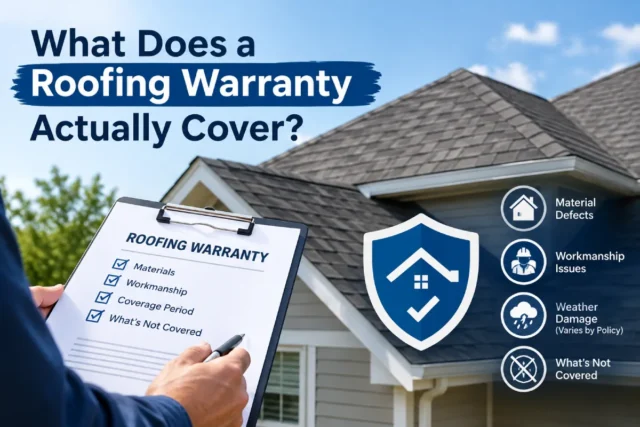
The manufacturer warranty covers the material against defects. It comes from the manufacturer; it typically has conditions attached about correct installation and adequate ventilation, and it is often prorated so its value falls over time.
The workmanship warranty covers the contractor installing it correctly. It comes from the contractor, and it is only worth what the contractor is worth in the year you need it.
The contract should state both: length, what each covers, and what voids them. The overwhelming majority of early roof failures are installation failures, which the manufacturer warranty does not cover. Ask how the workmanship warranty is transferred if you sell.
Schedule, weather, and the site
A start date and an expected duration, with a statement of what happens if weather interrupts. Rain during a tear-off is a normal event, and the contract should say who carries the risk of it.
Also worth having in writing: working hours, where materials and the dumpster will sit, protection of landscaping and driveway, and clean up including a magnetic nail sweep. Those sound minor until they are not, and preparing for the work is easier when they are agreed.
Cancellation and disputes
Many jurisdictions give a statutory right to cancel a contract signed at your home within a short window. In the United States, the Federal Trade Commission’s Cooling-Off Rule gives you until midnight of the third business day to cancel many sales made at your home. Where a right like this applies, the contract is generally required to say so. Its absence is informative.
There should also be something about how disagreements are resolved. It does not need to be elaborate, but a contract silent on the subject leaves you with only the expensive option.
Before you sign
Take it away and read it somewhere other than at the kitchen table with the salesperson waiting. Any contractor worth hiring expects this. Urgency applied at the signing stage is not a scheduling reality; it is a technique.
Check that everything you were told verbally appears in the document, because anything that does not is not part of the deal. Then read it against the other quotes you have, as comparing estimates describes, since two contracts for the same roof frequently differ in scope rather than in price.
Lien waivers, where they apply
In many places, contractors, subcontractors, and material suppliers can register a claim against your property if they are not paid, and that right does not depend on whether you paid. If your roofer takes your money and does not settle with the supplier who delivered the shingles, the supplier can still come after the house.
The protection is a lien waiver: a document signed as payments are made, confirming that the party signing gives up the right to claim for the work covered. On a job of any size, it is reasonable to make each payment conditional on receiving waivers from the contractor and from anyone they have engaged.
This does not apply everywhere, and the mechanics differ, so it is worth confirming what applies where you live. Where it does apply, a contractor accustomed to working properly will not be surprised by the request.
If the job is going through an insurance claim
Claim-funded roofs come with a document worth reading very carefully before signing anything.
An assignment of benefits, or a similarly named agreement, transfers your right to deal with the insurer over to the contractor. It is presented as a convenience, and sometimes it is one. It also means the contractor negotiates the settlement, receives the money, and decides what the scope becomes, while you have handed away your position in that conversation.
Related, and equally worth pausing over: an agreement that commits you to using a contractor if and only if the claim is approved. Signed at the door in the days after a storm, that is often the first document produced, before any inspection and before any quote you could compare.
Neither is automatically improper, although some states now restrict the first: Florida, for example, prohibits assigning post-loss benefits under residential and commercial property policies issued on or after January 1, 2023. Both belong in the category of things to take away, read, and if necessary ask your insurer about directly, rather than sign on a doorstep. The same caution described in the warning signs applies with more force here, because storm work concentrates exactly the operators it describes.
Conclusion
A good roofing contract is specific about the material, honest about the unknowns, cautious about the money, and clear about which warranty covers what. Those four things prevent nearly every dispute that homeowners have with roofers.
If a contractor resists putting any of them in writing, you have learned something more useful than the price.