What Does a Roofing Warranty Actually Cover?
Less than most homeowners assume. The gap between what people think they have and what the document says is where the disappointment lives. The word warranty is used loosely in roofing sales, and it covers at least two entirely different things that fail in different ways.
The short version: the manufacturer covers the materials, the contractor covers the installation, and the great majority of roof problems are installation problems. The stronger-sounding of the two warranties is usually the one that will not help you.
Two warranties, two different promises
The manufacturer warranty
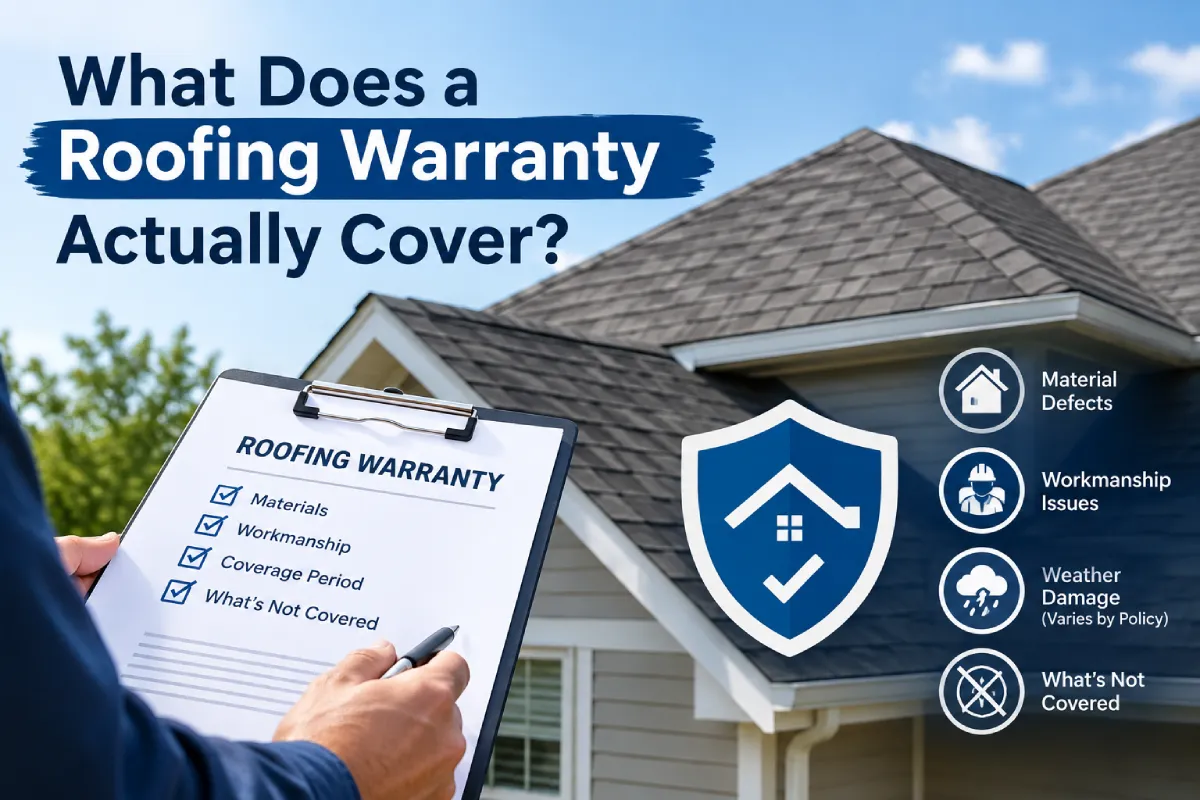
A manufacturer warranty covers defects in the product itself. Delamination, premature granule loss, a manufacturing fault that causes the material to fail before its rated life. It is backed by a company with substantial resources, which is its main strength.
The workmanship warranty
A workmanship warranty covers the installation, and it is backed only by the contractor who did the work. Nails in the wrong place, flashing detailed badly, inadequate fastening, a valley formed incorrectly. This is the warranty that covers most real failures, and it is worth precisely as much as the business standing behind it.
The asymmetry matters. A thirty year material warranty from a national manufacturer paired with a one year workmanship warranty from a contractor of unknown longevity is a weak position, however impressive the first number looks.
Why the headline number is misleading
Most material warranties are prorated, which means the coverage shrinks as the roof ages. A typical structure pays a high proportion in the early years and falls away steadily, so by the time a roof is well into its life the recoverable amount is a fraction of the replacement cost.
The logic is defensible, since you have had use of the material. The practical effect is that a warranty claim on a roof halfway through its life often returns a modest sum against a substantial bill.
Read how the proration works and from which year it begins. Some products offer a short non-prorated period at the start, sometimes described as full start or similar, and that initial window is where the meaningful coverage sits.
The part people miss: labor
A standard material warranty commonly covers the material and not the cost of removing the failed roof and installing the replacement. On a roof, labor is the larger half of the bill.
Enhanced or system warranties, usually available only when a certified installer installs a full set of the manufacturer’s components, often do include labor and sometimes come without a dollar cap. They generally cost more and require the contractor to be registered with the manufacturer. If a system warranty is being offered, ask what it includes that the standard one does not, and ask for the actual document rather than the brochure.
Ask for the document before you sign
Ask for the actual warranty text for the specific product and the written workmanship warranty from the contractor, and read both before the contract is signed. A verbal promise of lifetime coverage is not a warranty.
The two questions that reveal most:
- Does the material warranty include the labor to install the replacement material?
- How long is the workmanship warranty, and will the contractor put it in writing?
If a contractor cannot produce either document, that is the answer.
What voids it
Warranties are conditional, and the conditions are where claims are lost.
- Installation that departs from the manufacturer’s instructions, which is the most common reason a material claim fails.
- Inadequate ventilation, which manufacturers ask about early in any claim because heat is what ages the material.
- Pressure washing, which most manufacturers explicitly warn against on asphalt (see how to clean roof moss safely).
- Work by other trades on the roof afterwards, such as satellite dishes, solar mounts, or antennas.
- Lack of documented maintenance, where the warranty requires it.
- Storm damage and other events, which belong to insurance rather than warranty.
- Walking on the roof, on some fragile materials.
Ventilation is worth singling out. It is a condition on many warranties, and it is the item most often left out of a competitive quote, which means the roof can be installed in a state that compromises its own coverage. Why a roof needs ventilation covers what adequate actually means.
Transferring it when you sell
Manufacturer warranties are often transferable, frequently once only, usually within a limited window after the sale and sometimes for a fee. Miss the window and the coverage ends with your ownership.
Workmanship warranties are commonly not transferable unless the contract says otherwise. If that matters to you, it is a term to negotiate before signing rather than a discovery to make later.
Either way, the paperwork is worth keeping, because a documented warranty is one of the things that stops a buyer from treating your roof as older than it is.
Making a claim
Notify promptly, because delay is itself a ground for refusal on many policies. Go to the contractor first for anything that might be installation-related, and to the manufacturer for a suspected material defect.
You will need the original documentation: product, date of installation, installer, and the warranty registration if one was required. Some warranties must be registered within a period after installation to be valid at all, which is a step that gets missed constantly.
Photograph the problem, and expect an inspection. Expect ventilation and installation detail to be examined closely, because that is where the manufacturer looks first.
Conclusion
The workmanship warranty is the one that matters most and the one nobody asks about. Most roof failures are installation failures, and a long material warranty from a manufacturer does nothing about those.
Judge a contractor partly on the length and clarity of the workmanship coverage they will put in writing, alongside whether they are properly licensed and insured. A firm offering two years in writing and able to explain the exclusions is a better bet than one offering a lifetime verbally, and the contract is where that promise has to appear.