What Is a Roof Tear-Off, and When Can You Skip It?
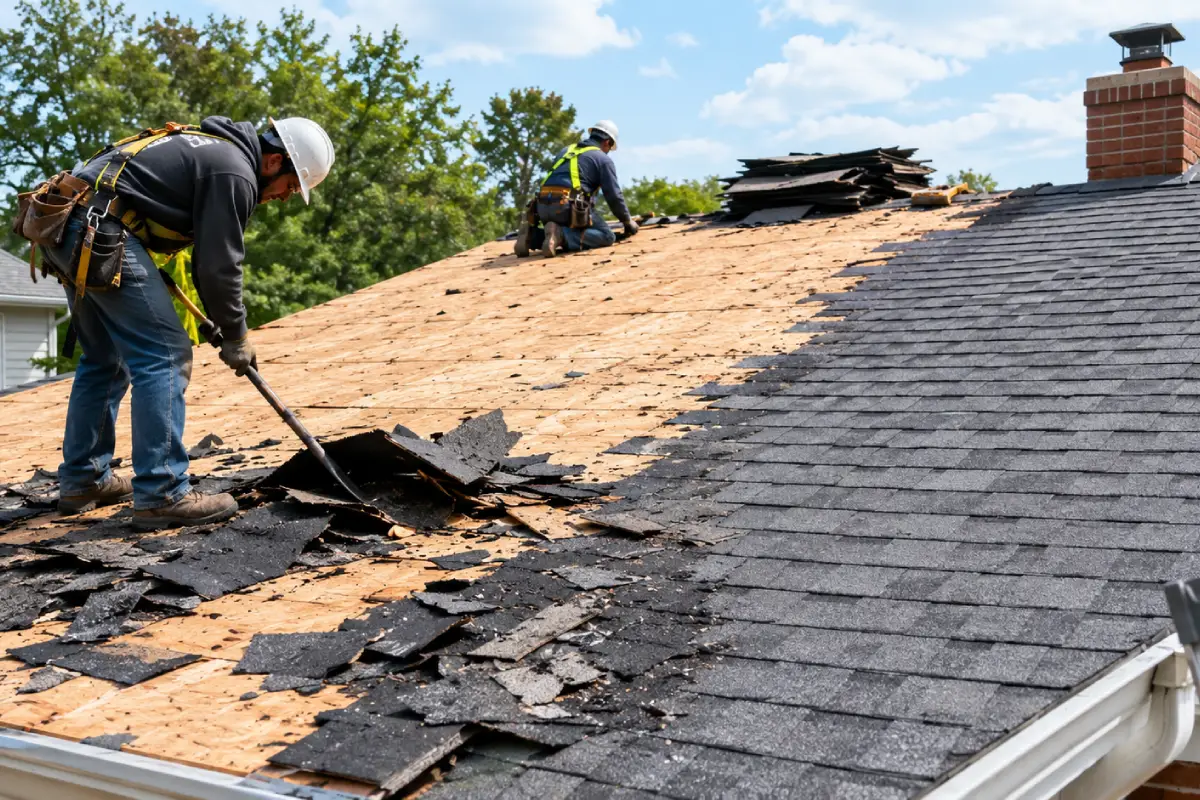
Tear-off is the part of a roof replacement where the old covering comes off. It is the noisiest day; it produces almost all of the mess, and it is the single largest variable line on most quotes after the material itself. It is also the point at which a contractor finds out what is actually underneath your roof, which is why it matters more than its position on the invoice suggests.
What a tear-off involves
The crew strips the existing covering down to the deck, usually working in sections so that no more of the roof is open at once than can be made watertight again the same day. Old shingles, underlayment, and flashing come off. Nails are pulled or driven flush. The deck is swept and inspected.
Everything removed has to go somewhere, which is why a dumpster appears in the driveway and why disposal is a separate cost. It is charged by weight in most places, and old roofing is heavy, particularly if there is more than one layer of it.
The whole sequence is covered in more detail in what happens during a roof replacement. This article is about the decision attached to it.
The alternative: roofing over
The other option is an overlay, sometimes called a re-cover or a nail over: the new shingles go straight on top of the old ones, and nothing is stripped.
The appeal is obvious. No tear-off labor, no disposal, fewer days, a smaller number at the bottom of the quote. In the right circumstances it is a legitimate piece of work and not a shortcut.
The circumstances are narrower than the price difference makes them sound.
When an overlay is allowed, and when it is not
Codes based on the International Residential Code do not allow an overlay where the existing roof already has two or more layers, where the existing roof is water-soaked or too deteriorated to serve as a base, or where the existing covering is slate, clay, cement, or asbestos-cement tile. Local codes can be stricter, so check the rules where you live.
Beyond the layer count, an overlay is only sensible when all of the following are true.
- The existing roof lies flat. Curled, cupped, or buckled shingles telegraph through the new layer, and the new roof takes on the shape of the old one.
- The deck is sound. If the deck cannot be seen, it cannot be assessed, and any rot underneath is being sealed in rather than found.
- There is no active or historic leaking. Water that has already been getting in has been getting in somewhere, and covering it does not answer where.
- The structure can take the weight. A second layer is a second layer of dead load, permanently.
There is one more consideration that rarely appears in the conversation: many shingle manufacturers reduce or void their warranty when the product is installed over an existing roof, and most contractors offer a shorter workmanship warranty on an overlay. The savings are real, and so is what you give up for it.
Why tearing off usually wins
The argument for stripping is not that the old roof is heavy or untidy. It is that you cannot fix what you cannot see.
Deck damage, failed flashing, missing or inadequate ventilation, and old repairs done badly are all invisible until the covering is off. A tear-off turns them into findings that can be dealt with while the roof is open, which is the cheapest moment in the roof’s life to deal with any of them. An overlay leaves every one of them in place, under a new roof that now has to be removed to reach them.
That is also why a tear-off quote should be explicit about what happens if something is found. Which brings us to the part homeowners are most often surprised by.
The line that changes after the quote
No contractor can price deck repair accurately before the deck is visible. Reputable quotes handle this by stating a rate: a price per sheet or per square foot of decking replaced, applied to whatever is actually found.
Two things to check. First, that the rate is written down, because a rate agreed in advance is a very different conversation from a number produced afterwards. Second, whether the quote assumes any decking replacement at all, since a quote that assumes none will always look cheaper than one that carries a realistic allowance for a roof of that age.
This is one of the most common reasons two honest quotes differ, and it is worth reading alongside what moves the cost of a roof replacement and how a new roof is priced before you compare numbers.
What to expect on the day
Tear-off is loud, and it is loud inside the house rather than only outside. Debris and nails come down, so cars, patio furniture and anything fragile need moving. Dust and small fragments come through roof spaces, so anything stored in the attic should be covered. There is more on this in what to do before a roof replacement.
A well-run tear-off never leaves more roof open than can be closed before the end of the day, and the crew should be watching the forecast as closely as you are.
How many layers do you already have?
Since the layer count often decides whether an overlay is even permitted, it is worth knowing before contractors start quoting rather than taking their word for it afterwards.
You can usually tell from the ground with a little care. Look at the roof edge at a gable or where the covering meets a fascia, and count the distinct bands of material in the exposed edge. A second layer also tends to change the profile of the roof at the eaves, giving a thicker, slightly stepped line. Inside, an attic hatch sometimes gives a view of the deck edge.
If you cannot tell, ask each contractor what they found and how they established it. Two contractors giving different answers about how many layers are on your roof is a useful thing to discover early, and it explains a great deal about why their numbers differ.
What happens if it rains mid-job
An open roof and a forecast that changes is the single most common disruption to a replacement, and how a contractor handles it separates competent operations from the rest.
Good practice is to strip only what can be dried in before the end of the day, and to keep the site able to be closed at short notice. That means enough underlayment on site to cover exposed deck, tarps available, and a crew that watches the forecast rather than the clock.
Ask this before work starts:
Ask directly what happens if weather stops the job with the roof open, and whether any resulting damage is their responsibility. It is a fair question, the answer costs nothing to give, and a vague reply is uninformative. It is also worth confirming before you agree a start date in a wet season, alongside the other points in preparing for the work.
Conclusion
An overlay saves real money on a roof that is flat, dry, single-layered, and structurally sound, and gives up warranty coverage and any chance of finding what is underneath. A tear-off costs more and is the only version of the job where the roof gets fixed rather than covered.
If you are deciding between them, the question is not which is cheaper today. It is whether you are prepared to buy a roof without knowing what it is being laid on. For most houses, and certainly for any roof that has ever leaked, the answer settles itself.