What Is Roof Decking, and When Does It Need Replacing?
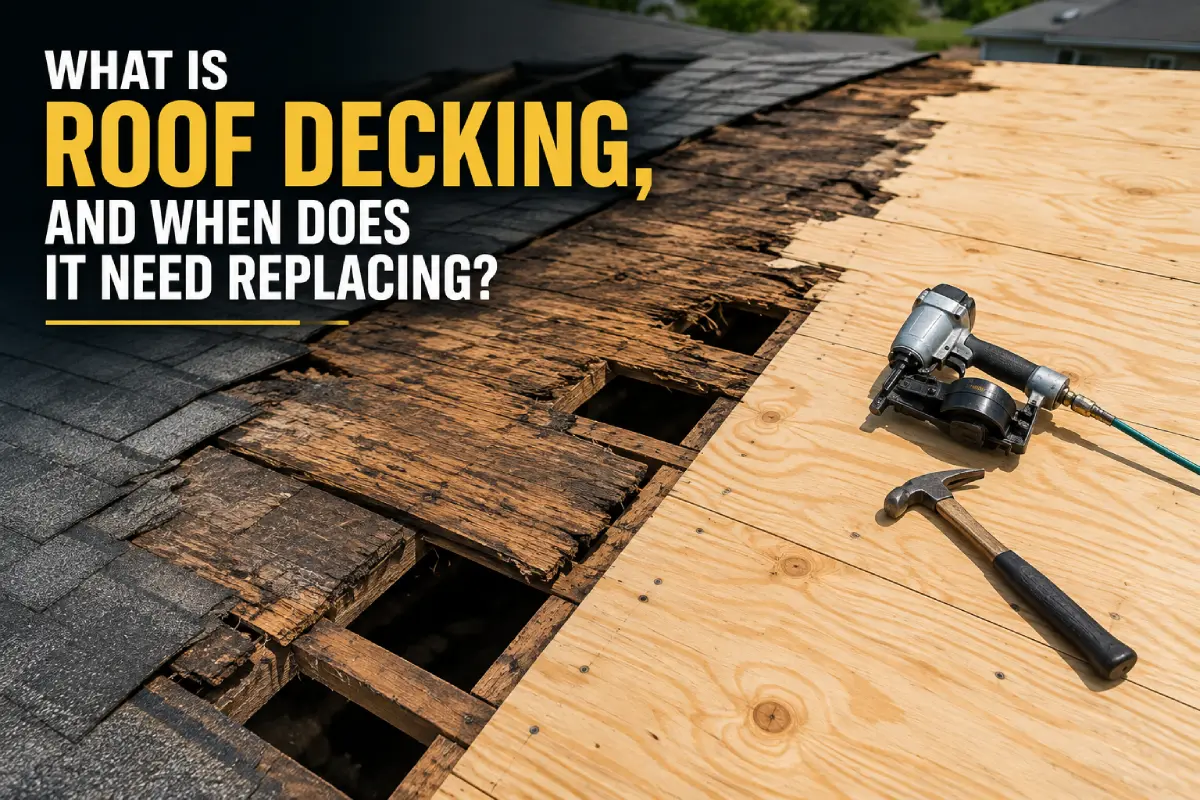
The deck is the layer nobody quotes for, and everybody ends up talking about. It is the continuous surface of boards or panels fixed across the rafters, and it is what the entire roof is nailed to. Shingles, underlayment, and flashing all sit on top of it, which means it is invisible until the roof comes off, and it is the reason quotes change once the job starts.
What the deck is, and what it does
On most houses built in the last several decades, the deck is plywood or oriented strand board, in sheets, nailed across the rafters or trusses. On older houses, it is often planks laid side by side, sometimes with gaps between them, which is why an older roof can look striped from inside the attic.
The deck does two jobs at once. It gives every nail something to hold, and it ties the roof structure together so that the rafters act as one surface rather than as separate sticks. A soft deck fails at the first job long before it fails at the second, which is why the earliest symptom is nails letting go rather than anything dramatic.
What damages a deck
Almost always water, and almost always water that arrived slowly.
- A long-running leak. Not the dramatic kind. A slow roof leak around flashing or a valley can soak the same patch of deck for years before it stains a ceiling.
- Condensation from below. This one surprises people. Warm, damp air from the house reaching a cold deck condenses on the underside, and a roof with poor ventilation can rot its deck without a single drop coming through the covering. See roof leak or attic condensation.
- Ice damming. Water backing up under the covering at the eaves, refreezing, and being held there. Covered in what causes ice dams.
- Age and the covering above it. A roof left too long past the end of its life stops keeping water out reliably, and the deck is the first thing to absorb the difference.
What you can see before the roof comes off
You cannot inspect a deck properly from outside, but you are not completely blind either. The attic is the useful vantage point, and none of this requires going onto the roof.
From inside, on a dry day, look at the underside of the deck for dark staining, white or gray bloom, or any area that looks different from the rest. Look at the nail points coming through: rusted nails mean moisture has been reaching them. Sunlight visible through the deck on a plank roof is normal; sunlight through a sheet deck is not.
From outside and from the ground, a deck that has gone soft over an area often shows as a dip or a wave in the roof surface. A line in the roof that is no longer straight is worth taking seriously, and telling whether a roof is sagging covers how to judge that and when it becomes urgent.
A dip is not proof of rot, and rot does not always produce a dip. Both are reasons to have somebody look properly, which is part of why regular inspection earns its place.
How much usually needs replacing
On a roof being replaced at a normal age, in a normal condition, most decks come through largely intact and a handful of sheets get changed, typically around penetrations, valleys and eaves where water concentrates. Whole deck replacement happens, but it is the exception, and it usually accompanies a roof that was left far too long or a leak nobody chased.
Because the honest answer before the strip is we do not know yet, the way a quote handles that uncertainty tells you a great deal about the contractor. There is more on this in what a tear-off involves.
The rate to agree in advance
Every quote for a roof replacement should carry a written price for decking replacement: a figure per sheet or per square foot, applied to whatever turns out to be needed. Not an estimate of the total, which nobody can give, but the unit price that will be used.
Agreeing that before the roof opens converts a potential argument into arithmetic. Without it, you are relying on a number produced at the exact moment your roof is open and you have the least leverage in the whole project. It belongs on the list of questions to ask a roofer, and it is one of the reasons two quotes for the same roof can differ, as the cost factors article explains.
Ask also to be shown what is being replaced and why, before it goes in the dumpster. A reasonable contractor expects that question.
Why deck work is not optional
It is tempting, faced with an unexpected line on the bill, to ask whether the soft areas can be left and covered.
Why this cannot be skipped
They cannot, in any meaningful sense. New shingles nailed into compromised decking do not hold properly, which is a wind resistance problem rather than a cosmetic one. The manufacturer’s warranty on the covering generally assumes a sound substrate. And the rot does not stop because something was laid over it. Deck replacement during a re-roof is the cheapest this work will ever be, because access is free and the roof is already open.
Plank decks and sheet decks are not interchangeable
If your house is older, the deck is probably planks rather than sheets, and that changes what a re-roof involves.
Plank decks were laid with gaps between the boards, which was correct for the wood shingles they usually carried, because those needed air beneath them. Modern asphalt shingles do not, and they need something solid to nail into at every point. A nail that lands in a gap holds nothing, and a roof with a proportion of its nails in gaps sheds shingles in wind while looking perfectly normal from the ground.
The usual answer is to overlay the plank deck with a thin sheet material to create a continuous nailing surface. That is a real cost and a real decision, and the International Residential Code (Section R905.2.1 in the 2018 edition) requires asphalt shingles to be fastened to solidly sheathed decks. The code does not define “solidly sheathed,” so whether an existing plank deck qualifies is decided locally; Springfield, Missouri, for example, accepts existing board or plank decking that meets several criteria, including being structurally sound, holding nails adequately, and meeting the shingle manufacturer’s installation instructions, including any limits on board spacing. A quote for an older house that says nothing about the plank deck has either checked and decided it is fine, or has not looked. It is worth knowing which.
The boards most often replaced are those that are cupped, split around old nail holes, or spongy at the ends where they meet a wall. End joints over rafters are where rot tends to concentrate.
Thickness, fasteners, and re-nailing
Two details that appear on better quotes and are missing from weaker ones.
Thickness
Deck sheets come in different thicknesses, and the right one depends on how far apart the rafters are. A deck that is too thin for its span flexes underfoot and works its nails loose over time. If sheets are being replaced, the new material should match or exceed what is there rather than being whatever was on the truck.
Re-nailing
On older houses, the deck was often fixed with smooth shank nails that have gradually withdrawn, which is why decks creak, and shingles above them lift. Re-nailing or screwing the existing deck to the rafters while the roof is open is inexpensive at that moment and impossible afterwards. In some jurisdictions it is now required at re-roof. Ask whether it is included.
Conclusion
The deck is the part of the roof you are least likely to think about and most likely to be surprised by. You can reduce the surprise: look in the attic before you get quotes, take a sagging line seriously, and insist on a written per-sheet rate in every quote you compare.
Do those three things and decking stops being the line that ambushes you and becomes the line you were expecting.