What Causes Ice Dams, and How Do You Stop Them?
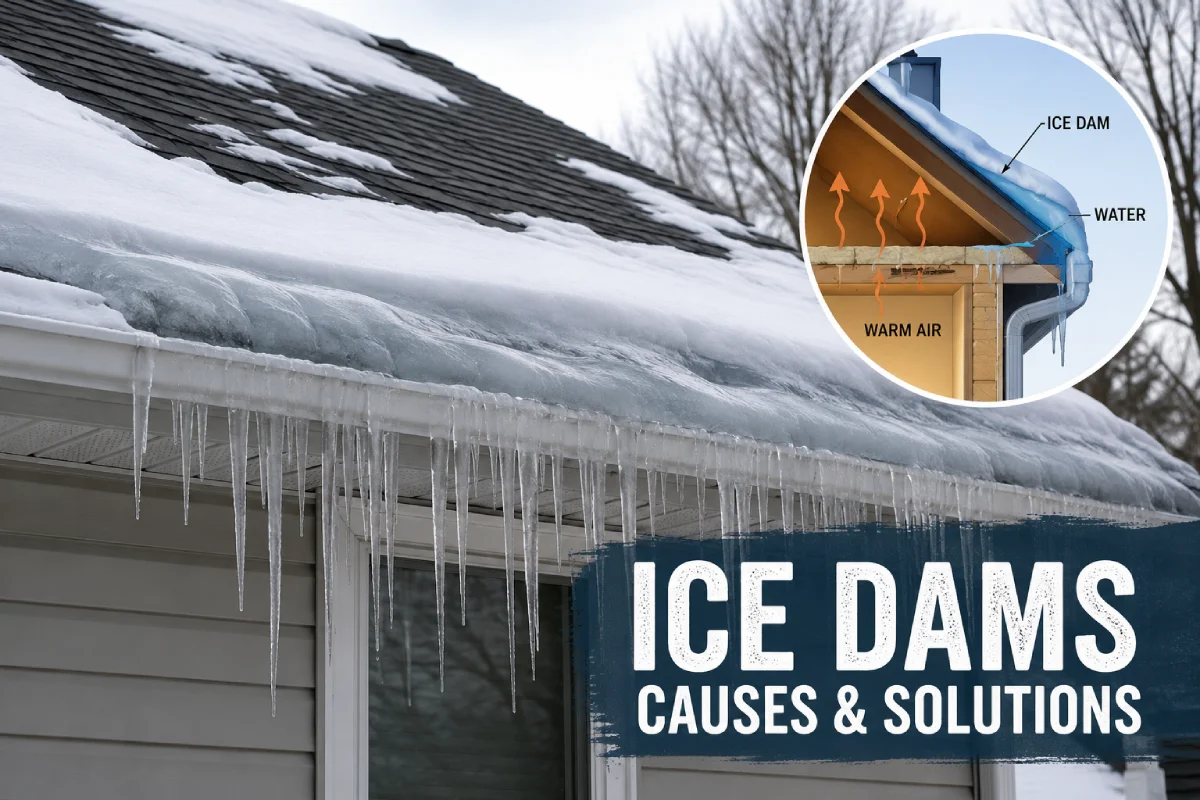
An ice dam is a ridge of ice that forms along the lower edge of a roof and stops melting snow from draining away. Water backs up behind it, works under the shingles, and ends up in the roof structure and the rooms below. Nothing has to be wrong with the roof covering for it to happen.
The cause is not the roof. It is heat escaping from inside the house into the roof space, warming the deck, and melting snow that refreezes when it reaches the cold overhang. An ice dam is a heating and insulation problem that happens to appear on the roof, which is why replacing the covering so rarely fixes it.
How does an ice dam form?
Four things happen in order. Heat from the house reaches the underside of the roof deck. Snow lying on the warmed section melts from below. The meltwater runs down the slope until it reaches the overhang, which has no heated room beneath it and stays at outdoor temperature. There it refreezes.
Repeat that over a few days, and the ice at the eave builds into a ridge. Once it is high enough, the next round of meltwater has nowhere to go. It sits behind the ice instead of running off, and shingles are designed to shed water moving downhill, not to hold standing water. It works up under the courses, reaches the deck, and finds the joints between sheathing panels.
This is also why the damage often appears at the top of an exterior wall or above a window rather than in the middle of a ceiling. Water entering at the eave runs down inside the wall cavity before it shows.
Where the heat is escaping
Some heat passes through the ceiling by conduction, which is what insulation slows down. The larger share is usually warm air physically moving through gaps, and insulation does very little about that.
Warm air rises and presses against the ceiling looking for a way out. The routes it takes are consistent from house to house: recessed light fixtures, the attic hatch, plumbing vent stacks, holes drilled for wiring, the gap around a chimney chase, ductwork running through the roof space, and bathroom fans or dryers that terminate in the attic instead of outside. A single uninsulated hatch can melt a visible patch of snow above it.
Insulation, air sealing, and ventilation do three different jobs
This is the distinction that decides whether the money you spend works, and it is routinely blurred.
- Insulation slows heat moving through the ceiling. It is a resistance, not a barrier.
- Air sealing stops warm air travelling through gaps, which insulation laid over an open gap does not do.
- Ventilation carries away whatever heat gets past the first two, keeping the deck close to outdoor temperature.
They are not alternatives. You need all three, and the order matters: seal first, then insulate, then check that the roof can actually breathe. The United States Department of Energy treats air sealing, insulating, and ventilating as one combined strategy for ice dam prevention rather than a list to choose from.
The conditions that produce one
An ice dam needs three things at once: snow on the roof, a deck above freezing under that snow, and an edge below freezing. Cold weather alone does not do it. What it is is a temperature difference across the same roof.
Building science sources describe the usual setup as an under-roof temperature above about 30F while the outside air sits below the low twenties, with several inches of snow already down. Those are typical conditions rather than fixed thresholds, and they shift with the roof assembly, but they explain the timing. Ice dams appear after a cold spell follows a decent snowfall, not during the first light covering of the season.
Worth knowingDeeper snow makes ice dams more likely, not less. Snow is itself an insulator, so a thick layer traps escaping heat against the deck and raises the temperature where the snow meets the roof. A large storm is a greater risk than a small one, which is the opposite of what most people assume.
Which roofs get them
Two identical houses side by side can behave completely differently, and the difference is almost always in the roof space rather than the covering. The risk is higher with a complex roofline carrying several valleys or dormers, a cathedral ceiling or any room with no attic above it, knee walls, a room built over an unheated garage or porch, recessed lights in an upstairs ceiling, a low slope that drains slowly, or ductwork running through the roof space.
If only one section of your roof produces ice, treat that as information rather than bad luck. It means the heat loss is local: a particular gap, a bay where insulation is missing or crushed, a duct above that part of the ceiling, or a soffit vent that has been blocked. Walking the same area of the attic on a cold morning usually finds it.
Is it actually an ice dam
A stain that appears on an upstairs ceiling in winter has three plausible causes, and they need different remedies. Working out which one you have before hiring anyone is the most useful half hour available to you.
| Ice dam | Condensation | Roof leak | |
|---|---|---|---|
| When it appears | During a thaw, with snow lying on the roof | After a thaw that follows a hard cold snap | During or just after rain |
| Where it shows | Top of exterior walls, outside corners | Scattered small stains across the ceiling | One repeating spot, often near a feature |
| In the attic | Wet insulation at the eaves | General frost on the sheathing and nails | A single dark track down a rafter |
| First fix | Air sealing, insulation, ventilation | Exhaust fans and ventilation | Repair on the roof |
The distinction between the first two matters more than it sounds, because neither is fixed by a roofer. Our guide to telling a roof leak from attic condensation goes through the checks in detail.
What to do while the ice is there
Before you do anything:
A snow-covered roof is not a walkable surface; ladders and ice are a poor combination, and large icicles fall without warning. Electrical service cables usually enter the house near the roofline, so a metal-handled rake in that area is genuinely dangerous. Cold shingles are brittle and break under treatment they would shrug off in July.
Almost everything useful here is done from the ground. If a job needs you on the roof, it needs somebody with proper equipment.
If water is already coming in, deal with that first and quickly. The US Environmental Protection Agency advises drying water-damaged materials within 24 to 48 hours, because in most cases mold will not grow if they are dry by then. The ice can usually wait a few days. Soaked drywall and insulation cannot. Contain the drips, move what is below them, switch off the circuit if water is near a light fixture, and photograph everything with dates in case you claim later.
The most effective thing you can do yourself is rake the snow off the lower roof from ground level. Clear the first few feet up from the edge, pull downwards with the slope rather than dragging sideways across the shingles, and leave a thin layer rather than scraping to the surface. Doing it after roughly every six inches of fresh snow is more useful than waiting for a problem.
If a dam has already formed, a sleeve filled with calcium chloride laid across it, running at right angles to the edge, melts a channel and lets the trapped water drain. That relieves pressure. It does not remove the dam. Use calcium chloride rather than ordinary rock salt, which is harsher on shingles, corrodes gutters and flashing, and kills whatever is planted below.
For a dam that is causing real damage, low-pressure steam applied by a professional is the only method that clears it quickly without harming the roof. Check that steam is what you are getting. Some firms use pressure washers, which strip the granules off asphalt shingles.
Never do these:
- Do not chip, hammer, or chisel the ice. Cold shingles crack, and people go through roofs doing this.
- Do not use a pressure washer, which removes shingle granules.
- Do not use a blowtorch or heat gun. Roofs catch fire this way every winter.
- Do not throw rock salt onto the roof.
- Do not pull the gutters off in midwinter. It does not remove the dam, and it damages the fascia.
- Do not open a wet ceiling before the water has stopped.
How to stop them coming back
All of the above manages a symptom. The cure is in the roof space, and it is warm weather work. If you are reading this in January, the realistic plan is to get through the winter with raking and containment and book the attic work for spring.
Seal the ceiling plane first.
The aim is a continuous barrier between heated rooms and the roof space, and continuity is the whole point, because air finds whatever you leave. Seal around plumbing stacks and wiring, weatherstrip the hatch, close the gap around the chimney chase with fire-rated material, and deal with recessed lights, which sometimes need replacing with sealed units rather than packing insulation around a hot fixture.
Then insulate.
How much depends on your climate zone, with cold climate recommendations commonly landing in the R-49 to R-60 range, and the ENERGY STAR table of recommended levels by climate zone is the place to check rather than any single figure quoted in an article. Depth is not the only thing that matters. Insulation frequently stops short of the exterior wall, leaving the coldest strip of ceiling uncovered, which is often exactly where the dam forms. Insulation crushed under attic flooring or boxes has lost most of its value.
Then balance the ventilation.
It works as a system: cold air in at the soffits and warm air out at the ridge, and a ridge vent with no intake below it does very little. Blocked soffit vents are extremely common, because insulation blown in against the eaves crushes the airflow path shut. Rafter baffles are inexpensive and keep it open. The code baseline in the International Residential Code is one square foot of net free ventilating area per 150 square feet of attic floor, reducible to one per 300 only when particular conditions are met, so treat any flat statement of that ratio with caution and check your local amendment.
Finally, stop putting heat and moisture into the roof space. Seal and insulate ducts, and make sure bathroom fans and dryers vent outside rather than into the attic.
Will a new roof fix it?
Usually not, and this is worth being blunt about because it is an expensive assumption to get wrong.
A new roof replaces the covering. The heat loss that causes the dam is unchanged by new shingles, so a re-roof carried out without addressing air sealing, insulation and ventilation tends to produce ice dams again the following winter on a roof that now costs five figures.
What a re-roof does offer is the only practical moment to install an ice barrier along the eaves, a self-adhering membrane that seals around nail penetrations so that water backing up behind a dam meets a waterproof layer rather than bare decking. It is also the right time to correct ventilation components.
The distinction that mattersAn ice barrier protects the house from the consequences of an ice dam. It does not prevent one. Worth every penny at re-roofing time, and not a solution on its own.
When to call somebody, and which trade
| Reasonable to do yourself | Needs a professional |
|---|---|
| Raking snow from the ground | Anything requiring you to be on the roof |
| Calcium chloride within safe reach | Steam removal of an established dam |
| Containing a leak and documenting it | Air sealing and insulation work |
| Clearing gutters before winter | Ventilation changes |
| A careful look in the attic | Anything structural or electrical |
The trade matters as much as the decision, and most people default to the wrong one. A roofer handles damage to the covering, ventilation components, ice barrier, and re-roofing. An insulation contractor or energy assessor handles the actual cause, and this is where the permanent fix lives. An ice dam removal specialist handles emergency steaming. A restoration firm handles significant interior water damage. Calling a roofer about a problem caused by your attic is how people end up buying a roof they did not need, so it is worth asking the right questions first.
Two questions separate a good answer from a bad one. Ask what they think is causing the heat loss, and be wary of any reply that is only about the roof. Ask whether they will air seal before insulating, because the answer should be yes without hesitation.
Common questions
Do gutters cause ice dams?
No. Ice dams form on the roof surface and happen on houses with and without gutters. A gutter packed with ice is one of the coldest parts of the assembly, so it makes the eave freeze faster and gets blamed for a problem it did not start. Removing your gutters will not stop ice dams.
Are icicles the same as an ice dam?
No. Icicles hang off the edge into open air, while an ice dam sits on the roof and blocks drainage. Icicles are a symptom, meaning meltwater is running down a warm roof and refreezing at the cold edge, so large ones are worth investigating even though they are not the dam itself.
Will an ice dam melt on its own?
Eventually, yes. A sustained thaw clears it. The question is whether you can wait. If nothing is leaking inside, usually you can. If water is coming in, you cannot, because the interior damage continues while you wait for the weather.
Is it safe to knock icicles off my roof?
Generally not. Large icicles are heavy enough to injure somebody when they fall, and knocking them down usually means standing directly underneath them. It also does nothing about the dam behind them. Clear the area below, leave them alone, and deal with the snow on the roof instead.
Do heat cables work?
They keep a drainage channel open, which can prevent water backing up. What they do not do is address the heat loss causing the dam, and they cost money to run every winter. Sources genuinely disagree about whether they are worth installing, with some extension guidance advising against them. Treat them as symptom management rather than a fix.
Will more attic insulation alone fix ice dams?
Usually not. Insulation slows heat conduction through the ceiling, but most of the heat reaching your roof deck is warm air moving through gaps, and insulation does not stop moving air. Seal the ceiling plane first, then insulate, then check the ventilation.
Does homeowners insurance cover ice dam damage?
It depends on the policy and how the loss is classified. Broadly, sudden interior water damage is commonly covered, while removing the dam itself is often treated as maintenance and is not. Claims can be declined where the damage reads as gradual or maintenance-related. Read your own policy or ask your agent rather than relying on a general article.
Do metal roofs get ice dams?
They are less prone to them because snow slides off a smooth metal surface more readily, particularly on a steeper pitch, leaving less snow to melt and refreeze. Metal does not make a roof immune. If you are losing heat into the roof space, the mechanism still applies, especially in valleys and on low slopes.
What can I do if I rent?
Report it to your landlord or managing agent in writing straight away, with photographs and dates, because the attic work is theirs to arrange. In the meantime, protect your belongings, contain any drips, and document the damage for your own contents insurance. Do not get on the roof.
Is it too late to do anything this winter?
It is too late for the permanent fix, because air sealing and insulation are warm-weather work. It is not too late to manage the winter: rake the lower roof after snowfalls, cut a channel if a dam forms, contain any leaks, and book the attic work for spring.
Conclusion
Ice dams look like a roofing failure and are almost never one. The ice at your eaves is a readout of how much heat your ceiling is leaking, which is why raking, salting, and even re-roofing all leave you in the same position the following winter.
Get through the cold months from the ground, then go and look in your attic in the spring. Seal the gaps, insulate properly to the edges, and make sure air can move from soffit to ridge. That is the work that ends the problem, and it is cheaper than the ceiling it saves. Adding it to your autumn preparation is how you stop thinking about it altogether.