How to Choose a Roofing Contractor: 10 Things to Check
Your roof is one of the most important parts of your home, and when it needs to be repaired or replaced, the contractor you choose to do the work matters just as much as the materials that go on top of it. A skilled, reputable roofing contractor will install your roof correctly, stand behind their work, and make the process as smooth as possible from start to finish. A poor choice in contractor can lead to a botched installation, endless frustration, wasted money, and a roof that fails years before it should.
The challenge is that choosing a roofing contractor is not something most homeowners do often. You might replace your roof once or twice in your lifetime, so you do not have a lot of experience to draw on. And because roofing is a trade where the quality of the work is largely hidden from view once the shingles go on, it can be difficult to tell a good contractor from a bad one until problems surface months or years later.
This article walks you through the ten most important things to check before hiring a roofing contractor. Taken together, these checks give you a reliable framework for identifying a contractor who will do quality work, treat you fairly, and protect your investment for the long term.
1. Verify Their License
The first and most fundamental check is whether the roofing contractor holds a valid license to perform roofing work in your state, county, or municipality. Licensing requirements vary by location — some states require roofing contractors to hold a specific roofing license, while others require a general contractor’s license that covers roofing work. Some local jurisdictions have their own licensing requirements on top of state requirements.
A licensed contractor has met minimum standards of competence and professionalism as defined by the licensing authority. This typically includes passing an exam, demonstrating a certain level of experience, and maintaining bonding and insurance requirements. Hiring an unlicensed contractor leaves you with little recourse if something goes wrong — the licensing board cannot help you, and your options for recovery may be limited.
Always ask for the contractor’s license number and verify it independently. Most licensing boards have online databases where you can look up a license number, confirm it is active, and check for any disciplinary actions or complaints. Do not simply take the contractor’s word that they are licensed — verify it yourself.
2. Confirm Their Insurance Coverage
Roofing work involves significant risk. Workers are operating at height with heavy materials, power tools, and challenging physical conditions. If a worker is injured on your property and the contractor does not carry adequate insurance, you could be held financially responsible for medical bills, lost wages, and other costs.
A reputable roofing contractor carries two types of insurance. General liability insurance covers damage to your property that occurs during the project — for example, if a falling shingle damages your siding, or if a crew member accidentally breaks a window. Workers’ compensation insurance covers injuries to the contractor’s employees while they are working on your property.
Ask the contractor for certificates of insurance for both general liability and workers’ compensation. Review the certificates to confirm that the policies are current and that the coverage limits are adequate. Then take the extra step of calling the insurance company to verify that the policies are active and have not been cancelled. Some contractors let their insurance lapse between jobs, and the certificate they show you may be outdated.
Do not accept a contractor who says they do not need workers’ compensation because they use subcontractors or independent workers. In many states, the homeowner can be held liable for injuries to uninsured workers on their property regardless of the employment arrangement. Make sure everyone who will be working on your roof is covered.
3. Check Their Reputation and Reviews
In the age of online reviews, a contractor’s reputation is more transparent than ever. Before hiring anyone, research their reputation through multiple channels.
Start with Google reviews. Look at both the overall rating and the individual reviews. Pay attention to how the contractor responds to negative reviews — a professional, constructive response to criticism indicates a company that takes customer service seriously. A pattern of dismissive, defensive, or hostile responses is a red flag.
Check the Better Business Bureau for the contractor’s rating and any complaints filed against them. While a BBB rating is not the sole indicator of a company’s quality, a pattern of unresolved complaints is a concern.
Look for reviews on other platforms as well — Yelp, Angi, HomeAdvisor, and social media pages. No company will have a perfect record, but you are looking for a pattern of positive experiences, professional conduct, and satisfied customers.
Beyond online reviews, ask the contractor for references from recent projects — ideally projects similar to yours in scope and material. A contractor who is confident in their work will be happy to provide references. Contact those references and ask about their experience: Was the work done on time? Was the crew professional? Were there any problems, and if so, how were they resolved? Would they hire the contractor again?
4. Look for Local Experience and Presence
A contractor with deep roots in your community has more at stake than one passing through. Local contractors depend on their reputation for repeat business and referrals. They are familiar with local building codes, permit requirements, weather conditions, and the common roofing issues in your area. They will be around to honor their warranty years down the road.
Ask how long the contractor has been operating in your area. A company that has been in business locally for five, ten, or twenty years has demonstrated staying power and a track record that you can verify. A company that opened a local office last month — or one that showed up in your neighborhood after a recent storm — does not have the same track record.
Check the contractor’s physical address. A legitimate roofing company has a real business address — an office, a showroom, or at least a permanent business location. Be cautious of contractors who only list a P.O. box or a cell phone number with no verifiable business location.
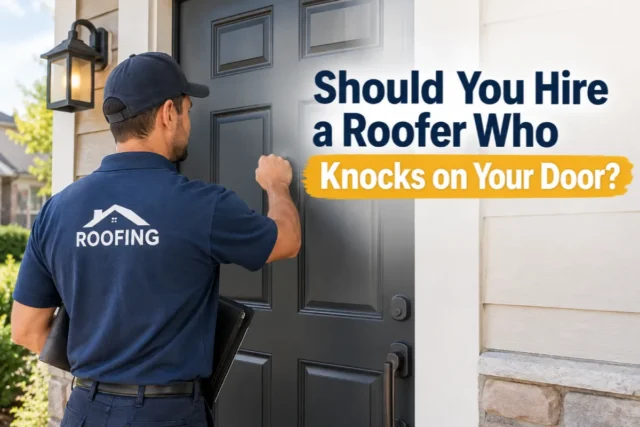
Storm-chasing contractors — companies that travel to areas hit by severe weather, sign up as many customers as possible, complete the work, and then leave — are a well-known phenomenon in the roofing industry. While some of these companies do decent work, the problem arises when warranty issues surface later and the company is nowhere to be found. A local contractor with a permanent presence in your area eliminates this risk.
5. Evaluate Their Communication and Professionalism
From the first phone call or email, pay attention to how the contractor communicates. Professionalism in communication is a strong indicator of professionalism in the work itself.
A good contractor responds promptly to inquiries. They show up on time for appointments and estimate visits. They listen to your concerns and answer your questions clearly, without jargon or condescension. They provide written estimates that are detailed and transparent. They follow up when they say they will.
A contractor who is difficult to reach, vague in their responses, dismissive of your questions, or unreliable in keeping appointments before you have even hired them is unlikely to improve once they have your money. The pre-project interaction is the contractor’s best behavior — it is when they are trying to win your business. If their best behavior is lacking, imagine what the rest of the project will be like.
Professionalism also extends to how the contractor presents themselves. A clean, branded vehicle, company uniforms or shirts, a professional-looking business card, and printed marketing materials may seem superficial, but they indicate a company that invests in its image and takes its business seriously. This is not a requirement — some excellent small contractors work out of an older truck — but it is one of many data points to consider.
6. Ask About Their Crew and Subcontractors
Not every roofing company that gives you an estimate will be the company that does the work. Some larger contractors use subcontractors for some or all of the installation. This is not necessarily a problem — many reputable companies use trusted subcontractors who work exclusively for them — but it is something you should understand before you sign a contract.
Ask the contractor directly: Who will be doing the work? Is it your own crew or subcontractors? If subcontractors are used, how long have you worked with them? Are they licensed and insured?
If the work will be done by subcontractors, confirm that those subcontractors carry their own workers’ compensation insurance. If they do not, the liability could fall on you.
Understanding the crew structure also helps you know who to talk to during the project. If a subcontractor is doing the work, will there be a project manager or foreman from the contracting company on-site to oversee the job and serve as your point of contact?
7. Review Their Warranty Offerings
A roofing warranty is only as good as the company backing it. Before hiring a contractor, understand the warranty coverage they offer and the terms that apply.
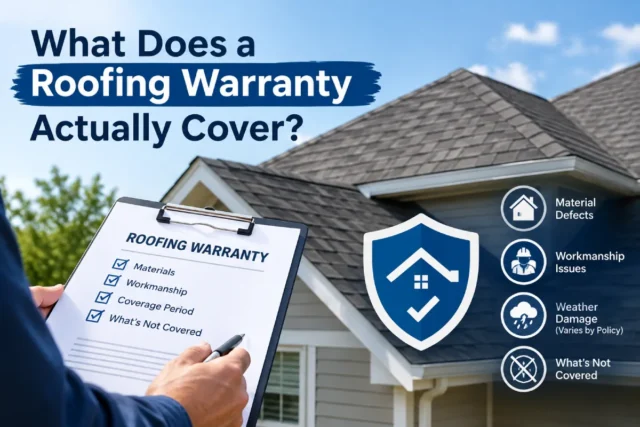
There are two types of warranty on every roof. The manufacturer warranty covers the roofing materials against defects. The workmanship warranty covers the installation — if the roof leaks or fails due to an installation error, the workmanship warranty is what protects you.
Manufacturer warranties vary by product and can range from 25 years to lifetime coverage. However, many manufacturer warranties are prorated after a certain number of years, meaning the coverage decreases over time. Some manufacturers offer enhanced warranty programs that provide longer non-prorated coverage, but these programs typically require the contractor to be certified by the manufacturer and to install a complete system of the manufacturer’s products.
Workmanship warranties are entirely at the contractor’s discretion. Some contractors offer one-year coverage. Others offer five, ten, twenty, or even lifetime workmanship warranties. A longer workmanship warranty indicates confidence in the quality of the installation and a commitment to standing behind the work.
The most important question to ask about any warranty is: Will you be here to honor it? A lifetime warranty from a company that goes out of business next year is worthless. This is where local presence, years in business, and financial stability matter. A well-established local company is more likely to be around to honor a warranty claim years down the road.
8. Get a Detailed Written Estimate
A professional roofing estimate should be a comprehensive, written document — not a number scrawled on the back of a business card. The estimate should include a detailed description of the work to be performed, the specific materials to be used (including brand names, model numbers, and colors), the cost of labor and materials broken out separately or in sufficient detail to understand the pricing, the timeline for the project, the payment schedule, the warranty terms, and any conditions or exclusions.
The estimate should also address how the contractor handles unexpected issues, such as decking damage discovered during tear-off. Will the additional work be priced at a pre-agreed rate? Will you be consulted before additional work proceeds?
A vague estimate is a risk for both parties. If the scope of work is not clearly defined, disagreements can arise about what was included in the price and what was not. A detailed estimate protects you by setting clear expectations and gives the contractor a clear scope to work within.
9. Understand Their Payment Terms
Payment terms are an important indicator of a contractor’s legitimacy and financial stability. Be cautious of any contractor who demands full payment upfront before any work has begun. This is one of the most common characteristics of scam operations.
A typical and reasonable payment structure for a roofing project includes a small deposit — usually 10 to 30 percent of the total project cost, though some states cap it lower — at the time of signing, a progress payment at a defined milestone (such as completion of tear-off or delivery of materials), and the final payment upon completion of the work and your satisfaction.
The final payment should be contingent on a walkthrough inspection where you have the opportunity to review the work and confirm that everything has been completed to your satisfaction. This gives you leverage to ensure that any punch-list items or outstanding issues are addressed before the contractor receives their final payment. Ask for lien waivers from the contractor and major suppliers as you pay, too; our guide to what should be in a roofing contract explains how they protect you.
Protect yourself on payment
Never pay in cash without a receipt. Use a check, credit card, or another traceable payment method that creates a record of the transaction. Get a receipt for every payment.
If a contractor offers a discount for paying in full upfront, that can be tempting — but weigh the risk. If the contractor does not complete the work or does it poorly, recovering your money is much harder when you have already paid everything.
10. Trust Your Instincts
After you have checked the license, verified the insurance, read the reviews, evaluated the communication, and reviewed the estimate, take a moment to consider how you feel about the contractor and the interaction as a whole.
Do you feel respected and heard? Did the contractor take the time to answer your questions and explain the process? Did you feel pressured to make a decision quickly, or were you given the space to consider your options? Did the contractor seem genuinely interested in your project, or did you feel like just another number?
Your instincts are informed by all of the tangible checks you have performed, but they also incorporate subtle cues that are harder to articulate — tone of voice, body language, the feeling of the interaction as a whole. If something feels off, even if you cannot pinpoint exactly what it is, pay attention to that feeling. There are plenty of good roofing contractors out there, and you should feel confident and comfortable with the one you choose.
Conversely, if a contractor impresses you on every front — professional, knowledgeable, responsive, transparent, and backed by a strong reputation — that is a strong signal that you have found the right partner for your project.
Conclusion
Choosing a roofing contractor is a decision that will affect your home for decades. The ten checks outlined in this article — license, insurance, reputation, local presence, communication, crew structure, warranty, detailed estimate, payment terms, and your overall comfort level — give you a comprehensive framework for making that decision wisely.
No single check is sufficient on its own. A contractor can be licensed but have terrible reviews. A contractor can offer a great warranty but use uninsured subcontractors. A contractor can give you a detailed estimate but pressure you to sign immediately. The power is in looking at the full picture.
Take your time, do your homework, and choose a contractor who meets all of your criteria — not just the ones related to price. The cheapest contractor is rarely the best value. The best value is a contractor who does quality work, stands behind it, and treats you with respect from the first phone call to the final inspection.
Your roof protects everything underneath it. The contractor you choose to install it is one of the most important decisions you will make as a homeowner.