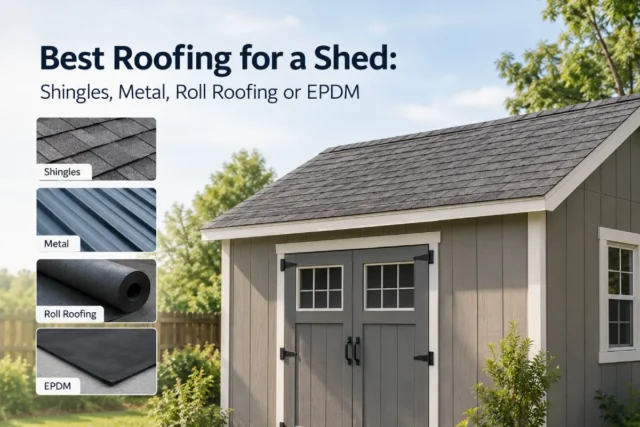
Minimum Roof Pitch for a Shed, by Roofing Material
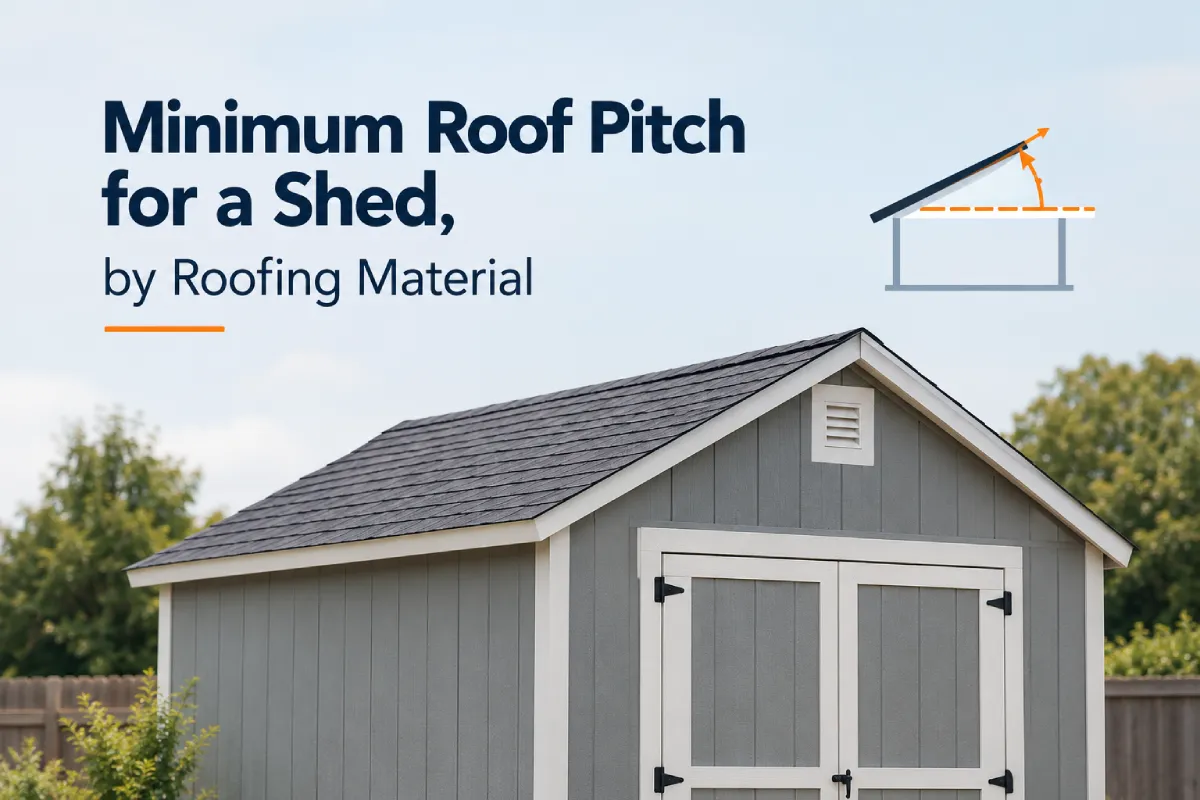
The lowest pitch a shed roof can have depends on what covers it: 2 in 12 for asphalt shingles, 1 in 12 for roll roofing, 3 in 12 for exposed-fastener metal (1/2 in 12 with sealed laps), and 1/4 in 12 for EPDM or mechanically seamed standing seam. Pitch is rise over run, so 2 in 12 means the roof climbs 2 inches for every 12 inches it runs.
Settle the pitch before you buy the covering, because the pitch decides which coverings are allowed at all.
Minimum roof pitch for a shed, by material
| Covering | Minimum pitch | Condition |
|---|---|---|
| Asphalt shingles | 2 in 12 | Double underlayment from 2 in 12 up to 4 in 12; one layer at 4 in 12 and steeper |
| Roll roofing | 1 in 12 | Concealed-nail or double-coverage method; exposed-nail needs more slope |
| Metal panels, exposed fasteners | 3 in 12 | Laps unsealed |
| Metal panels, exposed fasteners | 1/2 in 12 | Laps sealed as the maker instructs |
| Standing seam, mechanically seamed | 1/4 in 12 | Snap-lock versions are often rated only down to 3 in 12 |
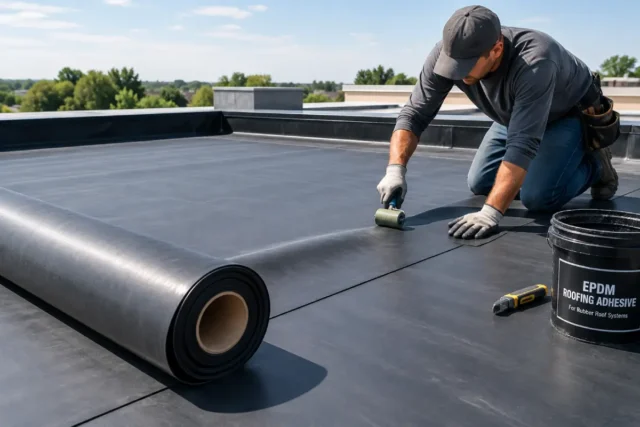
| EPDM rubber membrane | 1/4 in 12 | Water must drain; no ponding |
These are the residential code minimums. A manufacturer’s installation instructions apply where they are stricter, and for metal they often are.
Why guides quote different numbers
Advice on shed roofs jumps between 2, 3 and 4 in 12 because the sources are answering different questions. 2 in 12 is the code floor for shingles with double underlayment. Higher figures usually come from a product’s own instructions or from a builder’s caution, not from the code.
Follow the strictest limit that applies to your product: the code, then the maker’s instruction sheet, then any local rule. A local building department can require more than the model code.
How to measure the pitch of your shed roof
Pitch is the rise divided by the run, scaled to 12. On a lean-to or single-slope shed the quickest measurement is the difference in wall heights: if the high wall stands 18 inches taller than the low wall across a depth of 8 feet (96 inches), the pitch is 18 ÷ 96 × 12, which is 2.25 in 12.
On a finished roof, hold a level horizontal against the surface, measure 12 inches along it, and measure straight down from the level’s end to the roof.
| Pitch | Angle | Rise over an 8 ft depth |
|---|---|---|
| 1/4 in 12 | 1.2° | 2 in |
| 1/2 in 12 | 2.4° | 4 in |
| 1 in 12 | 4.8° | 8 in |
| 2 in 12 | 9.5° | 16 in |
| 3 in 12 | 14.0° | 24 in |
| 4 in 12 | 18.4° | 32 in |
Guides written outside the US usually give angles, and 10 degrees is roughly 2 in 12. The roof pitch calculator and the slope converter change any rise and run into pitch and degrees, and the shed roof calculator shows how much taller the high wall needs to be for a pitch you choose.
Which shed roofs fall short
A single-slope shed is the usual offender. It is the simplest roof to build and the one most often built too shallow, and a lean-to shed often sits right on the 2 in 12 line.
A gable shed has two slopes at the same pitch, so one measurement is enough. A gambrel has two different pitches, and the upper, shallower slope is usually the one that limits the covering. Each slope has to meet the minimum for whatever covers it, as shingling a gambrel shed roof explains.
If your shed roof is too shallow
There are three ways out, and sealant is not one of them.
- Change the covering. Below 2 in 12, use roll roofing down to 1 in 12 or an EPDM rubber roof down to 1/4 in 12. Metal with sealed laps works down to 1/2 in 12 where the panel’s maker allows it.
- Add slope. Raise the high wall or fit tapered framing over the deck to reach 3 in 12, then use ordinary panels. Metal roofing on a flat roof walks through the method, including the height limits and permit.
- Double the underlayment if the roof is between 2 in 12 and 4 in 12 and you want shingles, as the shed shingling guide describes.
Extra nails, caulk and cement cannot rescue a covering used below its minimum. The laps are the weak point, and slope is what keeps water moving past them.
More shed roof guides
- How to install asphalt shingles on a shed roof
- How to shingle a lean-to shed roof
- How to shingle a gambrel shed roof
- How to finish the last row of shingles on a shed roof
- How to install a metal roof on a shed
- How to install rolled roofing
- How to install a rubber (EPDM) roof
- How many bundles of shingles a shed roof needs
- Best roofing for a shed: shingles, metal, roll roofing or EPDM
Working out quantities and pitch? The shed roof calculator, shingle bundle calculator and drip edge calculator do the arithmetic.
Conclusion
The minimum roof pitch for a shed comes down to one measurement. Measure the rise and run first, then find the covering your pitch clears. If it clears none of the rows above, the roof needs more slope, not better sealing. For a shed that is a few inches short of 2 in 12, a membrane or roll roofing is usually a simpler fix than rebuilding the frame, and installing a metal roof on a shed becomes an option once the slope reaches 3 in 12.