
What Is Roof Flashing, and Why Does It Leak?
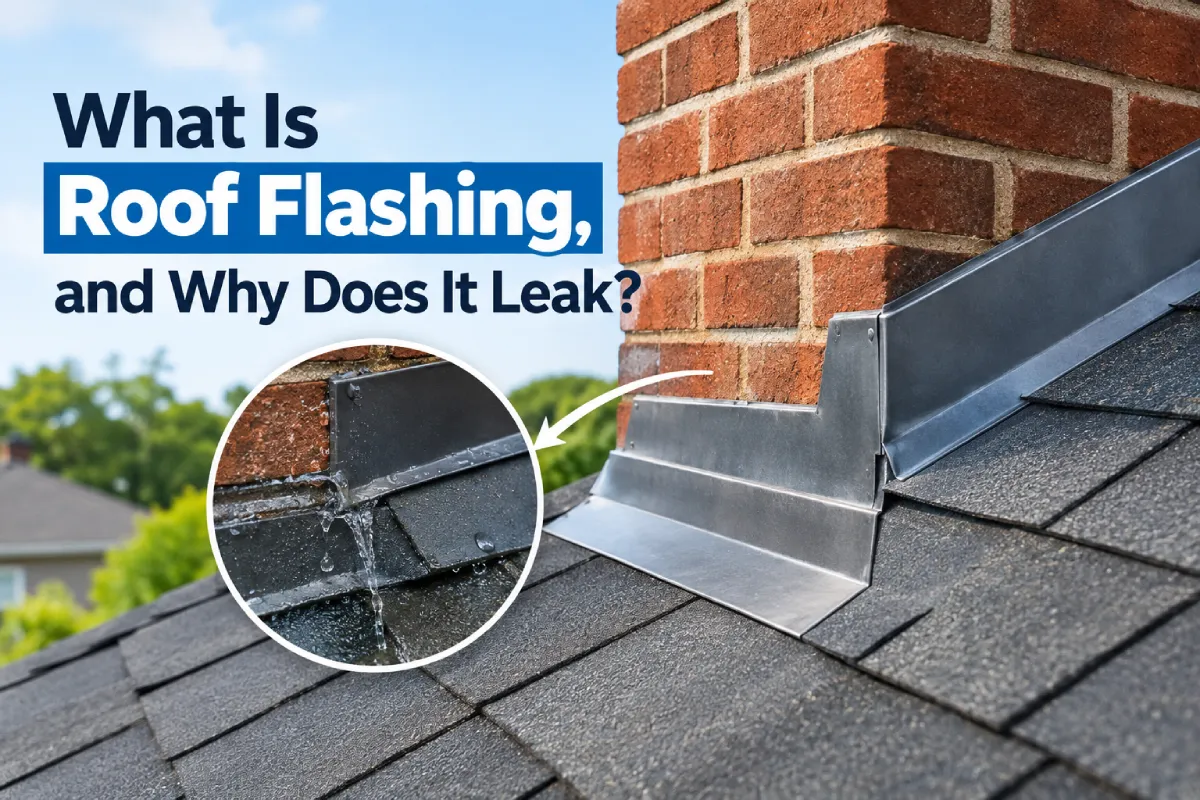
Flashing is the thin sheet material, usually metal, that seals the joints where a roof meets something else. A chimney, a wall, a vent pipe, a skylight, the line where two slopes fall into a valley. It is not the part of the roof anybody looks at, and it is the part that leaks.
The reason is simple enough. Shingles, tiles, and slates are very good at shedding water down an uninterrupted slope. Every place that slope is interrupted needs a different solution, and that solution is flashing. When a roof leaks, the covering is often in perfectly good condition, and the failure is at one of these joints.
Where flashing goes
There are more types than most homeowners realise, and knowing the names is useful when you are reading a quotation.
- Step flashing runs where a slope meets a vertical wall, as individual pieces woven in with each course of shingles.
- Counterflashing sits above step or base flashing on a chimney or wall, tucked into the masonry so water cannot get behind it.
- Valley flashing lines the channel where two slopes meet and carries a great deal of water.
- Vent pipe flashing, often called a boot, seals around a soil or plumbing pipe with a rubber collar.
- Drip edge runs along eaves and rakes, directing water into the gutter rather than behind it.
- Kickout flashing is a small angled piece where a roof edge meets a wall, and it is the one most often missing altogether.
Why flashing leaks more often than the covering
Flashing fails for reasons that have very little to do with age and a great deal to do with how it was fitted.
The material moves. Metal expands and contracts through every temperature cycle while the masonry or timber it is fixed to moves at a different rate. Over years, that works fixings loose and opens seams. Flashing is also the one part of a roof where several trades meet, so it is the part most likely to be somebody else’s responsibility and therefore nobody’s.
Above all, flashing is where shortcuts are cheapest to take and hardest to see from the ground.
Sealant is not flashing
This is the single most common failure, and it is worth stating plainly. A bead of roofing cement or silicone smeared over a joint is not a repair. It is a delay.
Properly detailed flashing works by geometry. Water runs down, meets a piece of metal that is lapped over the piece below it, and is directed back out onto the surface of the roof. Nothing is relying on adhesion. Sealant, by contrast, is relying entirely on a bond between two materials that expand at different rates, in direct sun, through frost. It fails, usually within a few seasons, and it often fails invisibly because the cracked bead still looks like a seal from six feet away.
The flashing that is missing rather than broken
Kickout flashing deserves its own paragraph because its absence causes damage far out of proportion to its size.
Where a roof edge runs into a wall, water travelling down the step flashing has to be thrown clear of the wall and into the gutter. A kickout is a small piece of angled metal that does exactly that. Leave it out, and the water runs straight down behind the cladding instead, soaking the wall sheathing continuously every time it rains, for years. The roof does not leak. The wall rots. By the time it shows inside, the repair is a wall repair rather than a roof repair.
Older houses frequently never had one. It is worth walking round the outside of your house and looking at every point where a roof edge dies into a wall.
Reused flashing at re-roofing
When a roof is stripped and recovered, flashing should generally be replaced with it. Old metal that has been prised up, bent back, and refitted has worked hardening at every fold and nail holes in the wrong places.
It is also a genuine cost line, which is why it goes missing from competitive quotations. A quotation that is cheaper than the others is sometimes cheaper because the flashing is not in it. When you compare quotations, look specifically for whether new flashing is specified, and at which locations. This is a question worth asking before the tear-off starts, because afterwards the answer is buried under a new roof.
The wrong metal in the wrong place
Dissimilar metals in contact, with water running between them, corrode. Aluminium flashing against copper, or bare steel fixings through aluminium, will fail faster than either material would alone. Aluminium is also attacked by fresh masonry and mortar, which matters where flashing is let into a chimney.
You do not need to become a metallurgist about this. You do need to know that it is a real failure mode, so that when a valley or chimney flashing has failed early, corrosion between materials is on the list of explanations rather than simply bad luck.
How to tell flashing is the problem
Most flashing leaks announce themselves in a particular way. The stain appears in the same place every time, and it appears in relation to a feature rather than in the middle of a ceiling. Below a chimney breast. Along the line where a single storey extension meets the main house. In an upstairs corner where a dormer sits above.
A leak that tracks rainfall and appears at a consistent spot near a chimney, wall junction, skylight, or valley is a flashing leak until proven otherwise. That is a different pattern from a stain that spreads slowly in cold weather with no rain, which points to moisture in the roof space rather than water coming in from outside.
From the ground with binoculars, you can often see the evidence: lifted or rippled metal at a wall junction, a rubber pipe collar that has perished and split, rust streaks, or visible tar smeared over a chimney joint by somebody who has been here before you. Tracing a leak back to its source is worth doing carefully, because water can travel a long way along a rafter before it drips.
What a proper repair involves
Repairing flashing correctly usually means lifting the surrounding covering, because the flashing sits under it. That is why a genuine flashing repair costs more than a smear of sealant and why the cheap option is offered so often.
On a chimney, doing it properly means new step flashing woven into the courses and counterflashing let into a cut in the mortar joint, not surface-mounted and sealed. On a valley, it means the metal running the full length with correct laps. On a pipe, it means a new boot rather than a rubber collar wrapped in mastic.
If the covering around the flashing is near the end of its life anyway, the calculation changes, and it becomes a question of repair against replacement rather than a flashing decision on its own.
Conclusion
Flashing is a small proportion of the cost of a roof and a large proportion of its failures. It fails at joints, it fails because of how it was fitted rather than how old it is, and it is the first thing to suspect when a leak keeps returning to the same spot.
Two things protect you. Insist that new flashing is specified and priced when you have a roof replaced, and treat any proposal to solve a flashing leak with sealant alone as a temporary measure that you have agreed to knowingly, rather than a repair you have paid for.