
How to Find a Roof Leak: Trace It From Stain to Source
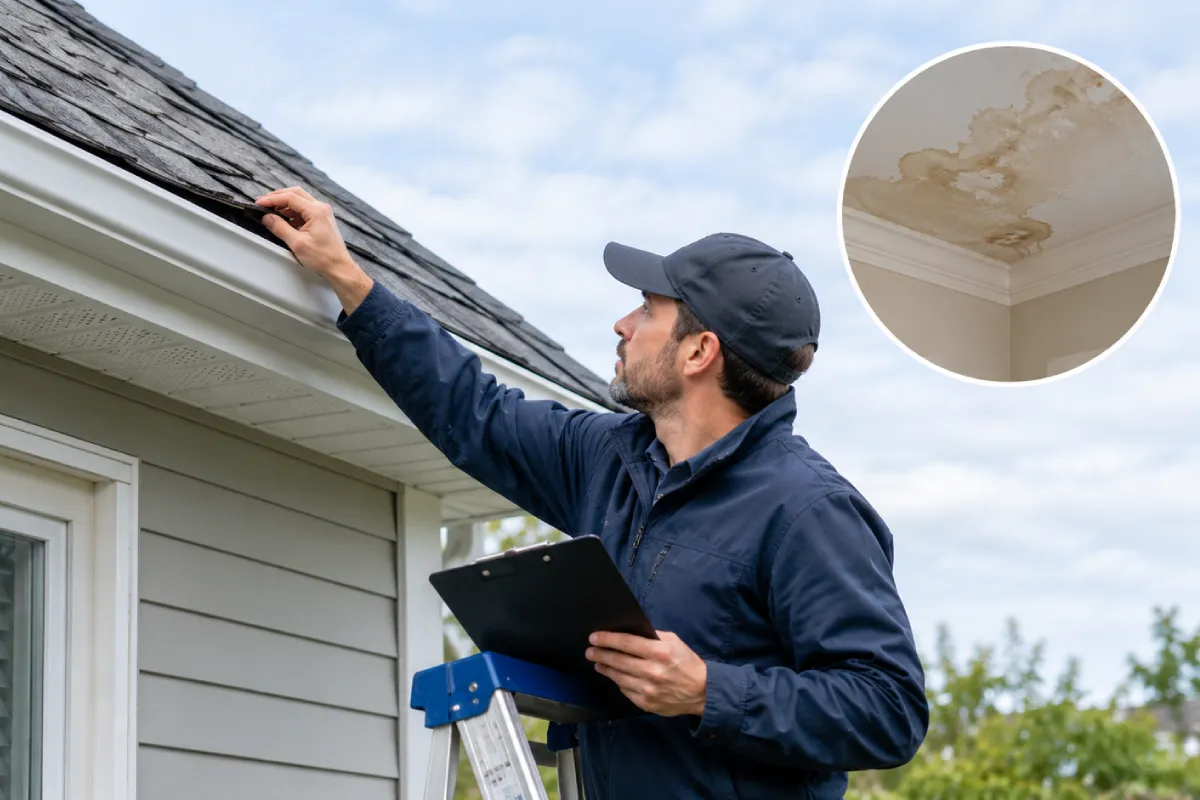
The stain on the ceiling is where the water came out, not where it came in. To find a roof leak, mark the stain, follow the wet path up through the attic, check the likely entry points outside, and confirm the suspect with a hose test, one section of roof at a time. Most leaks can be located without walking on the roof at all.
Why the stain is not the leak
Water follows rafters, decking and pipes before it drips, so the entry point is usually higher than the darkest part of the stain and often to one side of it. That is why guessing from the ceiling fails, and why the search works backward from the stain.
Step 1: Map what you can see inside
Outline the stain in pencil and write the date beside it, so you can see whether it grows. Photograph it, check the rooms and walls above it, and note when it appears: during rain, only in wind-driven rain, after a thaw, or in dry weather. The timing narrows the search, and the Roof Leak Finder turns three answers about where and when into the likeliest causes. If the ceiling is bulging with water, deal with that first; what to do when you discover a roof leak explains how.
Step 2: Trace the water in the attic
Go up during or just after rain with a flashlight, if you can do so safely. Look at the underside of the roof deck for dark stains, damp or compressed insulation, wet sheathing, rusty nail tips and daylight. Follow any stain up the rafter to the highest wet point and mark it with chalk. Step only on the framing, never on insulation or drywall.
Then measure from a fixed reference such as a chimney or a vent pipe to the wet spot, and measure the same distance on the roof outside to find the spot there. What to look for in your attic covers the rest of the inspection.
Step 3: Check the likely entry points outside
From the ground with binoculars, or from a ladder at the eave, look uphill of the spot you marked. Where the stain is tells you where to look first:
| Where the stain is | Look first at |
|---|---|
| Under or near a vent pipe, often a bathroom or kitchen ceiling | The vent pipe boot; see vent pipe boot leaks |
| Near a chimney | The chimney flashing and the crown; see roof flashing |
| Along an outside wall below the roofline | The flashing where the roof meets the wall, and the gutter |
| Below a valley, or in the middle of a slope | The valley, and lifted or missing shingles above the stain |
| Near the eave in winter after snow | An ice dam; see what causes ice dams |
| After humid weather with no rain | Condensation, not a leak; see leak or condensation |
Step 4: Confirm with a hose test
If the search has found a suspect but not proved it, run a hose test with a helper in the attic watching with a flashlight.
- Start low, on the roof just below the suspect spot, and work up.
- Wet one small section at a time with a gentle stream from a garden hose, not a pressure washer, for several minutes.
- If nothing shows, move sideways, then up, so each section is tested on its own.
- When the helper sees a drip, stop and mark the spot.
Do it on a dry day above freezing, from a ladder or a safe, low roof. Never wet the whole roof at once, because then you cannot tell which area leaked.
If you still cannot find it
Leaks with more than one entry point, or that only appear in certain winds, can defeat a homeowner’s search. Some roofers use moisture meters and thermal imaging to find wet insulation or sheathing without a hose, and some charge $100 to $300 for diagnosis, as how much it costs to repair a roof notes. Keep your notes and photographs; they shorten any search.
Once you have found it
Cover it or patch it for now and plan the permanent repair. How to fix a roof leak lists temporary and permanent repairs with typical costs, why a roof leaks covers the causes, and signs of roof damage is a checklist of what to watch for.
More roof leak guides
- Why a roof leaks: common causes
- How to fix a roof leak
- Roof vent pipe boot leaks
- Signs of roof damage you should never ignore
- Roof leak or attic condensation
- What roof flashing is and why it leaks
- What to look for in your attic
- What causes ice dams
- Ponding water on a flat roof
The Roof Leak Finder points to the likeliest cause from where and when the water appears.
Conclusion
How to find a roof leak comes down to working backward: from the stain, up the wet path in the attic, to the entry point outside, then proving it with water. Write down what you see at each step, and test one section at a time.