EPDM vs. TPO vs. Modified Bitumen: Which Flat Roof Is Right?
A flat roof is not flat. Every one is built with a slope across it, usually slight enough that you would not notice standing on it, because a genuinely level roof would hold water, and a roof that holds water eventually lets it in. The International Residential Code sets a minimum design slope of 1/4 inch per foot for EPDM, TPO, PVC, and modified bitumen roofs. When people talk about flat roof problems, they are almost always talking about drainage that stopped working or a membrane that was joined badly.
Why a flat roof is a different problem
That is the first thing worth understanding about this category. On a pitched roof, gravity is doing most of the work and the covering is shedding water. On a flat roof, the covering is a continuous waterproof skin, and the joints in that skin are where the decision between materials actually matters.
The 3 systems you will be quoted
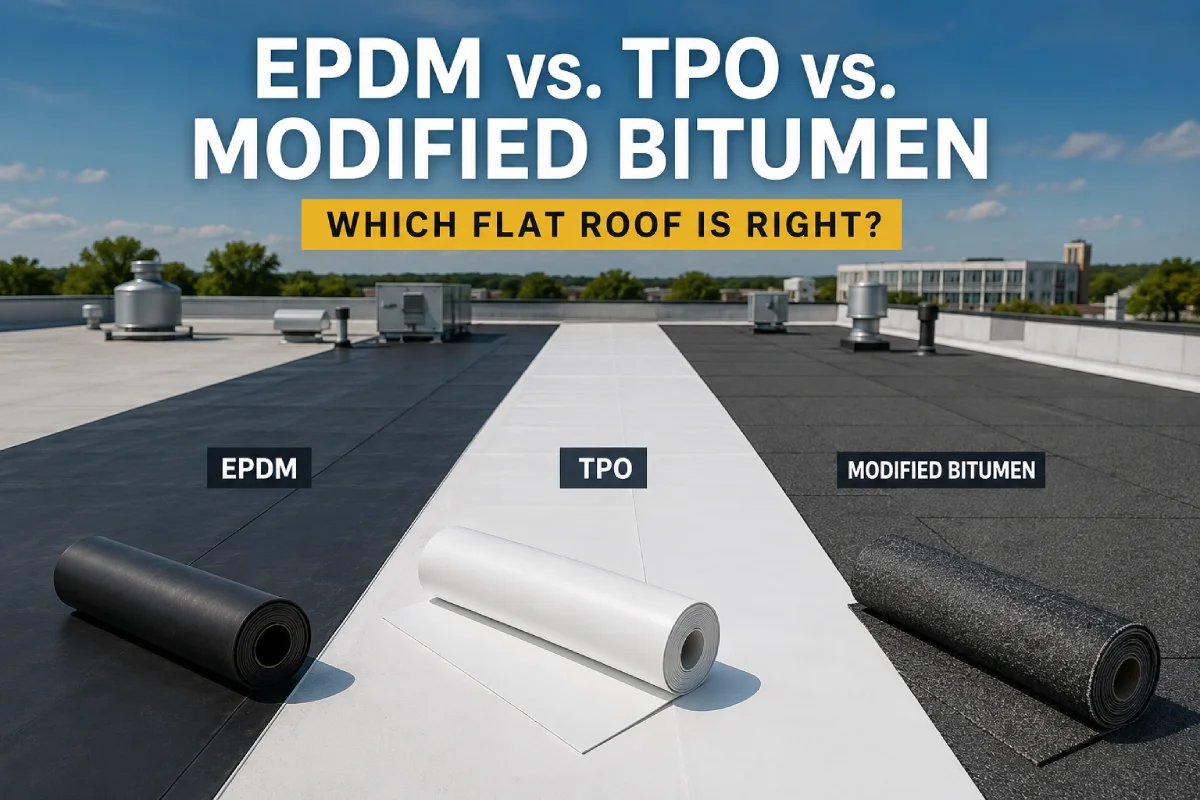
Residential flat roofing in most markets comes down to three single-ply or built-up systems. There are others, but if you ask three contractors for quotes, these are what you are most likely to see.
EPDM, the rubber one
EPDM is a synthetic rubber membrane, usually black, laid in large sheets. Its main advantage is that a small roof can often be covered in a single piece with no field joints at all, and a joint that does not exist cannot fail.
It handles temperature movement and ultraviolet exposure well, and it is forgiving of a slightly imperfect deck beneath it. Its weaknesses are that it is black, so it absorbs heat rather than reflecting it, which matters if the space underneath is habitable and cooled. It is also relatively easy to puncture, so a roof that gets walked on for access to equipment or windows needs protection laid over it.
Where joints are needed, they are glued or taped rather than welded, and that is the part that depends most on the person doing it.
TPO and PVC, the welded ones
TPO is a thermoplastic membrane, usually white or light gray, and PVC is its older and more expensive relative. The important difference from EPDM is how the seams are made: these are heat-welded, which fuses the sheets into a single piece of material rather than sticking them together.
A properly welded seam is the strongest joint available in flat roofing, and it can be tested on the day. The qualifier matters, because welding needs the right equipment and the right technique, and a poor weld looks acceptable and is not. If you are quoted a welded system, ask how the seams are tested before the crew leaves.
The light color reflects heat rather than absorbing it, which is a genuine benefit over a heated or cooled room. TPO is a younger product than EPDM and formulations have changed over the years, so long-term field evidence is thinner.
Modified bitumen, the layered one
Modified bitumen is the descendant of traditional built-up felt roofing: asphalt sheet material with polymer modifiers, laid in two or more layers with the joints staggered, bonded by torch, hot adhesive, or self-adhesive backing.
Its advantage is redundancy. Because there are multiple layers with offset joints, a failure in one layer does not immediately become a leak, and it takes physical abuse better than a single-ply membrane. Its disadvantage is that there are many more joints in total, and torch-applied systems bring an open flame onto your roof, which some insurers and some buildings will not accept.
What actually decides the choice
Homeowners tend to compare these on lifespan, and lifespan is the least useful comparison, because published expectations for all three overlap heavily in the twenty to thirty year region and the installation moves the real outcome further than the material does.
These are the questions that decide it in practice.
- Is the space below heated or cooled? If yes, a reflective membrane is worth having, and insulation strategy matters more than membrane brand.
- Will anybody walk on it? Roof terraces, access routes to rooftop equipment and window cleaning all argue for a tougher build or a protective surface.
- How complicated is the roof? Lots of curbs, pipes and skylights mean lots of detailing, and detailing is where flat roofs leak. A system your contractor details well beats a theoretically better system they detail badly.
- Who is installing it, and are they certified for that system? Most manufacturers train and approve installers, and most meaningful warranties require an approved one.
Drainage is the real subject
Ponding water is the single most common reason a flat roof fails early. Standing water accelerates degradation of every membrane, magnifies the effect of any weakness in a joint, and adds weight where the structure has already sagged enough to create the puddle.
Any quote for a flat roof should say what happens to the water: where the slopes run, how many outlets there are, and whether there is an overflow if the main outlet blocks. If the existing roof ponds and the quote does not address why, you are buying a new membrane for an old problem. A roof leak on a flat roof usually starts here.
What to ask before you sign
The general ground in the questions worth asking any roofer applies, plus a few specific to flat work.
- Is the contractor approved by the manufacturer of the system quoted?
- How are the seams made, and how are they checked?
- What is being done about slope and drains?
- Is the insulation being replaced, and what thickness?
- Does the warranty cover the membrane only, or the installation as well?
That last one separates a real warranty from a decorative one more reliably than any other question, and it applies just as much when you compare estimates from different contractors.
Warm deck and cold deck: where the insulation goes
This decides more about how a flat roof performs than the membrane on top of it, and it is rarely explained to homeowners.
In a cold deck, sometimes called a vented roof, the insulation sits below the roof deck, between the joists, and the deck itself stays at roughly outside temperature. This is the traditional arrangement, and it depends completely on a ventilated void above the insulation to carry away moisture. If that void is missing or blocked, warm air from the room condenses against the cold deck and the structure rots. Many failed flat roofs are cold decks whose ventilation stopped working.
In a warm deck, an unvented assembly, the insulation goes above the deck, directly under the waterproofing. The deck stays warm and close to room temperature, so condensation does not form on it and no ventilated void is needed. This is now the preferred arrangement in most new and replacement flat roofing, and it is more forgiving of imperfect detailing.
If a quote replaces the membrane but leaves an existing cold deck untouched, ask specifically what has been done about the ventilated void. Renewing the waterproofing over a cold deck that was already failing internally solves the visible problem and none of the actual one.
How the cost compares to a pitched roof
Per unit of area, flat roofing generally sits above basic asphalt shingle work and below the premium pitched materials, but comparing on area alone is misleading, for two reasons.
First, flat roofs are usually small relative to the house, so fixed costs such as access, setup, and minimum charges represent a much larger share of the total. A small flat roof can look expensive per square foot while being a modest job overall.
Second, the detailing drives the price more than the field area does. A plain rectangle is quick. The same area with two skylights, a plumbing vent pipe, a wall flashing detail, and a parapet is a different job, because every one of those is a hand-formed detail and every one is a potential leak. This is the same principle set out in what moves the cost of a roof, concentrated into a smaller space.
Conclusion
All three systems work. None of them is a bad choice, and the differences between them are smaller than the difference between a careful installation and a rushed one. Choose the system your contractor is trained and experienced in, insist that the drainage question is answered rather than inherited, and treat seam quality as the thing you are actually buying.