Can You Put Asphalt Shingles on a Flat Roof? What the Code Allows
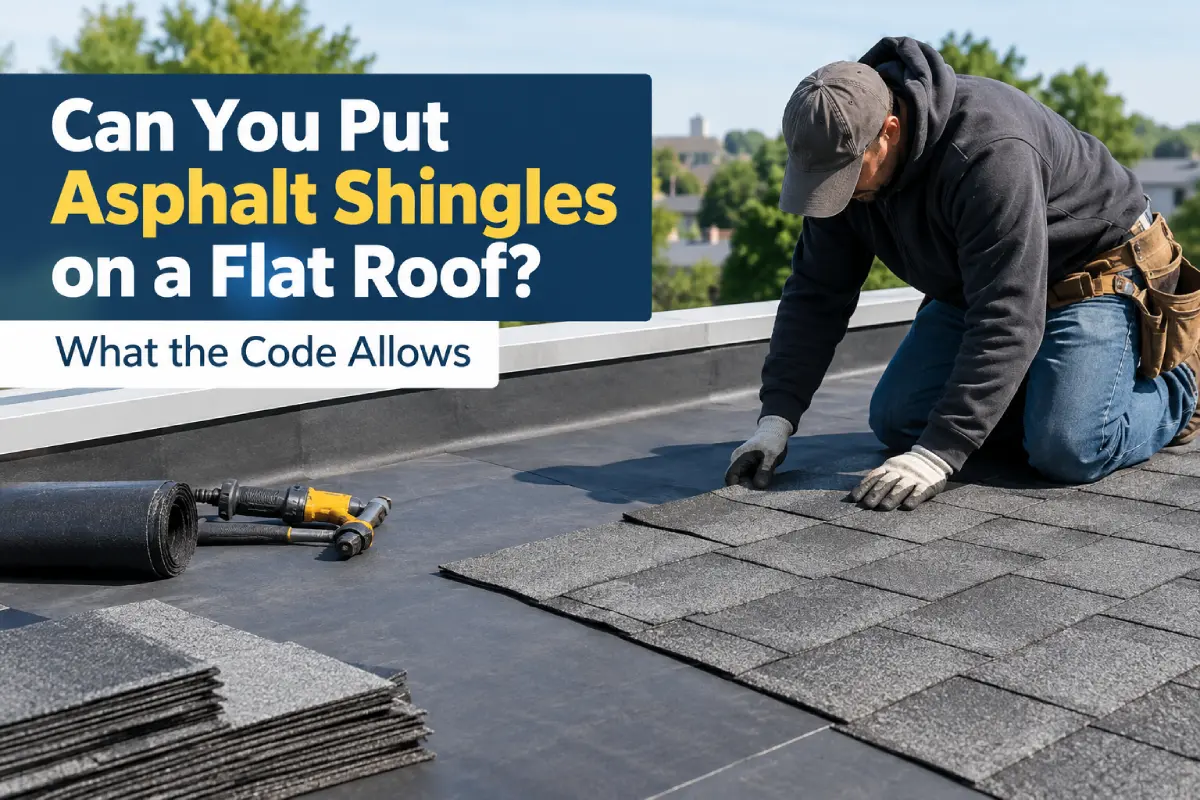
No. Asphalt shingles cannot be installed on a flat roof. The residential code does not allow them on any roof with a pitch below 2 in 12, and a flat roof, which in building terms usually means a slope of around 1/4 inch per foot, is far below that.
Guides that show “how to install shingles on a flat roof” are almost always describing a low-slope roof between 2 in 12 and 4 in 12, which is a different thing. That distinction decides whether a shingle roof works, so it is worth being precise about it.
Why shingles need slope
Shingles are not waterproof as a layer. They are a system of overlapping pieces, and they keep water out because gravity carries it down and over each overlap faster than it can travel sideways or upward into one.
On a flat or nearly flat roof that stops working.
- Water moves slowly or stands. Ponded water sits against the laps for hours or days.
- Wind pushes it uphill. On a shallow roof, wind-driven rain travels back under the shingle above.
- Capillary action draws it in. Water creeps into the tight gap between courses.
- Freezing makes it worse. Water that got under a shingle expands when it freezes, lifting the lap and letting more in next time.
None of that can be fixed with more nails or more sealant. It is a question of geometry.
What the code allows
Under the International Residential Code, which most US states use as the basis for their residential codes:
- Below 2 in 12: asphalt shingles are not permitted.
- 2 in 12 up to 4 in 12: shingles are permitted only over a double layer of underlayment, laid so every point on the roof has two layers.
- 4 in 12 and above: standard single underlayment.
Manufacturers set the same minimums, and many add their own conditions for low slopes, such as self-adhered underlayment over the whole deck. A shingle installed below the manufacturer’s minimum slope is typically outside its warranty.
Measure before you decide
Pitch is the rise in inches over 12 inches of horizontal run. Hold a level horizontally against the roof, measure 12 inches along it, and measure straight down to the roof surface. Under 2 inches, shingles are out. The roof pitch calculator converts any rise and run you can measure.
What happens if someone does it anyway
Shingles on a flat roof do get installed, usually on sheds, porch roofs, and additions where somebody wanted the roofing to match the house.
The result is predictable. The roof may survive a dry season, then leaks start at the laps, typically in the lowest areas where water pools, and they spread as the decking softens. Beyond the leaks:
- The installation does not meet code, so it can fail an inspection or be flagged when the house is sold.
- The shingle warranty does not apply.
- An insurer can decline water damage caused by a covering installed contrary to code and to the manufacturer’s instructions.
- The decking under a long-term leak often has to be replaced along with the roof. What happens to roof decking explains why that gets expensive.
If your roof is actually 2 in 12 to 4 in 12
Then shingles are allowed, and the roof can be done properly. The requirements are what make it last:
- Double underlayment as the code requires, or self-adhered ice-and-water membrane across the whole deck, which many roofers prefer on slopes this shallow.
- Drip edge at eaves and rakes, lapped in the correct order.
- Shingles rated by their manufacturer for the slope. Most standard products are rated to 2 in 12 with low-slope application; check the wrapper.
- Careful sealing. Low-slope shingles rely heavily on their sealant strip; in cool weather, hand-seal tabs as the maker instructs.
- Well-detailed flashing where the low roof meets a wall, since water moves slowly past it.
Expect a low-slope shingle roof to be less forgiving than a steep one, especially in areas with heavy snow or ice. Where ice dams are a risk, the self-adhered underlayment is not optional in practice. What causes ice dams covers why.
What to use on a flat roof instead
Flat roofs need a material that is waterproof as a continuous layer, not one that relies on overlaps. The choices, from simplest to most substantial:
- Roll roofing (mineral-surfaced asphalt rolls): inexpensive and DIY-friendly, allowed from 1 in 12, so it is still not for truly flat roofs. It suits sheds and outbuildings, with a short service life.
- Self-adhered modified bitumen: peel-and-stick base and cap sheets that seal at the laps without torches. It works down to low slopes and is manageable for a careful DIYer on a small roof.
- EPDM rubber: a single sheet with no laps on a small roof, rated down to 1/4 in 12. It is a popular DIY choice for garages, porches and additions.
- TPO or PVC: heat-welded single-ply membranes, generally installed by professionals.
EPDM, TPO and modified bitumen compared goes through how to choose among the main systems.
If the point was to match the house
Sometimes the real goal is appearance: a porch or addition roof that looks like the main roof from the street. There are two honest ways to get there.
Change the slope. Framing a new, steeper roof over the flat one, or building tapered sleepers on top of it, can bring the pitch up to 4 in 12 or more, and then standard shingles are fine. This is structural work that usually needs a permit and a check of the loads, the height against neighbors and planning rules, and how the new roof drains.
Accept a different material on the low part. A low-slope membrane in a matching color is often barely visible from the ground, since you cannot see the surface of a flat roof from below anyway.
Conclusion
Asphalt shingles need at least 2 in 12, and double underlayment up to 4 in 12. A flat roof does not meet either figure, and no installation technique changes that.
Measure the pitch first. If it is 2 in 12 or more, shingles can be done properly with the low-slope requirements above. If it is lower, use roll roofing, modified bitumen, or a membrane such as EPDM, or change the slope before choosing shingles.
If the roof is too flat for shingles, the Flat Roof Membrane Calculator estimates the membrane and materials instead.