Roofing Contractor Red Flags: 12 Warning Signs to Watch For
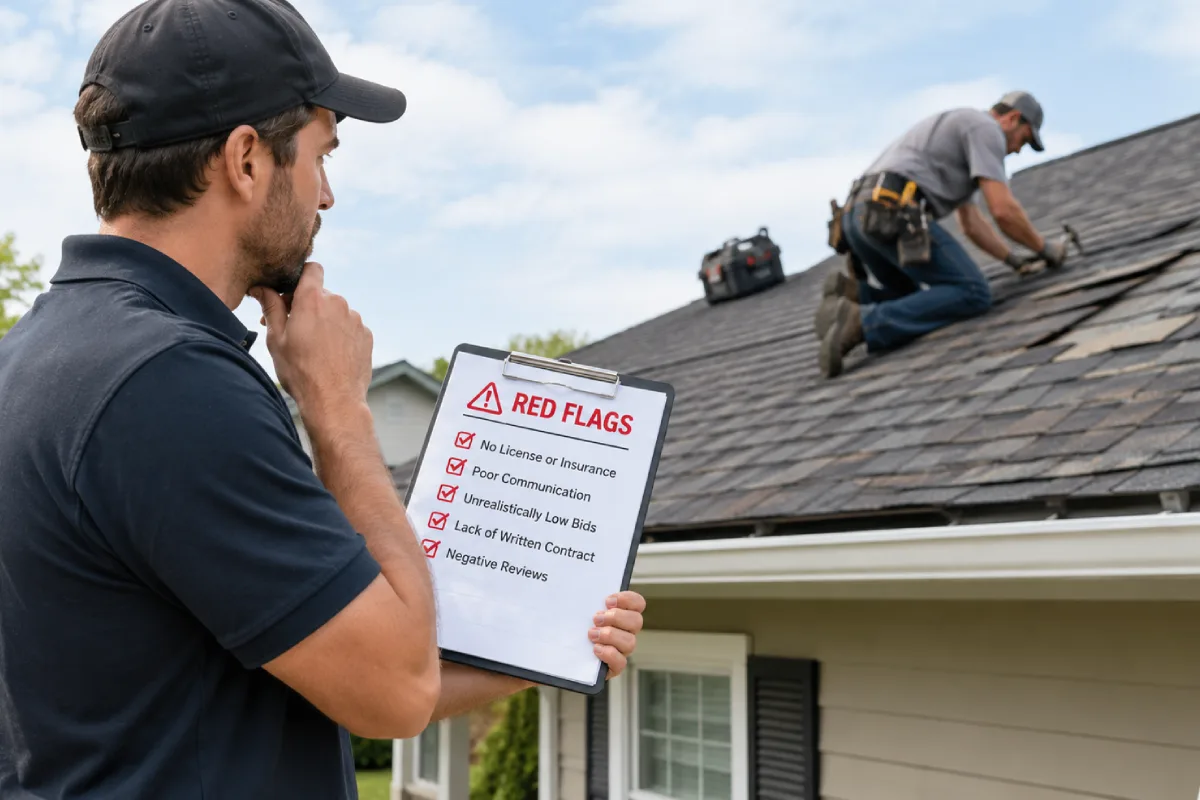
Choosing the right roofing contractor can save you thousands of dollars, years of frustration, and the headache of dealing with a failed roof. Choosing the wrong one can cost you all of those things and more. Unfortunately, the roofing industry — like any industry — has its share of unqualified, dishonest, or outright fraudulent operators. They may look professional, sound knowledgeable, and offer attractive prices, but beneath the surface, they are setting you up for problems.
The good news is that warning signs are almost always present if you know what to look for. Dishonest or incompetent contractors tend to follow predictable patterns, and those patterns are visible to informed homeowners who are paying attention.
This article covers twelve red flags that should make you pause, ask more questions, or walk away entirely. Not every red flag is an automatic disqualifier on its own — sometimes there is a legitimate explanation — but when you see multiple red flags from the same contractor, the pattern is telling you something important.
Red Flag 1: They Show Up Uninvited After a Storm
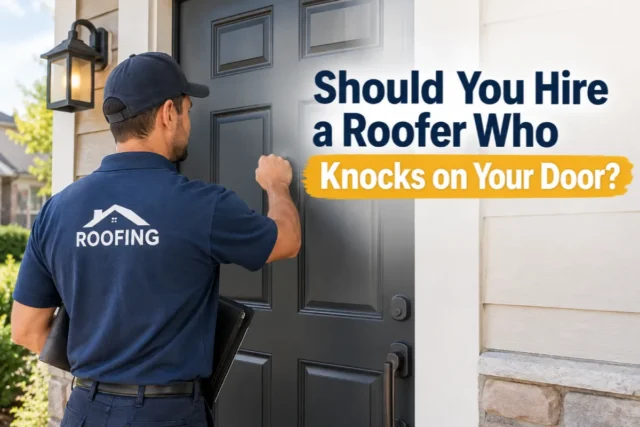
One of the most common tactics in the roofing industry is the door-to-door solicitation after a storm. A contractor knocks on your door — sometimes within hours of a hailstorm, windstorm, or other severe weather event — and tells you they noticed damage on your roof. They offer a free inspection and suggest that you file an insurance claim immediately.
While some legitimate contractors do canvass neighborhoods after storms, this approach is also the hallmark of storm-chasing operations — companies that follow severe weather events, sign up as many customers as possible, collect insurance payments, and leave town. The work they do may be adequate, or it may be substandard. Either way, when problems surface months later, the company is long gone and the warranty is unenforceable.
A legitimate contractor who happens to be working in your area after a storm will be transparent about their business, provide verifiable credentials, and not pressure you to sign anything on the spot. If a contractor appears at your door uninvited and immediately pushes for a contract or an insurance claim, slow the process down. Do not sign a “contingency agreement” or anything that assigns your insurance benefits to them on that first visit, and remember that the Federal Trade Commission’s Cooling-Off Rule generally gives you until midnight of the third business day to cancel a qualifying sale made at your home. Get their license and insurance information, verify it, check their reviews, and take time to make a decision.
Red Flag 2: They Pressure You to Sign Immediately
High-pressure sales tactics are one of the most reliable warning signs in any industry, and roofing is no exception. A contractor who tells you that you must sign today to lock in a price, that the deal is only available right now, or that they have other customers waiting and cannot hold your spot is trying to prevent you from doing your due diligence.
Legitimate contractors understand that a roof replacement is a major investment and that homeowners need time to compare estimates, check references, and make an informed decision. They provide their estimate, answer your questions, and give you the space to decide at your own pace. They are confident enough in their work and their pricing that they do not need to rush you.
If a contractor uses phrases like “this price is only good today,” “we are booking up fast and I cannot guarantee a spot next week,” or “your insurance money will expire if you do not act now,” recognize these for what they are: pressure tactics designed to short-circuit your decision-making process. A good roof at a fair price will still be available next week.
Red Flag 3: They Demand Full Payment Upfront
A deposit at the time of signing is standard practice in the roofing industry. Most contractors ask for a deposit of 10 to 30 percent of the total project cost to cover the cost of materials and secure the project on their schedule. This is reasonable and normal, within the limits some states set by law; California, for example, caps a home improvement down payment at $1,000 or 10 percent of the contract, whichever is less.
The most expensive red flag
However, a contractor who demands full payment before any work has begun is a serious red flag. There have been countless cases where homeowners paid a contractor in full upfront, only to have the contractor disappear without doing the work — or do a fraction of the work and never return.
The standard payment structure in the industry is a deposit at signing, a progress payment at a defined milestone (such as completion of tear-off or delivery of materials), and the final payment upon completion of the work and your satisfaction. This structure keeps both parties accountable — the contractor has an incentive to complete the work to your satisfaction, and you retain leverage until the work is done.
Be equally cautious of a contractor who requests cash-only payments. Cash payments leave no paper trail, making it difficult to prove that payment was made if a dispute arises. Use a check, credit card, or another traceable payment method that creates a clear record of every transaction.
Red Flag 4: Their Estimate Is Suspiciously Low
Everyone loves a good deal, and when you receive estimates ranging from $10,000 to $18,000 and one contractor offers to do the job for $6,000, the low bid is tempting. But in roofing, a price that seems too good to be true usually is.
An estimate that is dramatically lower than all other bids for the same scope of work is likely cutting corners somewhere. The most common ways to reduce the bid price include using cheaper, lower-quality materials, excluding critical components like flashing replacement or ventilation upgrades, planning to reuse existing materials that should be replaced, using unskilled or uninsured labor, skipping the tear-off and installing over the existing roof, or planning to make up the difference with change orders once the project is underway.
The change-order strategy deserves special attention. Some contractors deliberately submit a low bid to win the job, knowing that once work begins and your old roof has been torn off, you are committed. They then present you with a series of additional charges for items that should have been included in the original estimate. By the time the project is complete, you may end up paying as much as — or more than — the higher bids you originally received.
A legitimate estimate is detailed, comprehensive, and competitive. It may not be the lowest bid, but it is honest about what the project costs when done right.
Red Flag 5: They Cannot Provide Proof of Insurance
We have covered the importance of verifying insurance in detail in our guide to checking a contractor’s license and insurance, but it bears repeating as a red flag. A contractor who cannot provide current certificates of insurance for both general liability and workers’ compensation is a contractor you should not hire.
Some contractors claim they are exempt from insurance requirements, that they are a sole proprietor and therefore do not need workers’ compensation, or that they are between policies and will have coverage by the time the work starts. While there are limited situations where these explanations may be legitimate, you should verify every claim independently before accepting it.
An uninsured contractor puts you at direct financial risk. If a worker is injured on your property, if the contractor’s work causes damage to your home, or if a third party is injured as a result of the project, you could be held liable. The cost of a single injury claim or property damage lawsuit can easily exceed the cost of the entire roof replacement.
Red Flag 6: They Do Not Provide a Written Contract
A verbal agreement is not sufficient for a roofing project. Every aspect of the project — the scope of work, the materials, the price, the timeline, the payment schedule, the warranty terms, and the process for handling unexpected issues — should be documented in a written contract that both parties sign.
A contractor who wants to proceed without a written contract, who provides only a vague one-page proposal, or who asks you to sign a contract that is missing key details is exposing you to significant risk. If a dispute arises about what was agreed to, a written contract is your primary protection.
A proper roofing contract should include a detailed description of the work to be performed, the specific materials to be used (brand, model, color), the total cost and payment schedule, the estimated start date and project duration, the warranty terms (both manufacturer and workmanship), the process for handling change orders and unexpected issues, the contractor’s license and insurance information, and signatures from both parties.
Read the contract carefully before signing. If anything is unclear or missing, ask for clarification or additions. A professional contractor will be happy to ensure the contract is thorough and clear.
Red Flag 7: They Have No Local References or Reviews
A contractor who has been working in your area should be able to provide references from local homeowners and should have an online presence with reviews. If a contractor cannot provide references from recent projects in your area, or if they have no online reviews at all, it may indicate that they are new to the area, that they have a poor track record they are trying to hide, or that they are a fly-by-night operation.
Be cautious of contractors who provide references only from distant locations or from projects completed many years ago. Recent, local references are the most relevant and the most reliable indicators of current performance.
Also be cautious of contractors who have only perfect five-star reviews with no negative feedback whatsoever. While it is possible for a company to have an excellent reputation, a profile with nothing but glowing reviews — especially if the reviews all sound similar or were posted within a short time frame — may be manufactured.
A realistic review profile has mostly positive reviews with some mixed feedback and an occasional negative review. What matters is the overall pattern and how the contractor responds to criticism.
Red Flag 8: They Offer to Pay Your Insurance Deductible
In some states, it is illegal for a contractor to waive or pay your homeowner’s insurance deductible. In all states, it is unethical and a significant red flag.
This tactic works like this: The contractor offers to absorb your insurance deductible — say, $1,000 — as an incentive to hire them for your roof replacement. They then inflate the insurance claim to cover the cost of the deductible, billing your insurance company for work that was not performed or materials that were not used. This is insurance fraud, and while the homeowner may not be the one initiating it, they can be implicated.
Beyond the legal and ethical concerns, a contractor who engages in this practice is demonstrating a willingness to be dishonest. If they are willing to commit fraud to get your business, what else are they willing to do? What corners will they cut on the installation? What materials will they substitute? What warranty promises will they fail to honor?
If a contractor offers to pay your deductible, decline the offer and find a different contractor.
Red Flag 9: They Are Vague About Materials and Methods
A professional roofing contractor should be able to tell you exactly what materials they plan to use — by brand name, product line, and grade — and how they plan to install them. If a contractor’s estimate or conversation is vague about materials (“we use high-quality shingles”), does not specify brands or products, or dismisses your questions about installation methods, that vagueness is a warning sign.
Vagueness about materials leaves room for substitution. A contractor who promises “top-quality shingles” without specifying a brand can install the cheapest shingles available and technically fulfill their promise — at least in their own interpretation.
Vagueness about installation methods may indicate a contractor who does not follow manufacturer specifications or building codes. Proper roofing installation involves specific techniques for underlayment, flashing, nailing, valley construction, and ventilation. A contractor who cannot describe their approach in detail may not have the knowledge or the intention to install your roof correctly.
Ask for materials to be specified by brand and product name in the written contract. If the contractor resists this level of specificity, ask yourself why.
Red Flag 10: They Have No Physical Business Address
A legitimate roofing company has a real, verifiable business location — an office, a warehouse, a showroom, or at least a permanent commercial address. If a contractor lists only a P.O. box, a cell phone number, or a residential address as their business address, it may indicate a temporary or transient operation.
This is particularly concerning after storms, when out-of-area contractors set up temporary operations in the affected region. These contractors may do adequate work, but their lack of permanent local presence means that warranty service, if needed, may be impossible to obtain.
A contractor who has invested in a physical business location has demonstrated a level of commitment to the community that a transient operation has not. They have overhead, staff, and a reputation tied to that location — all of which create accountability.
Red Flag 11: They Badmouth Every Other Contractor
A confident, professional contractor differentiates themselves through their own merits — their experience, their process, their materials, and their warranty. They do not need to tear down their competitors to make themselves look good.
If a contractor spends a significant portion of their pitch criticizing other companies — calling them incompetent, dishonest, or overpriced — that behavior tells you something about their character and their professionalism. It may also indicate that they are more focused on winning the job through persuasion than through the quality of their bid.
It is reasonable for a contractor to point out differences in approach, materials, or warranty terms between themselves and their competitors — especially if you ask them to. But there is a clear line between constructive differentiation and unprofessional trash-talking. If a contractor crosses that line, consider how they might behave if a dispute arises on your project.
Red Flag 12: Their Online Presence Tells a Different Story
In today’s connected world, a contractor’s online presence is a window into their business. If the image they present in person does not match what you find online, pay attention to the discrepancy.
A contractor who presents themselves as a large, established company but has a website with broken links, stock photos, and no specific information about their team, their projects, or their history may be inflating their image. A contractor whose online reviews are consistently negative but who presents glowing testimonials in their marketing materials is creating a false impression. A contractor whose social media shows a pattern of customer complaints, unfinished projects, or unprofessional behavior is revealing information they would prefer you not see.
Conversely, a contractor whose online presence is consistent with their in-person presentation — professional, transparent, and supported by genuine customer feedback — is demonstrating integrity across channels.
Take the time to research every contractor you are considering. Google their name, check the Better Business Bureau, look at their social media, and read reviews on multiple platforms. If what you find online raises concerns, bring those concerns up with the contractor and give them an opportunity to explain. Their response will tell you a lot.
What to Do When You See Red Flags
If you encounter one red flag from a contractor, it may not be a deal-breaker on its own — there could be a legitimate explanation. But if you see two, three, or more red flags from the same contractor, the pattern is telling you something important. Trust the pattern.
When you see red flags, you have several options. You can ask the contractor directly about the concern and give them an opportunity to explain. Sometimes a straightforward conversation resolves the issue. You can do additional research to verify or dispel the concern. You can seek a second opinion from another contractor or from a knowledgeable friend or family member. Or you can simply move on and focus your attention on contractors who do not raise concerns.
The most important thing is not to ignore red flags or rationalize them away because you are eager to get the project started, because the price is attractive, or because the contractor is charming and persuasive. Red flags are data points, and data points inform good decisions.
Conclusion
Choosing a roofing contractor is a decision that deserves careful attention. The twelve red flags outlined in this article — unsolicited door-to-door sales, high-pressure tactics, demands for full payment upfront, suspiciously low bids, lack of insurance, no written contract, missing references, deductible payment offers, vague materials and methods, no physical address, unprofessional behavior toward competitors, and inconsistent online presence — are your early warning system.
You would not ignore a warning light on your car’s dashboard. Do not ignore warning signs from a contractor. The cost of being vigilant is a small investment of time and attention. The cost of ignoring the signs can be measured in thousands of dollars, months of frustration, and a roof that does not protect your home the way it should.
Take your time, check the credentials, ask the questions, and trust your judgment. A good contractor will welcome your scrutiny because they have nothing to hide. A bad one will hope you are not paying attention.