Should You Hire a Roofer Who Knocks on Your Door?
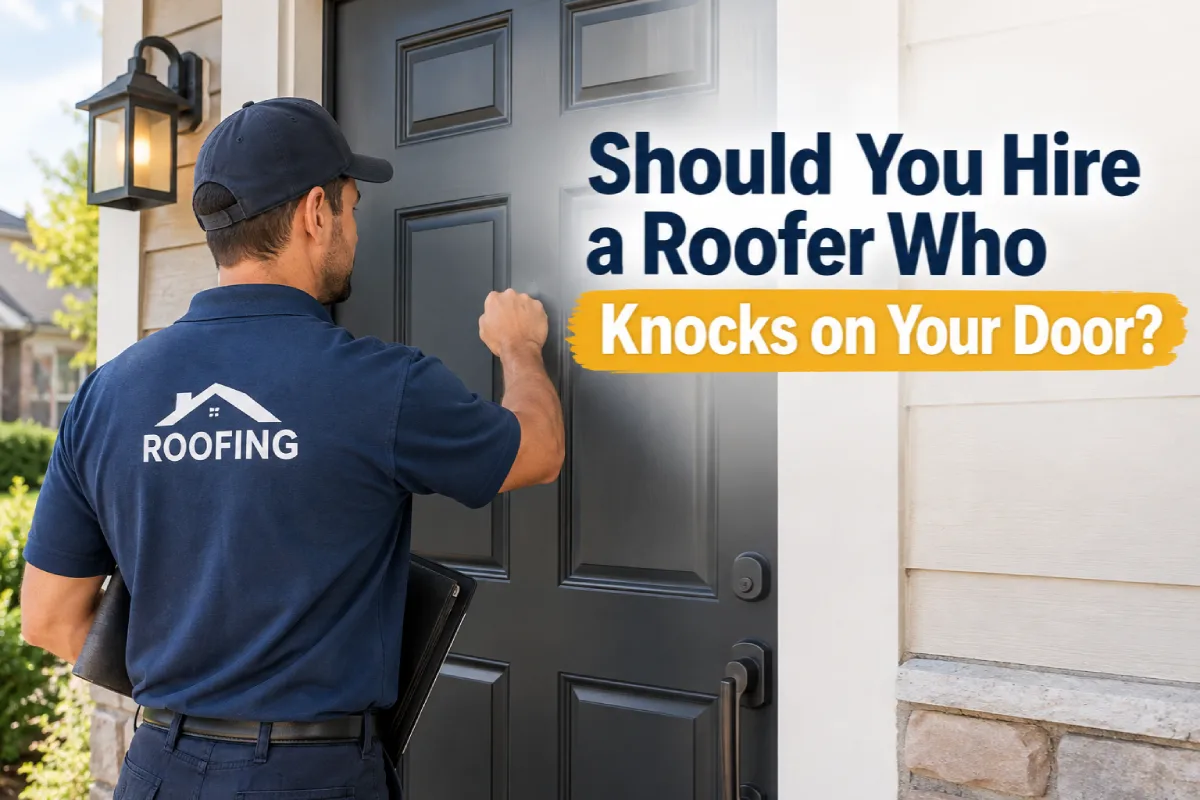
Usually not, and the reason is structural rather than personal. Roofing is not a business that normally needs door-to-door selling. Established local firms are busy through reputation and referral, which means the economics of knocking on doors mostly suit companies without either.
There are exceptions, and they are real. A crew already working on your street may legitimately mention that your ridge line looks damaged. The question is not whether anybody who knocks is dishonest. It is whether the situation is one in which you can make a good decision, and a doorstep after a storm is close to the worst environment for that.
Why they arrive after storms
Significant weather brings people into an area, sometimes from a long way away. Some are competent firms expanding capacity to meet genuine demand. Others follow weather from region to region, work quickly, and are gone before the first winter tests what they installed.
The problem this creates is not just quality. It is that a workmanship warranty is worth exactly as much as the business behind it, and a business with no local presence provides very little. Two years of cover from a firm that will not be in the state next year is not cover.
The pattern worth recognising
The approach tends to follow a script, and the individual steps sound reasonable on their own.
- An unsolicited visit, often framed as working nearby or inspecting the neighbourhood.
- A free inspection that finds damage. It essentially always finds damage.
- An offer to climb up straight away and photograph it.
- Urgency: a price good only today, a schedule filling up, a claim deadline expiring.
- An offer to handle the whole insurance claim for you.
- A suggestion that your deductible can be waived, covered, or absorbed.
- Paperwork to sign now, sometimes described as authorising the inspection rather than the work.
Two of those deserve naming plainly. Absorbing or waiving a deductible is misrepresentation to an insurer and is illegal in many places, and the homeowner is a party to it. And paperwork presented as an inspection authorisation is sometimes a contract or an assignment of your insurance claim, which transfers control of the claim away from you.
Never do this at the door
Do not sign anything, of any kind, while somebody is standing on your step. Not an inspection authorisation, not a contingency agreement, not an assignment of benefits. Do not let anybody climb onto your roof on the day they knocked, because a stranger alone on your roof with a camera and no supervision is a position with obvious problems, and damage found afterwards cannot be attributed. Do not pay a deposit. Nothing about roof damage requires a decision within the hour, whatever you are told.
If you want to take it further anyway
Sometimes the person at the door is a perfectly good local contractor. Slowing the process down costs nothing and filters efficiently.
Take a business name, a licence number, and a physical local address, then let them leave. Verify the licence with the issuing authority and ask for certificates of insurance, verified with the insurer rather than accepted as a photograph. Look for a local trading history rather than a recently registered company name.
Then arrange your own inspection with a firm you found independently, and get at least one other quotation. If the original damage report was accurate, a second opinion confirms it. If it was invented, the second opinion is how you find out. The full checklist is in how to choose a roofing contractor, and the verification steps are in how to check they are licensed and insured.
A genuine contractor is untroubled by any of this. Reluctance to be verified is itself the answer.
Assess the claim about your roof yourself
You do not have to take anybody’s word for whether your roof is damaged, and you should not.
Most storm damage is visible from the ground with binoculars, and hail hard enough to matter dents gutters, vent caps, and air conditioning fins, which are at eye level. Telling whether a storm actually damaged your roof sets out what to look for.
Photographs offered by somebody trying to sell you a roof are worth treating with care. They are easy to take on a different house.
Conclusion
The answer is not that everybody who knocks is a fraud. It is that the doorstep removes every condition under which you would make a good decision: no time, no comparison, no verification, and pressure applied by somebody who chose you rather than the other way round.
Take the details, close the door, verify independently, and get your own quotations. If they are good, they will still be good next week. The warning signs to watch for apply with particular force to anybody you did not go looking for.