
What Extra Costs Appear After a Roofing Estimate?
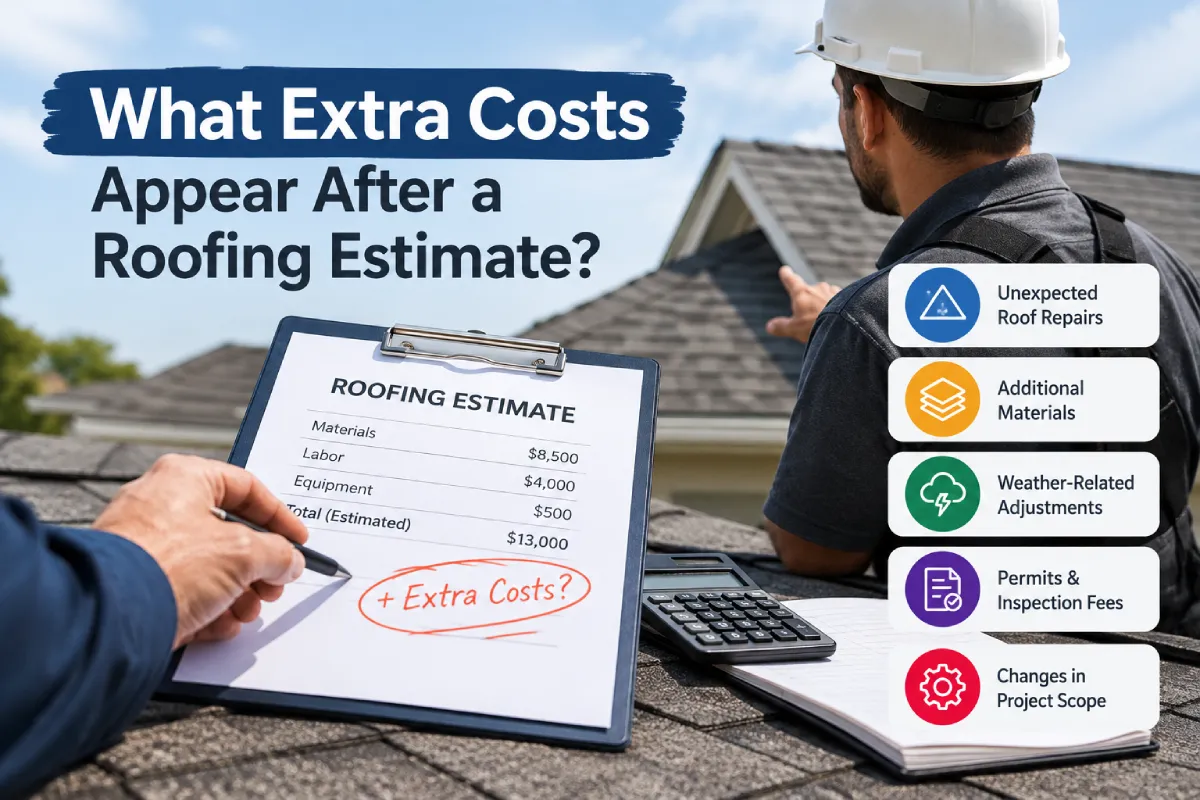
The number on a roofing quotation is a prediction about a surface nobody has seen. Until the old covering comes off, the deck underneath is a reasonable assumption rather than a known quantity, and that is the honest reason final invoices sometimes exceed quoted figures.
Some of those additions are legitimate and unavoidable. Others are the predictable result of a quotation written to look competitive. The difference is almost always visible before you sign, if you know what to look for.
Decking, which is the big one
This is the most common addition by a wide margin, and the most legitimate. Nobody can see the condition of the boards until the covering is off, and rot or delamination at the eaves and in the valleys is common on older roofs.
The fix is not to eliminate the uncertainty but to price it in advance. A quotation should state a rate per sheet or per board for replacement, so that if ten sheets are needed, you already know what ten sheets cost. Without that rate, the price is set after the roof is open and you have no leverage at all.
Ask what allowance is included, ask for the unit rate in writing, and ask to be shown and photographed anything condemned before it is removed. There is more on the material itself in what roof decking is and when it needs replacing.
The single question that prevents most disputes
Ask every contractor for a written per-sheet rate for decking replacement, and ask what quantity is already allowed for in the price. A quotation with no rate is not cheaper than one that includes it; it is simply a quotation where that cost has not been agreed yet. Compare quotations on the assumption that some decking will need replacing, because on an older roof it usually does.
Extra layers of old roofing
If the existing roof has more than one layer, the tear-off takes longer and produces far more waste, which costs both labour and disposal.
Contractors usually establish this before quoting, but not always, and a second layer discovered on the day is a genuine addition. It is a straightforward question to ask beforehand, and often answerable from the roof edge. What a tear-off involves covers why this matters beyond the cost.
Flashing and ventilation
These are the two items most often quietly absent from a competitive quotation, and their absence is what makes it competitive.
Flashing at chimneys, walls and valleys should generally be renewed with the covering. Old metal that has been pried up and refitted has work hardening at every fold and nail holes in the wrong places. If the quotation does not say new flashing, assume the old is being reused.
Ventilation is the same story. Improving intake and exhaust at the point of re-roofing is inexpensive, and it decides how fast the new covering ages, but it is an addition to a number that is being compared against other numbers. A quotation that includes it is not more expensive; it is more complete. Why a roof needs ventilation explains what is at stake.
Structural work and features
Rotten fascia or soffit is frequently found once the gutters and edge are opened up, and it needs carpentry rather than roofing. Chimneys are another common one: repointing, a new cap or flaunching often becomes obvious when the surrounding roof is stripped.
Skylights are worth deciding on in advance. Refitting an old skylight into a new roof is usually a false economy, since the seal is the part that fails and you are about to have the surrounding area open. Replacing one during the re-roof is far cheaper than replacing it afterwards.
Permits, disposal and access
Permit fees and inspections vary by jurisdiction and are sometimes excluded from a quoted price. Ask whether the permit is included and who pulls it, because who pulls the permit carries consequences beyond the fee.
Disposal is usually included and occasionally itemised separately. Access charges appear where a skip or dumpster cannot be placed conveniently, where scaffolding is required, or where the property is difficult to reach.
How to prevent most of it
Almost all of this is manageable at the quotation stage rather than the invoice stage.
- Insist on a written unit rate for decking, and an allowance quantity.
- Confirm in writing whether flashing is new or reused, and at which locations.
- Confirm whether ventilation work is included.
- Ask how many layers are on the roof now.
- Confirm permit, disposal, and access are in the price.
- Require a written change order process, with your approval before any additional work proceeds.
- Ask to be sent photographs of anything found and condemned.
Those last two matter most. A change order clause that requires your written approval before extra work is carried out turns a surprise invoice into a decision you made.
Conclusion
Genuine additions come from things nobody could see, and decking is the main one. Avoidable additions come from things left out of the quotation to keep the number low, and flashing and ventilation are the usual candidates.
The cheapest quotation is frequently the one with the most left out, which is the central point in why roofing quotations differ so much. Price the uncertainty in advance, get the change order process in writing, and the final invoice stops being a surprise.