How Long Does a Slate Roof Last, and What Does It Cost?
Slate is the oldest roofing material still in ordinary use, and the only one where a hundred-year lifespan is a realistic expectation rather than a sales line. It is also the heaviest, the most expensive, and the least forgiving of a poor installation.
Most people reading about slate are in one of two situations. Either they own a house that already has a slate roof and need to know whether it can be saved, or they are re-roofing and want to know whether slate is worth what it costs.
The answers are different, and the first one matters more, because slate roofs are condemned far more often than they deserve to be.
What slate actually is
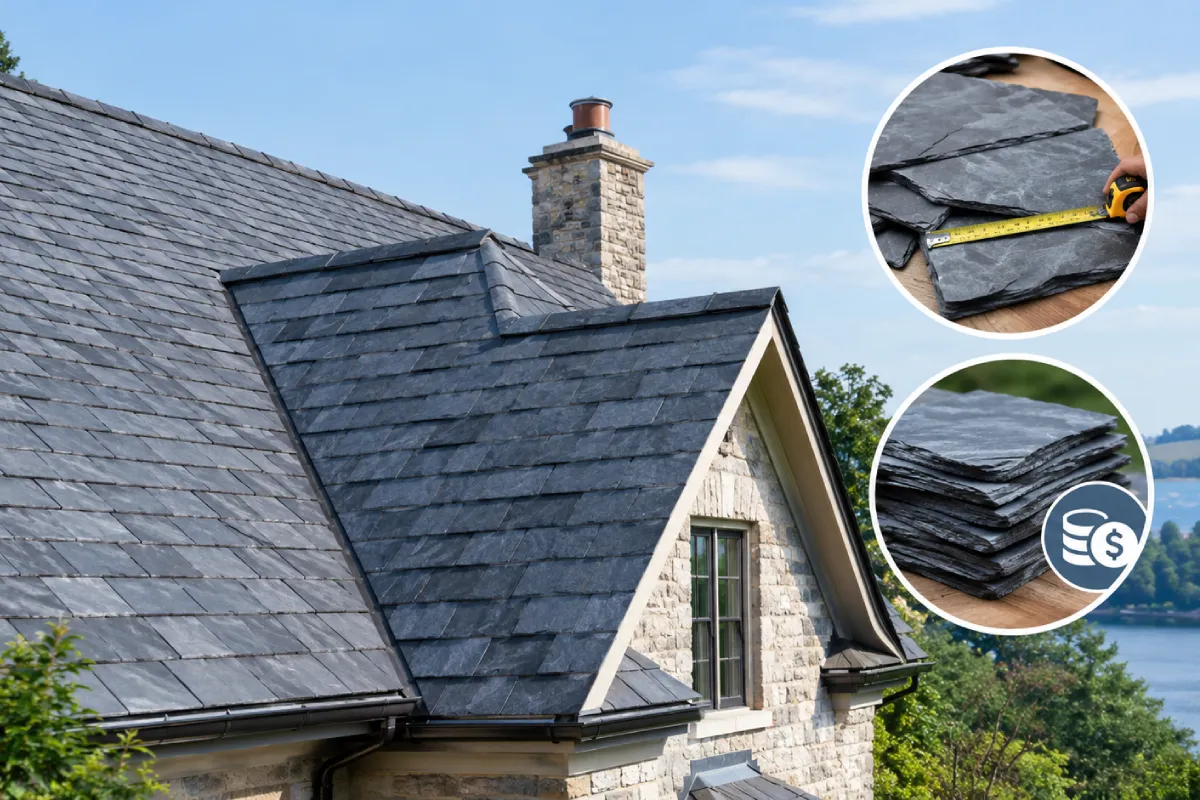
Natural slate is quarried stone, split along its grain into thin tiles. It is not manufactured, and that matters: the hardness, the color and the expected life of a slate depend on which quarry it came from. Two slate roofs of the same age can be in completely different condition because the stone came from different places.
There is also a second product sold under the same name. Synthetic slate is a molded composite, usually rubber or polymer with mineral filler, made to look like the real thing. From the ground, the two are hard to tell apart. In every other respect they are different materials: synthetic slate weighs a fraction as much, costs a fraction as much, and lasts a fraction as long. Neither is a bad choice, but they are not substitutes for one another, and a quote that says only slate has not told you which one you are buying.
How long a slate roof lasts
Hard slates from the better quarries are commonly documented at seventy-five to a hundred years or more, and roofs well past that are not unusual in places where slate has been used for centuries. Softer slates are typically given fifty to seventy-five. Those are ranges rather than promises, and where the stone came from moves the number more than anything you can do to it afterwards.
The more useful fact is this one: the slate almost always outlives everything holding it up. Nails corrode. Flashing at chimneys and valleys fails. Underlayment breaks down. Battens rot. All of those have lifespans measured in decades rather than centuries, which means a slate roof that is leaking badly at sixty years old usually has perfectly good stone on it and a fixing problem underneath.
This is worth knowing before anyone quotes you for a replacement. A slate roof can often be stripped, the fasteners and flashing renewed, and the same slates put back with a percentage of new ones mixed in. That work is not cheap, but it is a different proposition from buying a whole new roof, and a contractor who does not raise it as an option may simply not do that kind of work.
The weight problem
Slate is several times heavier than asphalt shingles for the same area of roof. A house framed and built for a light covering will not necessarily carry a heavy one.
This is the point in the conversation where the honest answer is that you need somebody qualified to look, and that somebody is a structural engineer rather than a roofer. Whether your roof structure can take slate depends on the size and spacing of the rafters, the condition of the timber, the span, and the snow load where you live. None of that can be assessed from a description, and none of it should be settled by an estimate that simply says the structure looks fine.
Budget for this from the start:
If the structure does need strengthening, that cost belongs in the comparison from the beginning. It is a common reason slate turns out not to be viable on a house that was never built for it.
What slate costs, and why
Slate sits at the expensive end of every roofing comparison, usually by a wide margin over asphalt and comfortably above metal roofing or clay and concrete tiles. Four things drive that.
- The material. Quarried stone, sorted and graded, shipped heavy.
- The labor. Slating is a specialist trade with a smaller pool of people who can do it well. Scarce skill is expensive skill.
- The time. A slate roof takes longer to lay than a shingle roof of the same size.
- The structure. Any strengthening the weight requires is a separate cost on top of the roof itself.
Nobody can price your roof honestly without seeing it, but as a rough national guide, natural slate typically runs about $15 to $35 per square foot installed, before any structural work; our cost per square foot guide puts that alongside other materials. What is worth doing is reading what actually moves the cost of a roof before you compare quotes, so that a large number can be understood rather than just accepted or rejected.
When slate makes sense
Slate is a straightforward decision in a few situations and a poor one in others.
When It Makes Sense
It makes sense when the house already has slate, and you want to keep it; when you expect to own the house long enough for a century of life to mean something; when the building sits in an area where the local authority or a conservation designation requires a matching material; and when the structure was built for the weight in the first place.
When It Makes Less Sense
It makes less sense when you expect to move within a decade, because you will pay for lifespan you never use, and the resale market rarely returns the difference in full. It also makes less sense where no local contractor works in slate regularly, because a specialist material installed by somebody learning on your roof is the worst of both.
Finding someone who can work on slate
Slating is genuinely a separate skill from shingling, and general roofing experience does not transfer as much as people assume. Fixing slate too tightly cracks it. Fixing it too loosely lets it move and break. Cutting and dressing it properly takes practice.
When you talk to contractors, ask specifically how much slate work they do rather than whether they can do it, and ask to see roofs they have laid or repaired. The general advice in choosing a roofing contractor and the questions worth asking all apply here, with the specialism as an additional filter on top.
Slipped slates, and how they are refixed
The classic slate roof problem is not a broken slate but a slipped one: a slate that has come loose and slid, leaving a gap. Almost always the cause is a corroded nail rather than anything wrong with the stone, which is the same nail fatigue that eventually ends the roof.
A single slipped slate cannot simply be nailed back, because the nail holes are covered by the courses above. There are two accepted repairs. A tingle is a strip of lead or copper fixed under the slate and bent up over its lower edge to hold it. It works, and it is visible from the ground as a small metal tab. The alternative is a slate hook, a stainless steel hook fixed into the batten that the replacement slate sits on. Hooks are less visible and generally more durable.
What matters more than which method is used is the pattern. One slipped slate is maintenance. Slates slipping in several places over a short period is nail fatigue arriving across the whole roof at once, and it is the signal that the roof is approaching the point of a full strip and refix rather than another patch.
Walking on a slate roof
Slate is stone, and stone cracks. A slate roof cannot be walked on the way a shingle roof can, and slates broken by foot traffic are one of the more common causes of damage during work by trades who are not slaters, including antenna installers, chimney sweeps and solar fitters.
Proper access uses roof ladders and crawl boards that spread load onto the battens rather than onto individual slates. If anyone needs to work on your roof for any reason, that is worth establishing before they climb, not afterwards.
Conclusion
If you already have a slate roof, find out whether the stone is sound before you accept that it needs replacing, because the fasteners and flashing fail long before the slate does. If you are considering slate on a house that does not have it, settle the weight question with a structural engineer before you get attached to the idea.
Slate is the only common roofing material that can genuinely outlive the person who pays for it. That is worth a great deal in the right house, and very little in the wrong one.