How to Check If a Roofing Contractor Is Licensed and Insured
Do this first
Before you hand over a deposit, sign a contract, or let anyone climb onto your roof, there is one critical verification you need to complete: confirming that your roofing contractor is properly licensed and adequately insured. This is not a formality. It is one of the most important steps you can take to protect yourself, your home, and your financial well-being.
An unlicensed or uninsured contractor exposes you to serious risks. If an uninsured worker is injured on your property, you could be liable for their medical expenses and lost wages. If an unlicensed contractor performs substandard work, you may have no recourse through licensing boards or regulatory agencies. If the work does not comply with local building codes — something a licensed contractor is trained to understand — you could face fines, problems with your homeowner’s insurance, or complications when you sell your home.
Checking a contractor’s license and insurance is not difficult, but it does require you to go beyond simply asking the contractor if they are licensed and insured. You need to verify the information independently. This article explains exactly how to do that, step by step.
Understanding Contractor Licensing
Contractor licensing is a system of regulation designed to protect consumers. It requires contractors to meet minimum standards of competence, experience, and ethical conduct before they can legally offer their services. The specific licensing requirements for roofing contractors vary significantly from state to state and sometimes from one municipality to another.
Some states have a specific roofing contractor license category. In these states, a contractor must hold a roofing-specific license that demonstrates knowledge of roofing materials, installation methods, building codes, and safety practices. Other states include roofing under a general contractor license, which covers a broader range of construction activities. And some states have minimal or no state-level licensing requirements for roofing contractors, leaving regulation to individual counties or cities.
The types of licensing you might encounter include a state contractor’s license issued by a state licensing board, a local business license issued by a city or county, a specialized roofing license that covers only roofing work, and registration or certification with a state consumer protection agency.
Understanding which type of license is required in your area is the first step. Your state’s contractor licensing board website is the best place to start. A quick internet search for “[your state] roofing contractor license requirements” will usually point you to the right resource.
How to Verify a Contractor’s License
Once you know what type of license is required in your area, you can verify that your contractor holds it. Here is the process.
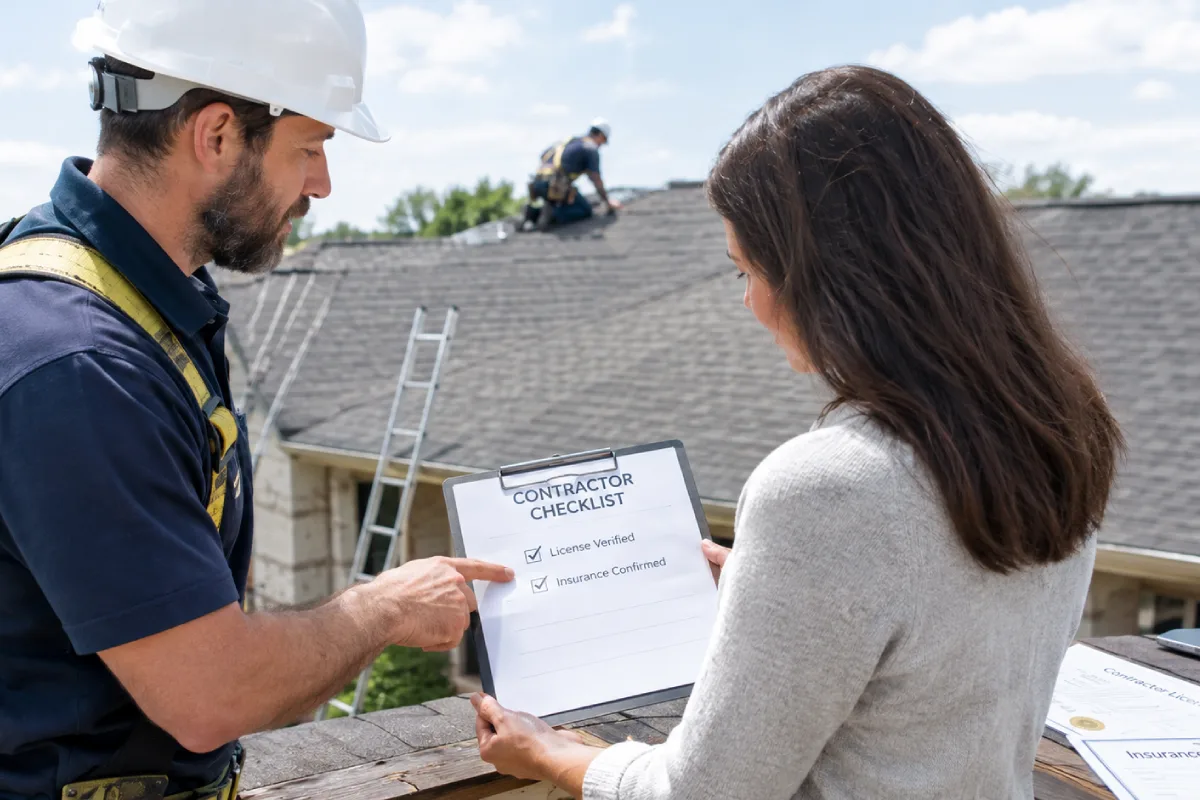
First, ask the contractor for their license number. A legitimate, licensed contractor will provide this without hesitation. If a contractor is reluctant to share their license number, makes excuses about why they do not need one, or claims that licensing is not required in your area when your research says otherwise, consider it a serious red flag.
Second, verify the license number independently. Most state licensing boards maintain online databases where you can look up a contractor’s license by number, name, or business name. These databases typically show the license status (active, expired, suspended, or revoked), the license type, the issue and expiration dates, any disciplinary actions on record, and sometimes bonding and insurance information.
When you look up the license, confirm that it is currently active — not expired or suspended. An expired license means the contractor is not currently authorized to perform work. Check the expiration date to make sure the license will remain valid throughout the duration of your project.
Confirm that the license type covers roofing work. If your state issues separate licenses for different trades, make sure the contractor’s license specifically covers roofing — not just general construction, plumbing, or some other trade.
Check for disciplinary actions. Licensing boards take complaints from homeowners seriously and may issue warnings, fines, suspensions, or revocations in response to violations. A history of disciplinary actions is a significant concern.
Third, confirm that the license belongs to the contractor you are dealing with. Verify that the name and business name on the license match the name on the estimate, the business card, and the contract. In rare cases, unlicensed contractors use another company’s license number to appear legitimate.
Understanding Contractor Insurance
Insurance protects you from financial liability if something goes wrong during the project. For roofing contractors, there are two essential types of insurance.
General liability insurance covers property damage and third-party injuries caused by the contractor’s work. If a falling shingle damages your car, if a crew member accidentally breaks your window, or if a defect in the installation causes water damage to your home, general liability insurance is what covers the cost of repairs or replacement. Without it, you would have to pursue the contractor directly for compensation — which can be difficult or impossible if the contractor does not have the financial resources to pay.
Workers’ compensation insurance covers injuries to the contractor’s employees while they are working. Roofing is one of the most dangerous occupations in the construction industry. Falls, heat-related illness, cuts, and other injuries are real risks. If a worker is injured on your property and the contractor does not carry workers’ compensation insurance, the injured worker may pursue a claim against you as the homeowner. In many states, the homeowner can be held liable for medical expenses, lost wages, and other costs if an uninsured worker is injured on their property — even if the homeowner had no involvement in the work.
Some contractors may tell you that they do not need workers’ compensation insurance because they are a sole proprietor with no employees, or because they use subcontractors who carry their own insurance. While there are legitimate situations where a sole proprietor operates without workers’ compensation (depending on state law), you should verify the claim and understand the risk. If the contractor uses subcontractors, ask for proof that those subcontractors carry their own workers’ compensation insurance. If they do not, the liability could still fall on you.
How to Verify a Contractor’s Insurance
Verifying insurance requires more than looking at a piece of paper. Here is how to do it thoroughly.
First, ask the contractor for certificates of insurance — one for general liability and one for workers’ compensation. A certificate of insurance (often called a COI) is a document issued by the insurance company that summarizes the policy, including the policyholder’s name, the insurance company, the policy number, the coverage limits, and the policy period.
Second, review the certificates carefully. Confirm that the policyholder’s name matches the contractor’s name or business name. Confirm that the policy period is current — the policy should be active now and remain active through the expected duration of your project. Check the coverage limits. For general liability, a minimum of $1 million per occurrence is standard and recommended for roofing contractors. For workers’ compensation, the limits are typically set by state law.
Third, verify the certificates directly with the insurance company. Call the insurance company listed on the certificate — using a phone number you find independently, not the number printed on the certificate — and confirm that the policy is active and the information on the certificate is accurate. This step is important because certificates can be forged, altered, or outdated. A contractor whose insurance has been cancelled since the certificate was issued may still be showing the old certificate to prospective customers.
You can also ask the contractor to have you named as an “additional insured” on their general liability policy for the duration of your project, which extends that coverage to claims against you arising from their work. It does not guarantee that you will be told if the policy is later cancelled, so if the project starts well after you checked, or runs long, confirm the coverage again. Many contractors will accommodate the request without issue.
What If a Contractor Is Not Licensed or Insured?
If your research reveals that a contractor is not properly licensed or does not carry adequate insurance, the answer is simple: do not hire them. No matter how attractive their price is, no matter how convincing their sales pitch is, and no matter how urgent your roofing need is, the risk of hiring an unlicensed or uninsured contractor is too great.
The potential consequences include personal liability for worker injuries, no recourse for substandard work or code violations, difficulty obtaining permits (since many jurisdictions require a licensed contractor to pull the permit), potential problems with your homeowner’s insurance if damage results from work performed by an unlicensed contractor, and complications when selling your home if the roof replacement was not properly permitted or inspected.
Some homeowners are tempted to hire an unlicensed or uninsured contractor because the price is significantly lower. The lower price is possible precisely because the contractor is not paying for licensing fees, insurance premiums, and the overhead associated with operating a legitimate business. You are essentially accepting all of the risk in exchange for a lower price. When something goes wrong — and the odds are higher with unlicensed contractors — the cost of the consequences almost always exceeds the savings.
Special Considerations for Storm Damage Repairs
After a major storm, roofing contractors descend on affected areas in large numbers. Some are reputable, established companies. Others are storm chasers — temporary operations that follow severe weather events, sign up as many customers as possible, and move on once the work is done.
In the rush to get repairs done quickly — especially when your roof is actively leaking — it can be tempting to hire the first contractor who shows up at your door. But this is precisely when you need to be most diligent about verifying licensing and insurance.
Ask storm-repair contractors the same questions you would ask any contractor. Verify their license, confirm their insurance, check their references, and understand their warranty. Pay special attention to their local presence — a contractor who opened a local office last week may not be around next year when you need warranty service.
If your damage is covered by insurance, take the time to go through the claims process properly. Your insurance company may have a list of approved or preferred contractors, and your adjuster may want to inspect the damage before work begins. Rushing to hire an unlicensed contractor before the insurance process is complete can create complications with your claim.
Red Flags During the Verification Process
As you verify licensing and insurance, watch for these warning signs.
A contractor who cannot or will not provide a license number is an immediate red flag. Every legitimate contractor knows their license number and can provide it without hesitation.
A contractor who shows you an expired license or a license that does not cover roofing work is either unaware of the requirements (which raises competence concerns) or hoping you will not check (which raises integrity concerns).
A contractor who provides insurance certificates but becomes evasive when you ask to verify them with the insurance company is a concern. Legitimate contractors welcome verification because it confirms their professionalism.
A contractor who claims that licensing and insurance are not necessary for your type of project — or that they are exempt from the requirements — should be viewed with skepticism. Verify the claim independently before accepting it.
A contractor who pressures you to make a quick decision and skip the verification process is prioritizing speed over your protection. A legitimate contractor will give you the time you need to do your due diligence.
Record Keeping
Once you have verified a contractor’s license and insurance, keep copies of the documentation for your records. Save the license number, the insurance certificates, and any correspondence related to the verification. Store these documents with your contract and other project paperwork.
If you file an insurance claim related to the roofing work, your insurance company may ask for the contractor’s license and insurance information. If you sell your home, the buyer’s inspector or attorney may request this documentation as well. Having it readily available saves time and demonstrates that you hired a qualified, legitimate contractor.
Conclusion
Verifying a roofing contractor’s license and insurance is one of the simplest and most impactful steps you can take to protect yourself during a roof replacement. It takes a small amount of time — a few phone calls and a few minutes online — but it can save you from enormous financial and legal exposure.
Do not skip this step, and do not take the contractor’s word for it. Verify independently, confirm the details, and keep copies of everything. A contractor who is properly licensed and fully insured is one who takes their business seriously and is committed to operating within the standards that protect you as a homeowner.
If a contractor fails this basic verification, they have given you all the information you need to make your decision. Move on and find a contractor who meets the standard.