How Much Does Roof Replacement Cost Per Square Foot?
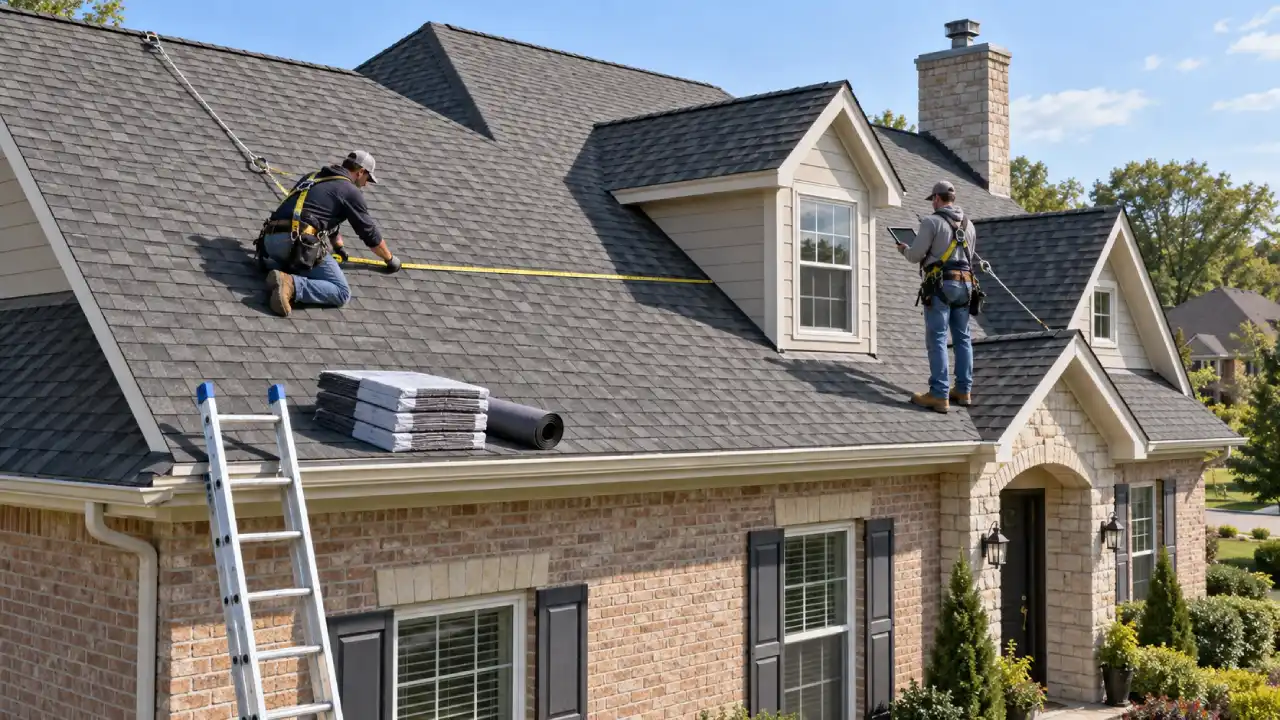
When you start researching the cost of a roof replacement, you will quickly encounter the “per square foot” pricing model. It is one of the most common ways roofing contractors and industry resources express costs, and for good reason — it provides a standardized way to compare pricing across different roof sizes, materials, and regions.
However, per-square-foot pricing can also be a source of confusion. The number you see quoted online or hear from a neighbor may not match the estimate you receive from a contractor, and different sources may quote very different ranges. That is because the cost per square foot for a roof replacement is not a single fixed number. It is a range that shifts based on the material you choose, the region you live in, the complexity of your roof, the condition of the underlying structure, and the contractor you hire.
This article breaks down per-square-foot pricing for roof replacement so you can understand what the numbers mean, how they vary, and how to use them when planning your budget.
Understanding the Basics of Per-Square-Foot Pricing
Roof replacement cost per square foot refers to the total installed cost — materials, labor, tear-off, disposal, and all associated work — divided by the total square footage of your roof surface. When a contractor quotes $5.00 per square foot, that means every 100 square feet of roof area will cost approximately $500 to replace, all in.
Per square foot is not per square
It is important to distinguish between “per square foot” and “per square” in roofing terminology. A roofing square is 100 square feet. So a quote of $5.00 per square foot equals $500 per square. Some contractors and industry sources use one measurement, some use the other. When comparing prices, make sure you know which unit is being used to avoid misunderstandings.
The per-square-foot cost includes everything: the tear-off of the old roof, disposal of the old materials, inspection and repair of the decking, installation of underlayment and flashing, installation of the new roofing material, ventilation components, cleanup, and the contractor’s profit margin. It is a comprehensive number that represents the total cost of the project divided by the roof area.
Average Cost Per Square Foot by Material
The roofing material you choose is the biggest variable in per-square-foot pricing. Here is a breakdown of typical installed costs per square foot for the most common residential roofing materials.
Asphalt shingles (3-tab): $3.00 to $4.50 per square foot. Three-tab shingles are the most basic and affordable asphalt option. They have a flat, uniform appearance and a shorter lifespan than their architectural counterparts. They remain a popular choice for budget-conscious homeowners and rental properties.
Asphalt shingles (architectural/dimensional): $4.50 to $7.00 per square foot. Architectural shingles are thicker, heavier, and more visually interesting than 3-tab shingles. They have a layered, textured appearance that mimics the look of more expensive materials. They also tend to have longer warranties and better wind resistance. This is the most popular roofing choice for American homeowners and represents the sweet spot of cost, performance, and appearance for most situations.
Metal roofing (corrugated/ribbed panels): $6.00 to $10.00 per square foot. Corrugated metal panels are the more affordable metal option. They are fastened with exposed screws and have a more utilitarian, agricultural appearance, though modern finishes have improved their aesthetics significantly.
Metal roofing (standing seam): $9.00 to $16.00 per square foot. Standing seam metal roofing is the premium metal option. Panels lock together with raised, interlocking seams that conceal the fasteners. This creates a clean, modern look and excellent weather resistance. Standing seam roofs are increasingly popular on both modern and traditional homes.
Wood shingles and shakes: $7.00 to $15.00 per square foot. Wood shingles are machine-cut for a uniform appearance, while shakes are hand-split for a more rustic look. Cedar is the most common wood species used. Wood roofing requires more maintenance than other materials and may be restricted in some areas due to fire codes.
Clay tile: $8.00 to $25.00 per square foot. Clay tiles are a classic roofing material, especially popular in Mediterranean, Spanish, and Southwestern architecture. They are extremely durable and long-lasting, but their weight often requires structural reinforcement of the roof framing.
Concrete tile: $7.00 to $19.00 per square foot. Concrete tiles offer a similar aesthetic to clay at a lower price point. They are still heavy and may require structural reinforcement, but they are somewhat less expensive to manufacture and install than clay.
Natural slate: $15.00 to $35.00 per square foot. Slate is the most expensive residential roofing material. It is quarried natural stone, each piece unique in color and texture. A properly installed slate roof can last over a century. Installation requires specialized skills and tools, which drives the labor cost higher.
Synthetic/composite roofing: $7.00 to $14.00 per square foot. Synthetic roofing products are engineered to replicate the look of slate, tile, or wood at a lower cost and weight. They are made from a variety of materials including rubber, plastic, and polymer blends. Quality varies significantly between manufacturers, so research is important.
How Region Affects Per-Square-Foot Costs
The same roof with the same materials can cost very different amounts depending on where you are in the country. Regional cost variations are driven by several factors.
Labor costs are the most significant regional variable. In high-cost-of-living areas — cities like New York, San Francisco, Boston, and Seattle — roofing labor rates are substantially higher than the national average. In lower-cost regions — parts of the Midwest, South, and rural areas — labor rates are lower. The difference can be 20 to 40 percent or more between the most and least expensive regions.
Material costs also vary regionally, though less dramatically than labor. Transportation costs affect the price of materials, especially heavy materials like tile and slate. Local supply and demand also play a role — in regions where metal roofing is very popular, the supply chain may be more efficient and prices somewhat lower.
Building code requirements vary by region and can affect both material choices and installation methods. Coastal areas in hurricane zones require roofing systems rated for high wind speeds, which may include enhanced fastening patterns, upgraded underlayment, and specific material ratings. Northern regions require ice and water shield in areas prone to ice dams. These code requirements add cost that is reflected in the per-square-foot price.
Climate also affects the type and quality of materials needed. In extremely hot climates, roofing materials must withstand intense UV exposure and thermal cycling. In cold climates, materials must handle freeze-thaw cycles and snow loads. Materials engineered for extreme conditions typically cost more than standard options.
Because labor is the biggest regional variable, an architectural shingle roof that sits within the national range of about $4.50 to $7.00 per square foot can come in below that range in lower-cost rural markets and well above it in high-cost metro areas. Local quotes are the only reliable guide to where your area falls.
How Roof Complexity Affects Per-Square-Foot Cost
Two roofs of the exact same square footage can have very different per-square-foot costs if one is simple and the other is complex. Roof complexity is one of the most underappreciated factors in roofing cost.
A simple roof has a basic shape — typically a gable with two slopes — few penetrations, a moderate pitch, and easy access from the ground. These roofs are fast and efficient to work on. Crews can move quickly, waste minimal materials on cuts, and complete the job in less time. The per-square-foot cost for a simple roof will be at the lower end of the range for any given material.
A complex roof has multiple slopes, valleys, dormers, hips, skylights, chimneys, intersecting walls, and varying pitches. Every transition point, angle, and penetration requires custom cutting, specialized flashing, and careful fitting. Crews work more slowly on complex roofs because every step requires more precision and more individual attention. Material waste is higher because more cuts are needed, and some offcuts are unusable. The per-square-foot cost for a complex roof can be 20 to 50 percent higher than for a simple roof of the same size.
Steep pitch is another major cost factor. A steep roof — anything with a pitch of 8:12 or greater — is harder and slower to work on than a moderate-pitch roof. Workers need additional safety equipment, materials cannot be staged on the roof as easily, and the installation process itself is more physically demanding. Very steep roofs (12:12 or greater) may require specialized staging or scaffolding, which adds further to the cost.
Multi-story homes also increase the per-square-foot cost. Working on a two- or three-story roof involves more time for material transport, more safety considerations, and more complex staging. Everything takes longer when you are working higher off the ground.
The Role of Existing Roof Condition
The condition of your existing roof and the underlying structure affects the per-square-foot cost in ways that are not always visible until the old roof is removed.
If your existing roof has multiple layers of shingles, the tear-off process takes longer and generates more debris. This adds to both labor and disposal costs, which are reflected in the per-square-foot price.
If the decking underneath the shingles is damaged — from moisture, rot, or pests — it must be replaced before the new roof goes on. Decking repair is typically priced on a per-sheet basis, with each sheet of plywood costing $70 to $150 installed depending on the extent of the work and local labor rates. Moderate decking repair might add $0.50 to $1.50 per square foot to the overall project cost. Extensive decking replacement can add more.
Some estimates include a standard allowance for decking repair, while others price it as a separate line item. Make sure you understand how your contractor handles decking repair in their estimate so you can compare bids accurately.
What Is and Is Not Included in Per-Square-Foot Pricing
When a contractor quotes a per-square-foot price, it should include the core components of a roof replacement: tear-off of the old roofing materials, disposal, inspection of the decking, installation of new underlayment and flashing, installation of the new roofing material, ridge cap and hip caps, standard ventilation components, cleanup, and the contractor’s workmanship warranty.
However, there are items that may or may not be included depending on the contractor and the specific estimate. These include decking repair beyond a standard allowance, gutter replacement or repair, soffit and fascia work, chimney repair, skylight replacement, upgraded ventilation systems, and premium flashing materials.
When comparing per-square-foot quotes from different contractors, it is essential to understand what is included in each price. A contractor who quotes $4.50 per square foot but excludes flashing replacement and ventilation is not offering a better deal than a contractor who quotes $5.50 per square foot with everything included. The lower number may actually result in a higher total cost once the excluded items are added.
How to Use Per-Square-Foot Pricing in Your Planning
Per-square-foot pricing is a useful planning tool, but it should be used as a starting point rather than a final answer. Here is how to use it effectively.
First, measure or estimate your roof area. If you do not know the exact square footage, a contractor can measure it during an estimate visit. Some online tools use satellite imagery to estimate roof area, though these are not always precise.
Second, identify the material you are considering and research the typical per-square-foot cost range for that material in your area. This gives you a ballpark budget range.
Third, multiply your roof area by the per-square-foot cost range to get an estimated project range. For example, a 2,000-square-foot roof with architectural asphalt shingles at $4.50 to $7.00 per square foot would be estimated at $9,000 to $14,000.
Fourth, adjust for complexity. If your roof has multiple dormers, a steep pitch, or other complexity factors, expect the actual cost to be toward the higher end of the range — or above it.
Fifth, get actual estimates from contractors. The per-square-foot planning exercise gives you a framework for evaluating those estimates. If a contractor’s quote is significantly below the expected range, ask what is excluded. If it is significantly above, ask what is driving the higher cost.
Per-Square-Foot Cost Does Not Equal Per-Square-Foot Value
It is tempting to choose the lowest per-square-foot price, but the cheapest installation is not always the best value. A roof is a long-term investment, and the quality of the installation has a direct impact on how long the roof lasts and how well it performs.
A roof installed by an experienced, reputable crew using quality materials and proper techniques may cost more per square foot upfront, but it will perform better, last longer, and require fewer repairs over its lifetime. A cheap installation that cuts corners on underlayment, flashing, or ventilation may develop problems within a few years, leading to costly repairs that erase the initial savings.
When evaluating per-square-foot costs, consider the total value proposition: the quality of materials, the reputation and experience of the contractor, the warranty coverage, and the expected lifespan of the completed roof. A slightly higher per-square-foot cost from a contractor who does the job right is almost always a better investment than a bargain price from someone who takes shortcuts.
The Bottom Line
Per-square-foot pricing provides a standardized, easy-to-understand way to estimate and compare roof replacement costs. For a typical asphalt shingle roof, expect to pay somewhere between $3.00 and $7.00 per square foot, with significant variation based on material, region, complexity, and contractor.
Use per-square-foot pricing as a planning tool to set your budget and evaluate estimates, but always dig into the details of what is included. The most important number is not the per-square-foot price itself — it is the total installed cost for a quality roof that will protect your home for decades.