What Is Roof Underlayment, and Do You Need It?
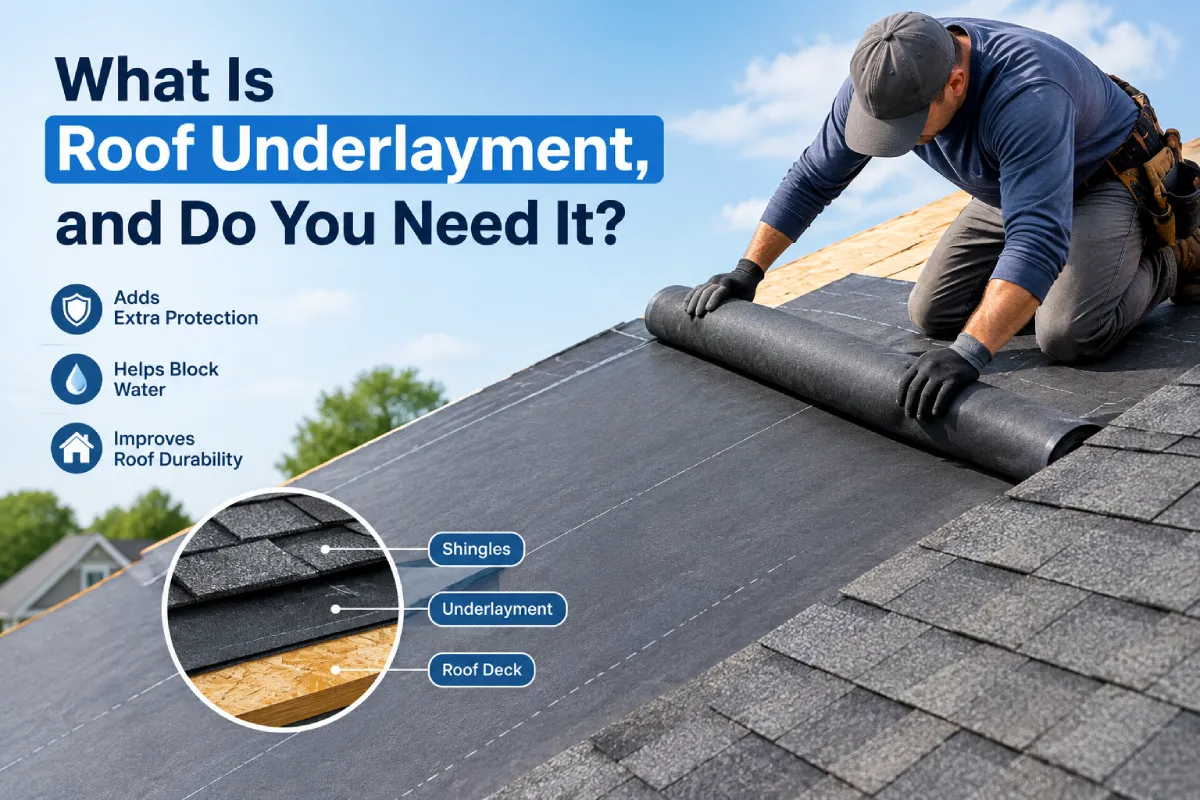
Underlayment is the layer between the roof deck and the covering. It is not visible once the roof is finished; it is rarely discussed when a roof is being sold, and it is the thing standing between your house and the water that gets past the shingles.
Because water does get past. Shingles and tiles are a shedding layer rather than a waterproof one, and wind-driven rain, ice at the eaves, and the gap left by a lifted shingle all put water onto the deck. Underlayment is what happens next.
What it is actually for
Three jobs, in order of importance.
It is a secondary barrier when water gets under the covering, which is the job that matters. It protects the deck during the installation itself, when the roof may be open overnight, or a storm may arrive mid-job. And it provides a degree of protection if the covering is damaged and repair is delayed.
None of that makes it a substitute for the covering. Underlayment left exposed for long degrades in sunlight, which is why the visible answer to a delayed job is not simply to leave the felt on.
Felt against synthetic
Traditional underlayment is asphalt-saturated felt, sold in weights usually described as fifteen-pound and thirty-pound. It is the cheaper option; it has a long track record, and its weaknesses are that it tears reasonably easily, absorbs water once torn, wrinkles when it gets wet, and degrades if exposed for extended periods.
Synthetic underlayment is a woven polymer sheet. It is lighter, much stronger in tear resistance, does not absorb water, lies flatter, and tolerates far longer exposure. It costs more per roll and covers more area per roll, so the difference in installed cost is smaller than the difference in price suggests.
To work out how many rolls you need, including ice barrier at the eaves, use the Roof Underlayment Calculator.
For most re-roofs, synthetic is the better choice, and it is now the default for many contractors. The place to check is the quote, because this is an easy line to downgrade quietly when a price is being sharpened.
The self-adhering membrane, which is a different product
Ice and water shield, sometimes called an ice barrier or eave protection, is not underlayment in the ordinary sense and should not be treated as an upgrade of it.
It is a self-adhering rubberized membrane that bonds to the deck and seals around the nails driven through it. That sealing is the point: ordinary underlayment is perforated by every fastener, while this material closes around them.
It goes where water is most likely to be trapped or concentrated rather than across the whole roof: along the eaves in climates with a history of ice forming there, in valleys, and around chimneys, skylights, and other penetrations. Building codes in cold regions require it at the eaves to a specified distance up the slope, and that distance is measured relative to the interior wall line rather than the roof edge. Requirements vary by jurisdiction and local amendments are common, so check rather than assume.
Be clear about what it does. It protects the house from the consequences of an ice dam. It does not prevent one, because dams are caused by heat escaping into the attic rather than by the covering.
Check this line on every quote
Underlayment is invisible once the roof is on, which makes it one of the easiest places to reduce a price without the difference showing. Ask what product is specified, whether it is felt or synthetic, and where self-adhering membrane is being used and to what extent. A quote that names the product and states the coverage is telling you something about the contractor as well as about the roof. One that says underlayment and nothing more has not answered the question.
So do you need it?
Yes. Building codes generally require underlayment under a new covering, manufacturer instructions require it for the material warranty to stand, and a roof fitted without it is non-compliant.
The real question is which product and how much of the roof gets the self-adhering membrane, and that depends on climate, roof pitch and geometry. Low slopes need more, because water moves more slowly. Complicated roofs with valleys and dormers need more, because those are where water concentrates.
Can existing underlayment be left in place?
On a full tear-off, no. The old underlayment comes off with the covering, and the deck is inspected before the new layers go on. That inspection is one of the arguments for a tear-off over an overlay.
Where a second layer of shingles is laid over the first, the existing underlayment stays where it is and cannot be assessed, which is one of several reasons an overlay is a compromise rather than an equivalent.
Conclusion
Underlayment is a small proportion of the cost of a roof, and it is the layer that decides what happens when the covering is breached. Synthetic outperforms felt for a modest difference in installed cost, and self-adhering membrane at the eaves and valleys is worth having wherever water is likely to back up.
Because none of it is visible afterwards, it has to be settled in the quote. Ask for the product name and the coverage in writing, and compare quotes on that line as carefully as on the shingle, since this is one of the places prices genuinely diverge.