Why Does a Roof Need Ventilation, and How Much?
Roof ventilation is the least visible part of a roof and one of the most consequential. It does not keep rain out; it is not what anybody chooses a roof for, and it is routinely left out of quotes. It is also, on a great many roofs that failed early, the reason.
The short version: a roof needs air moving through the space beneath it, entering low and leaving high. When that stops happening, the roof cooks in summer, sweats in winter, and ages faster than it should from the inside.
What ventilation is actually for
Two jobs, in two different seasons.
In summer, it removes heat
An unventilated roof space under the sun becomes extremely hot. That heat conducts down into the house, and it bakes the covering above from beneath. Asphalt shingles in particular age by losing volatiles and becoming brittle, and heat accelerates that. This is one of the mechanisms behind shingles reaching the end of their life early.
In winter, it removes moisture
This is the more damaging one and the less understood. A household produces a lot of water vapor, and warm moist air rises. When it reaches a cold roof deck, it condenses on the underside, exactly as it does on a cold window. Without airflow to carry it away, that moisture sits on the deck, and wet timber does what wet timber does.
A ventilated roof also keeps the deck closer to outside temperature, which reduces the melting and refreezing cycle at the eaves that causes ice dams.
How it works: low in, high out
Ventilation is a system, not a component, and it depends on air being able to complete a path.
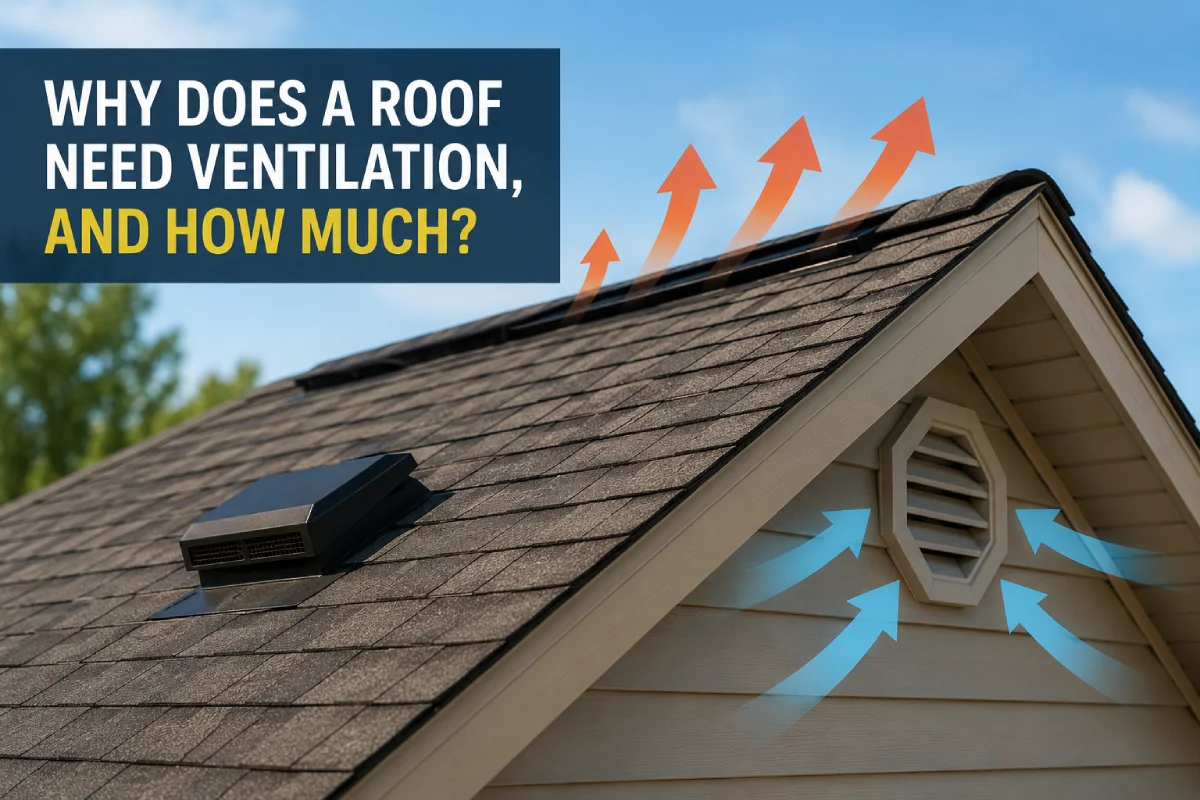
- Intake is at the eaves, usually vented soffits.
- Exhaust is at or near the ridge, usually a continuous ridge vent, sometimes box vents or gable vents. Air enters low, rises as it warms, and leaves high.
The part that goes wrong most often is intake. Exhaust vents are visible and get installed. Soffit vents are easy to block, and they get blocked routinely: by insulation pushed into the eaves during an upgrade, by paint, by debris, by birds. A roof with excellent ridge ventilation and blocked soffits has no ventilation at all, because there is nothing to draw.
Mixing exhaust types can also defeat it. A ridge vent combined with open gable vents may simply pull air in through the gables and straight out of the ridge, leaving the rest of the roof still.
Not every roof is meant to be vented, though. Section R806.5 of the 2024 International Residential Code permits unvented attics and unvented enclosed rafter assemblies when a list of conditions is met. Those conditions include keeping the attic space completely within the building’s thermal envelope, and the section sets specific rules for the type and placement of insulation, including vapor diffusion ports where air-permeable insulation is used in an unvented attic in Climate Zones 1, 2 and 3. These assemblies follow different rules, so find out which type you have before anybody changes the ventilation.
Signs a roof is not breathing
Most of these are visible from inside, in the attic, without going onto the roof.
- Frost or water droplets on the underside of the deck on a cold morning.
- Dark staining or bloom on the deck, particularly near the ridge.
- Damp or compressed insulation, especially at the eaves.
- A roof space that is markedly hotter than outdoors on a summer afternoon.
- Rusting nail points coming through the deck.
- Ice forming in a band along the eaves in winter while the rest of the roof clears.
From outside, shingles aging noticeably faster on one slope than another can point the same way. So can moss establishing on a slope that never seems to dry.
Why it gets left out of quotes
Because it is not what you asked for. You asked for a roof, and ventilation work is an addition to the number that makes a quote less competitive against one that omits it.
That is worth knowing when you compare what you are being charged for. A quote that includes ventilation improvements is not more expensive for the same thing; it is a different scope. Ask each contractor directly what they are doing about ventilation, and treat a shrug as an answer.
The moment to fix it
Ventilation is dramatically cheaper to correct while the roof is off. Ridge vents require cutting the deck along the ridge, which is trivial during a re-roof and disruptive afterwards. Soffit work is simplest while the crew and their equipment are already on site.
If you are having a roof replaced, this is the moment, and it will not come around again for twenty or thirty years. It belongs in the conversation alongside what happens during the replacement and the decking question, because all three are decisions taken while the roof is open.
What to ask
- What the intake and exhaust arrangement will be, and whether the intake is confirmed clear rather than assumed.
- Whether the existing ventilation was assessed or inherited.
- How insulation at the eaves is being kept out of the airflow path, since baffles are a small cost that is often skipped.
If the answer to all three is that the current setup will be reused as it is, ask what evidence there is that the current setup works. On a roof that is being replaced early, or one showing any of the signs above, that question deserves a real answer.
How much ventilation a roof actually needs
There is a standard way of expressing this, and knowing it lets you ask a question a contractor has to answer with a number.
Requirements are written in terms of net free area, the actual open area of a vent once its mesh and louvers are discounted, rather than the size of the hole it sits in. The commonly applied rule is one square foot of net free area for every 150 square feet of attic floor, improving to one in 300 only where both conditions in the International Residential Code are met: between 40 and 50 percent of the vent area sits high, no more than 3 feet below the ridge, with the rest in the lower third of the roof space, usually at the eaves; and, in climate zones 6, 7 and 8, a Class I or II vapor retarder is also fitted on the warm side of the ceiling. Local codes vary, so the exact figure that applies is a local question.
Two things follow from this. First, the split matters as much as the total: ventilation weighted heavily towards exhaust with too little intake performs worse than a smaller balanced system. Second, net free area is much less than it looks. A long run of soffit that appears vented may have very little genuine opening once the perforation pattern is accounted for.
Ask what net free area is being provided and how it splits between intake and exhaust. A contractor who works to the standard will answer without difficulty.
The problem that hides in the attic
Check this first
One of the most common causes of a wet roof space has nothing to do with the roof.
Bathroom exhaust fans, kitchen range hoods and clothes dryers are sometimes ducted into the attic rather than through it to the outside. Occasionally this is done deliberately in a cold climate on the theory that the warm air is useful; more often the duct simply came loose or was never connected. The result is that the wettest air in the house is delivered straight onto the underside of a cold deck, every day.
No amount of roof ventilation fully compensates for that, and it is a frequent reason a newly ventilated roof still shows condensation. While you are in the attic, follow every duct you can see and confirm it leaves the building rather than stopping short. Our guide to telling a roof leak from attic condensation covers the other checks. It is a cheap thing to find and a cheap thing to fix, and it is invisible from anywhere else in the house.
Conclusion
Ventilation does not keep water out, so it is easy to treat as optional. What it does is decide how fast everything else wears out. A roof that cannot breathe reaches the point of needing replacement years before the covering on it was rated to fail.
Look in your attic on a cold morning. It is the cheapest roof inspection available, and what you find there tells you more about the next twenty years than the shingles do.