Can You Pressure Wash a Roof?
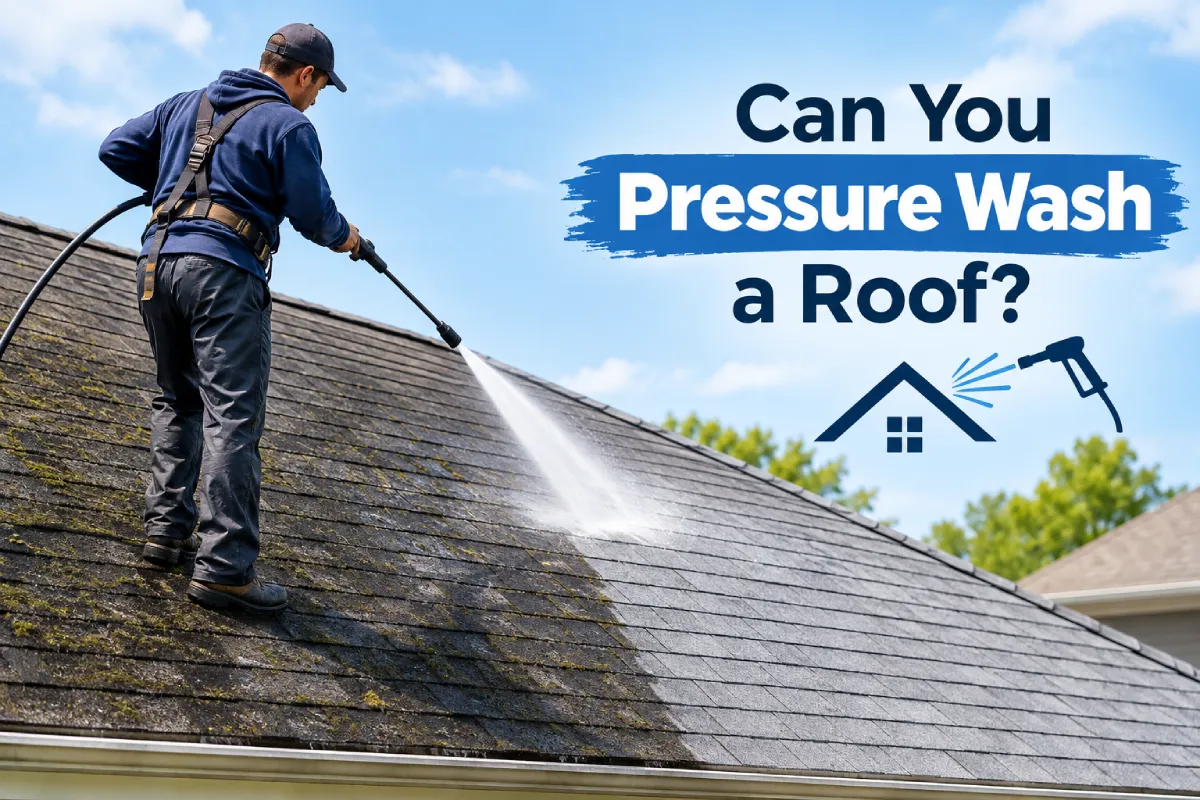
You can, in the sense that the machine will fit and the moss will come off. You should not, and on an asphalt shingle roof, the industry position on this is unusually clear rather than a matter of opinion.
The Asphalt Roofing Manufacturers Association, the trade body representing the major shingle makers, advises against high-pressure washing on asphalt roofing for removing algae or for any other purpose, on the grounds that it damages the roofing and is likely to cause premature failure. Most shingle warranties take the same view, which means a pressure-washed roof can lose its cover.
What pressure actually does to a shingle
An asphalt shingle is a mat, saturated with asphalt, with ceramic granules pressed into the surface while the asphalt is soft. Those granules are not decoration. They are the layer that shields the asphalt from ultraviolet light, and once they are gone, the material underneath ages quickly.
They are held by adhesion to a surface that has been weathering for years. A pressure washer removes them very efficiently. Estimates vary, but a single pass at high pressure is commonly described as costing several years of normal weathering, and it does so unevenly, leaving bare patches that fail before the rest of the roof.
Pressure also drives water upward under the courses, which is precisely the direction shingles are not designed to resist. Water pushed under a shingle reaches the decking, and that damage shows up months later as a stain rather than immediately as a problem.
How to tell it has happened
A pressure-washed roof looks excellent for about a fortnight. After that, the signs appear.
- A heavy deposit of granules in the gutters and at the base of the downspouts.
- Patches where the shingle surface looks darker or smoother than the surrounding area.
- Visible lines or streaks matching the path the operator took.
- Lifted or displaced shingles, particularly along the bottom courses.
- Moss returning within a season because the roots were never killed.
That last point is the practical irony. Pressure removes the growth you can see and leaves the root structure in place, so the moss comes back and the roof is now less able to resist it.
What to do instead
The method the manufacturers do endorse is chemical rather than mechanical, usually called soft washing. A cleaning solution is applied at low pressure, left to work for a period, and then rinsed off at something closer to garden hose pressure. The chemistry kills the growth; the water only carries the dead material away.
ARMA has published guidance on the solution and the method, and manufacturers publish their own instructions for their products. Read the instructions for the shingles actually on your roof before anybody applies anything, because that document is what a warranty claim will be judged against.
Two practical cautions. The runoff needs managing, since the solutions used will damage planting below the eaves, so vegetation gets wetted down and rinsed. And a soft wash does not restore granules that have already gone; it stops further biological damage on a roof that still has life in it.
There is more detail on doing this carefully in the guide to removing roof moss without damaging shingles.
Other roof coverings
The answer is not identical across materials, though the direction of travel is the same.
Tile and slate are harder surfaces and tolerate more, but pressure still drives water under the units and into the roof space, and it strips the surface coating from concrete tiles, which then absorb water and grow moss faster than before. Metal can be marked and its coating damaged, and pressure at a seam or fastener forces water into the assembly.
Cedar is the most vulnerable of all. Pressure raises the grain, erodes the soft summer wood, and shortens the life of the roof considerably, which matters on a covering that depends on drying properly.
Never do this yourself on a roof
Set aside the damage to the covering. Operating a pressure washer while standing on a sloped roof means holding a tool that pushes back at you, on a surface that is wet and now slick with dislodged growth, usually while looking down. It is one of the more reliable ways to fall from a roof. If a roof needs cleaning, it is a job for somebody working from a ladder or a platform with the right equipment, and increasingly it is done from the ground.
Before you book anybody
Roof cleaning attracts operators with a machine and a van, and the word cleaning covers both approaches. Ask directly.
Ask what pressure they will use, and be wary of an answer that avoids a number. Ask what solution they apply and how long it dwells. Ask whether the method complies with the shingle manufacturer’s instructions and whether it affects the warranty. Ask how they protect the planting below. Ask what they do about the cause, because moss on a shaded slope will return unless the shading is dealt with.
If the answer to the first question is that they use a pressure washer on shingles, that tells you what you need to know.
Conclusion
Pressure washing an asphalt roof strips granules you cannot replace for an appearance that lasts a season. The manufacturers advise against it, the warranties generally exclude it, and the moss comes back anyway.
Use a low-pressure chemical clean applied by somebody who can tell you what they are spraying, and deal with the shade that let the growth establish. If the roof is far enough gone that cleaning will not help, that is a different conversation about repair versus replacement, and cleaning it hard will not delay the answer.