Is It a Roof Leak, or Attic Condensation?

A damp patch appears on an upstairs ceiling in winter. The obvious conclusion is a roof leak, and the obvious response is to call a roofer. Quite often that is the wrong conclusion, and the roofer who arrives has nothing to fix.
Water on the underside of a roof in cold weather has three plausible sources: rain or meltwater getting in through the covering, condensation forming inside the roof space, or an ice dam backing water up under the shingles. They look similar from below, and they need completely different remedies. Working out which one you have, before anybody quotes for anything, is the most useful hour you can spend.
What condensation actually is
A household produces a surprising quantity of water vapor. Cooking, showering, washing and drying clothes, houseplants, breathing. That vapor is carried in warm air; warm air rises, and it makes its way into the roof space through every gap in the ceiling below.
When it reaches the underside of a cold roof deck, it does exactly what it does on a cold window. It condenses. In hard weather it freezes instead, and a layer of frost builds on the underside of the sheathing and on the points of every nail coming through it. Nothing has leaked. The water was already in the house.
Then the temperature rises, the frost melts all at once, and it rains inside your roof. That is the moment most people discover the problem, and it is why the timing of a stain is such a strong clue.
The timing test
This is the first and best question. When did the stain appear, in relation to the weather?
A roof leak tracks precipitation. It appears during or shortly after rain or melting snow, and it reappears the next time it rains. If it is raining hard and nothing is happening, and the stain grew during a dry cold snap, it is not a leak.
Condensation tracks temperature rather than rainfall. It typically shows up during a thaw that follows a stretch of severe cold, and it can appear when there has been no precipitation at all for days. A stain that grows on a dry morning after a freezing night is condensation until proven otherwise.
An ice dam needs snow lying on the roof and a freeze-thaw cycle, so it appears in the same conditions as condensation but only when there is snow cover.
The pattern test
Where the water shows is the second clue, and it is nearly as reliable.
A leak produces a single stain in a consistent place, usually traceable back to a feature: a chimney, a vent pipe, a valley, a skylight, a wall junction. It repeats in the same spot because the entry point does not move.
Condensation produces something different. Several small stains scattered across the middle of the ceiling, or a general dampness with no obvious center, because the moisture is forming across the whole underside of the deck rather than entering at one point. It is often worse in the rooms that generate the most moisture, so a bathroom or a kitchen ceiling is a common location.
Ice dam water tends to arrive at the outer edges: the top of an exterior wall, an outside corner, or above a window, because it enters at the eave and runs down inside the wall cavity before it appears.
The attic test settles it
If you can get into your roof space safely, this is where the answer usually is. Go up on a cold morning with a flashlight, stay on the joists or on attic flooring, and look at the underside of the deck.
What the deck tells you
- Widespread frost or beads of water across the sheathing, and glittering frost on the points of the nails, is condensation. It will be general rather than local, often heaviest near the ridge, and it will be present in places nowhere near your ceiling stain.
- A single dark track running down a rafter or along the deck, with dry material either side of it, is a leak. Water entering the roof follows timber, sometimes for several feet, before it drips. Following that track uphill leads to the entry point.
- Wet insulation concentrated at the eaves, with the rest of the roof space dry, points to an ice dam.
Dark staining or bloom on the deck that has clearly been there a long time tells you this is not new, whichever cause it turns out to be.
What makes condensation likely in the first place
Condensation is a ventilation problem wearing a moisture problem as a disguise, and it usually has more than one contributing cause.
- Bathroom fans or clothes dryers that terminate in the roof space instead of outside, which is common and is the single worst offender.
- Blocked soffit vents, most often crushed shut by insulation pushed into the eaves during an upgrade.
- Exhaust ventilation with no intake, so nothing is drawing air through.
- Gaps in the ceiling around light fixtures, the attic hatch, pipework and wiring, which let moist air up in quantity.
- A newly airtight house. Weatherstripping and new windows reduce the accidental ventilation that used to carry moisture away.
- High indoor humidity from drying laundry indoors or an unvented bathroom.
That last point catches people out after energy efficiency work. A house that never had a condensation problem can develop one within a season of being sealed up, because the moisture that used to leak out now has nowhere to go.
How to fix condensation
No roofing work will solve it, which is why identifying it correctly matters so much. The fix has three parts.
Reduce the moisture at source. Vent bathroom fans and dryers to the outside, through the wall or the roof, not into the attic and not into a soffit where the air is drawn straight back in. Use exhaust fans and run them long enough. Stop drying laundry indoors without ventilation.
Stop the moist air reaching the roof space. Seal the gaps in the ceiling: around light fixtures, the attic hatch, plumbing penetrations and wiring holes.
Get air moving through the roof space. Intake low at the soffits, exhaust high at the ridge, with the intake actually clear. This is the part most often found to be missing, and how roof ventilation is supposed to work is worth understanding before you pay anybody to alter it.
When it is genuinely a leak
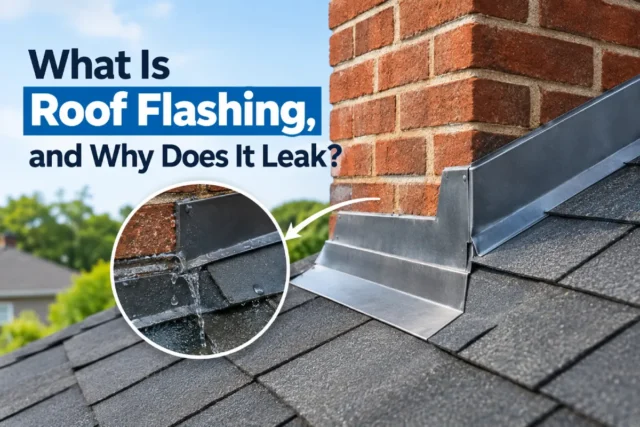
If the evidence points to water coming in from outside, the next job is finding where. Water travels, so the wet patch on the ceiling is rarely below the hole. Flashing at chimneys, walls and valleys is the most common source, followed by cracked vent pipe boots and damaged or missing shingles.
There is a full method for tracking a leak to its source, and it is worth working through before you call anybody, because a roofer who has to find the leak from scratch charges for the time. The common causes are a short list, and most leaks turn out to be on it.
Why getting this wrong is expensive
The failure mode here is not subtle. A homeowner with a condensation problem calls a roofer; the roofer finds no obvious defect but suggests the covering is getting on, and a roof is replaced. The following winter the ceiling stains again, because nothing that caused it has changed.
It is worth being direct that this is a bad outcome nobody set out to produce. A roofer inspects roofs, and a stain on a ceiling looks like a roofing question. Arriving with the timing, the pattern, and a description of what your roof space looks like on a cold morning changes the conversation entirely, and it is the sort of thing worth raising when you are deciding who to hire.
Conclusion
Three questions separate the three causes most of the time. Did it appear with rain, or with a thaw? Is it in one repeating spot, or scattered? And what does the underside of the deck look like on a cold morning, general frost or a single dark track?
Answer those before you pay for any work. Condensation is fixed with exhaust fans, air sealing, and ventilation, and it is generally the cheaper problem. A leak is fixed on the roof. Spending leak money on a condensation problem is one of the more common and more avoidable mistakes in home maintenance.