Why Are My Shingles Blistering or Bubbling?
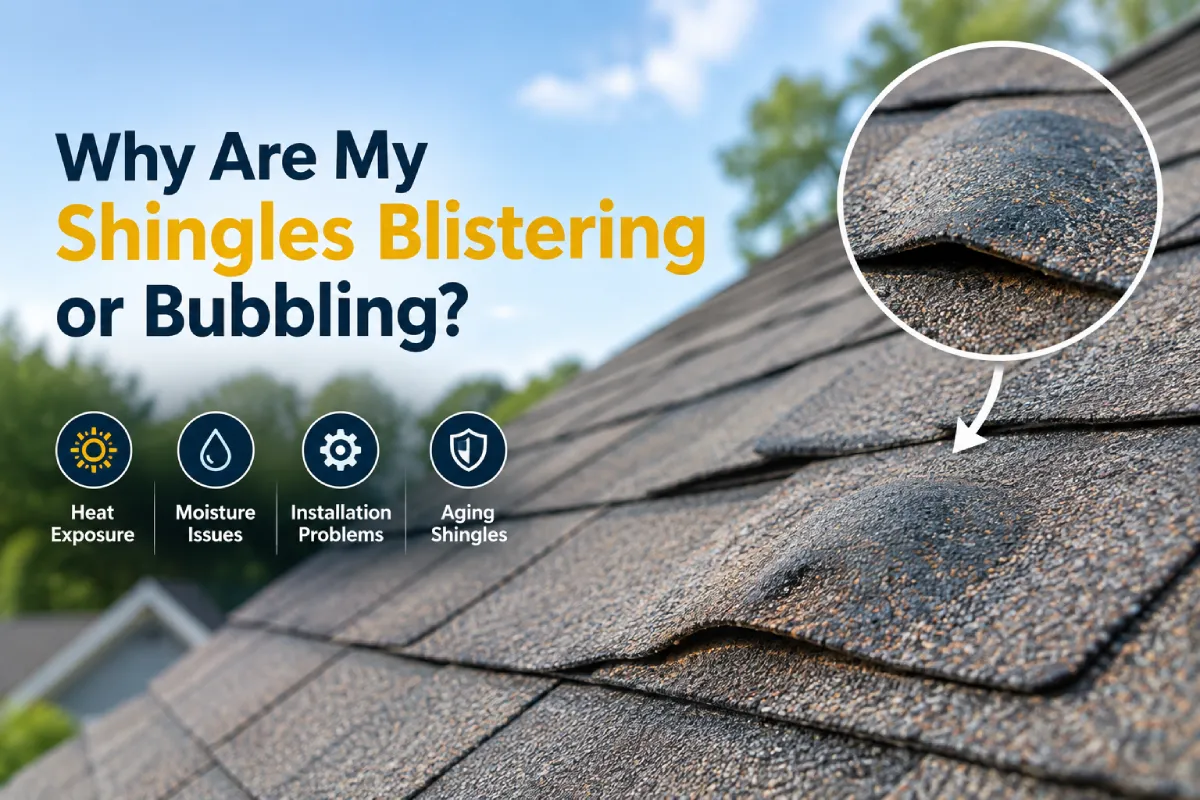
Blisters are small raised bumps on the surface of asphalt shingles. They look like bubbles in paint; they range from the size of a pinhead to something closer to a coin, and they are one of the more misunderstood things that happens to a roof. They are not hail damage; they are usually not a leak, and they are rarely an emergency. They are, however, telling you something about your roof space.
The short version: a blister is a pocket of trapped moisture or gas inside the shingle that expanded when the roof got hot. What matters is not the blister itself but whether it has burst, and why the roof is getting hot enough for it to happen.
What a blister actually is
An asphalt shingle is a mat, saturated and coated with asphalt, with ceramic granules pressed into the surface. If a small pocket of moisture or volatile gas ends up inside that sandwich, it sits there doing nothing until the roof heats up.
Then the sun raises the surface temperature well above air temperature, the trapped pocket expands, and it pushes the asphalt and granules upward into a small dome. That is a blister. If the pressure is enough, the dome breaks open, and the granules that were on top of it are lost.
An intact blister is largely cosmetic. A burst blister is a small patch of shingle with no granule protection, and granules are what shield the asphalt from ultraviolet light. That is the point at which blistering starts to matter, because it accelerates the normal ageing of the shingle in that spot.
Where the trapped moisture comes from
There are three routes, and they are not equally your problem to solve.
Manufacturing
Moisture or volatile compounds can be sealed into the shingle during production, leaving voids that expand later under heat. This is a defect, and it is the basis of a warranty claim if it can be established.
Installation in the wrong conditions
Shingles fitted damp, or stored badly and allowed to take up moisture before they went on, carry that water up onto the roof with them.
Heat from below
This is the one within your control, and it is the most common contributing factor. A roof space that cannot vent becomes extremely hot in summer, and that heat bakes the covering from underneath as well as from above. The shingle spends far longer at high temperature than it otherwise would, and anything trapped inside it has more opportunity to expand.
Blistering or hail damage
This confusion is worth resolving carefully, because the two have opposite consequences with an insurer. Hail damage is generally a covered peril. Blistering is generally treated as wear, a manufacturing issue, or a ventilation problem, and is generally not covered.
Four differences separate them reliably.
- Direction of the mark. A blister is raised. A hail bruise is a depression where the granules have been driven into the mat.
- How it feels. A blister is firm. A hail bruise feels soft and slightly spongy when pressed, because the mat beneath it has cracked.
- Distribution. Blisters are scattered randomly. Hail arrives with the storm and concentrates on the slopes that faced it.
- Relationship to the sun. Blistering follows heat, so it is worse on the slopes that get the most sun and above the hottest parts of the roof space. Hail has no relationship to sun exposure at all.
There is a further check that requires no roof access. Hail hard enough to bruise shingles dents soft metal, so gutters, vent caps and air conditioning fins will show it. If those are untouched, hail is unlikely to be your explanation. There is more on separating storm damage from ordinary wear if you are weighing up a claim.
Is it actually a problem?
Usually less of a problem than it looks. Scattered intact blisters on a roof that is otherwise performing are a cosmetic issue and not a reason to replace anything.
The situations that do warrant attention are these. Widespread blistering across whole slopes, particularly on a relatively young roof, suggests either a material problem or a serious heat problem and is worth investigating. Blisters that have burst in large numbers mean meaningful granule loss, and that shortens the life of the covering. Blistering combined with other symptoms, such as curling, cracking or heavy granule accumulation in the gutters, is a sign the roof is ageing quickly rather than a standalone issue.
The awkward part is that blistering cannot be repaired. You cannot un-blister a shingle. You can only address the cause and, if enough damage has been done, replace the covering when the time comes.
The ventilation connection
Because heat from below is the factor you can act on, this is where the useful work is.
A roof needs air entering low at the soffits and leaving high at the ridge. When that path is complete, the space beneath the deck stays much closer to outdoor temperature. When it is not, the space becomes an oven, and everything above it ages faster.
The failure is nearly always at the intake. Ridge vents are visible and get fitted. Soffit vents are easy to block and get blocked routinely, most often by insulation pushed into the eaves during an upgrade. A roof with excellent ridge ventilation and blocked soffits has no ventilation at all, because there is nothing to draw through. How much ventilation a roof needs, and how to tell whether yours is working, is worth reading if blistering has appeared on a roof that is not old.
Checking this costs nothing. Go into the roof space on a hot afternoon. If it is dramatically hotter than outside, you have found your contributing cause.
Warranty claims
Manufacturers do cover blistering caused by a material defect, and they generally exclude blistering caused by inadequate ventilation. That distinction is the whole argument, and it is why manufacturers ask about ventilation early in any claim.
If you want to pursue one, you need the original documentation: the product, the date of installation, and the paperwork from the installer. Photographs of the affected slopes help. So does evidence that the roof space is adequately ventilated, which strengthens the case that the problem came out of the factory rather than out of your loft.
Be realistic about the outcome. Most shingle warranties are prorated after the early years, so the value recovered on a roof partway through its life is often modest, and the labour to replace is frequently excluded.
What to do now
Look at the pattern rather than the individual blisters. Note which slopes are affected and whether they are the sunny ones. Check the gutters for unusual quantities of granules, which tells you whether blisters are bursting. Check the roof space temperature and whether the soffit vents are clear. Find your installation paperwork if the roof is young enough for a warranty to be live.
Then, if the roof is otherwise sound, do nothing about the blisters themselves and fix the ventilation. If the blistering is widespread and the roof is well into its life, this is one input into a wider repair or replace decision rather than a problem to solve on its own.
Conclusion
Blistering is a symptom, not a failure. Intact blisters are cosmetic, burst blisters cost you granules and therefore lifespan, and the underlying driver is very often a roof space that runs too hot.
Resist two temptations. Do not present blistering to an insurer as hail, because the differences are well understood and the claim will not survive inspection. And do not replace a roof because it looks bumpy. Check the ventilation first, because that is the finding that changes what happens next.