What Does Hail Damage on a Roof Actually Look Like?
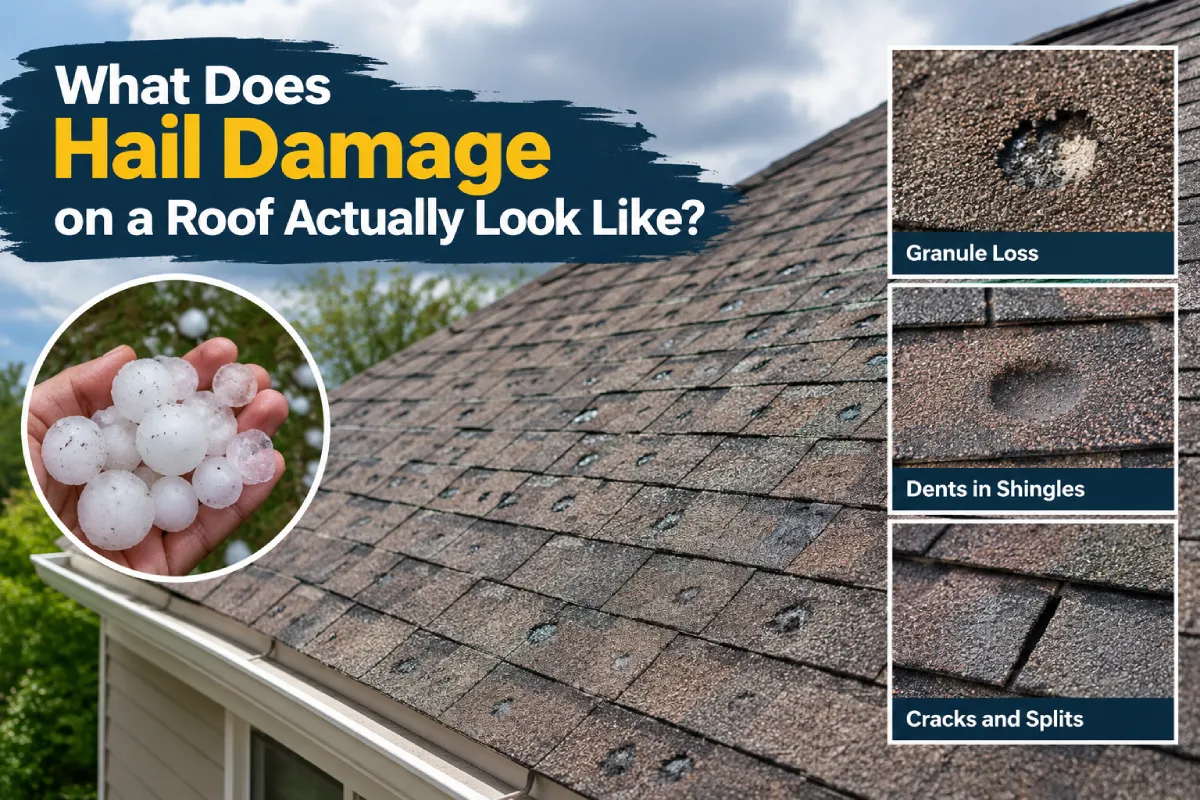
Functional hail damage is far less dramatic than people expect. It is not holes, and it is usually not visible from the ground. What an adjuster is looking for is a small round mark where a stone drove the granules down into the asphalt and cracked the mat underneath, and a roof can be covered in them while looking perfectly normal from the sidewalk.
That is why hail claims turn on evidence rather than impressions, and why so many are argued. The damage that matters is subtle, and several other things look exactly like it.
What a hail bruise actually is
A hailstone hits a shingle and compresses it. The granules at the point of impact are driven into the asphalt or knocked off entirely, and the fibreglass mat beneath cracks. The result is a roughly circular mark, darker than the surface around it because the asphalt underneath is now exposed.
The defining characteristic is not how it looks but how it feels. A genuine bruise is soft, slightly spongy when pressed, because the mat below has failed and there is give in the surface. Inspectors call this the push test, and it is the single most reliable way to tell hail from everything that resembles it.
The damage is functional because the mat is the structural layer. Once it is cracked, that spot will weather far faster than the roof around it, and it will eventually let water through.
The pattern tells you as much as the mark
Hail arrives with a storm, and storms have direction. That produces a distribution nothing else reproduces.
Damage concentrates on the slopes that faced the storm and is lighter or absent on the others. It is random within that area rather than following any line, and it has no relationship at all to sun exposure, roof pitch, or how hot part of the roof gets. If the marks are heavy on one elevation and absent on the opposite one, that is a strong indication of hail rather than wear.
The evidence at eye level
This is the most useful check available to a homeowner, and it requires no ladder at all.
Hail hard enough to bruise shingles leaves marks on softer materials first. Look at gutters and downspouts, vent caps and flashing, the fins on an air conditioning condenser, mailboxes, garage doors, window trim, and any painted metal on the property.
Dents there confirm the hail was large enough to matter, and they are far easier to photograph than a bruise on a shingle. Equally, clean soft metal after a hail storm is a genuine reason to doubt that your roof was damaged, whatever anybody at the door tells you.
Granule loss
A heavy deposit of granules at the base of the downspouts after a hail event is worth photographing, though it needs interpreting carefully.
Every roof sheds some granules, and an older roof sheds more. What points to hail is a sudden large quantity immediately after a storm, on a roof that was not shedding heavily before. That is difficult to prove after the fact, which is another argument for photographing your roof and gutters while nothing is wrong.
What gets mistaken for it
This matters because presenting the wrong thing to an insurer damages your position on everything else in the claim.
Blistering
Blistering is the most common confusion. Blisters are raised bubbles; hail bruises are depressions. Blisters feel firm, bruises feel soft. Blisters follow heat, so they are worse on sun-facing slopes, while hail follows the storm direction. Blistering is generally excluded from cover as wear, defect, or a ventilation problem, so telling the two apart is worth doing before you file.
- Ordinary age produces granule loss spread evenly across whole slopes rather than in discrete circles.
- Mechanical marks from a previous repair, foot traffic, or a dropped tool are usually clustered or in a line.
- Moss and algae mark the surface but do not bruise the mat.
Do not go up to check
Everything reliable in this article can be established from the ground: the soft metal, the granules at the downspouts, the debris, and the general condition through binoculars. The push test requires being on the roof, and after a storm that is a wet surface with loose debris and possible hidden damage. Let a professional do that part. If somebody offers to climb up on the spot to photograph damage for you, that is a reason to slow down rather than agree.
How it gets assessed
Adjusters generally count damage within a defined area of the roof rather than judging the roof as a whole. Where enough qualifying impacts are found within that area, replacement is commonly approved on the basis that spot repairs cannot restore a roof uniformly. Below that threshold, the outcome is usually a repair or nothing.
This is why a roof can have visible hail marks and still produce a declined claim. Cosmetic marking that has not cracked the mat is frequently excluded, and some policies now carry explicit cosmetic damage exclusions. It is worth knowing whether yours does before a storm rather than after.
Conclusion
Hail damage is round, soft to the touch, concentrated on the slopes that faced the storm, and largely invisible from the ground. The fastest way to know whether it is worth pursuing is to look at your gutters, vent caps, and air conditioning unit for dents.
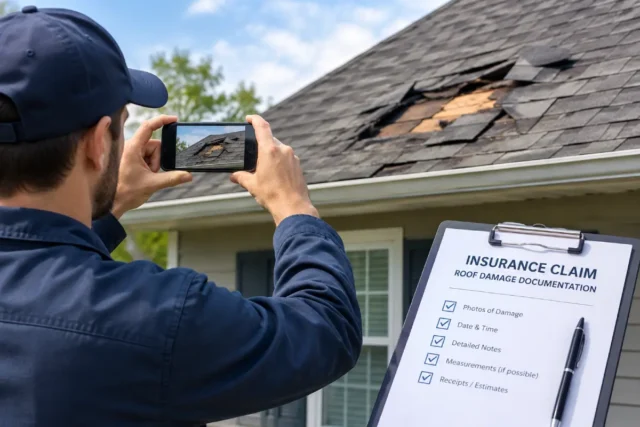
Photograph everything the same day, including the undamaged elevations, and get your own inspection rather than accepting one offered at the door. What you record in the first days is what the claim rests on.