What Should You Do in the First 48 Hours After a Storm?
The first two days decide most of what follows. Not because the roof deteriorates that quickly, but because the evidence does, the deadlines start running, and the people who arrive uninvited are at their most persuasive while everybody is still unsettled.
What follows is a sequence. Safety first, then damage limitation, then evidence, then notification, and only then decisions about contractors and repairs. Taken in that order, almost nothing goes badly wrong.
The first couple of hours: safety only
Before assessing anything, establish that the property is safe to be in and around.
Look for downed power lines anywhere near the house and treat every one as live. Look for structural damage: a sagging roofline, a large branch or debris resting on the roof, cracked masonry, a leaning chimney. If any of that is present, stay out of the affected area and call the relevant emergency service or utility.
Inside, if water is coming through near a light fixture or any wiring, switch off that circuit before touching anything. If a ceiling is visibly bulging it is holding water, and the area below it should be cleared of people and belongings.
Nothing here requires a ladder
Every useful action in the first 48 hours happens on the ground, inside the house, or in the attic. A roof after a storm is wet, littered with loose material, and may have damage you cannot see from above, which is exactly how people fall through decking. Tarping a roof is a job for somebody with equipment and insurance, not something to attempt in the rain. If a contractor suggests you go up to look at something, that alone is a reason to use somebody else.
Limit the damage
Most policies require you to take reasonable steps to prevent further loss, and failing to do so can reduce a settlement. Reasonable does not mean dangerous.
Contain water inside with buckets and towels, move furniture, electronics and anything absorbent out of the way, and lift rugs. Once the leak stops, get air moving with fans and a dehumidifier, because wet building materials begin to grow mold within roughly a day or two.
Outside, clear debris from around the property where it is safe to do so, but photograph it before you move it. If the roof is open and rain is forecast, arrange emergency covering through a roofer rather than attempting it.
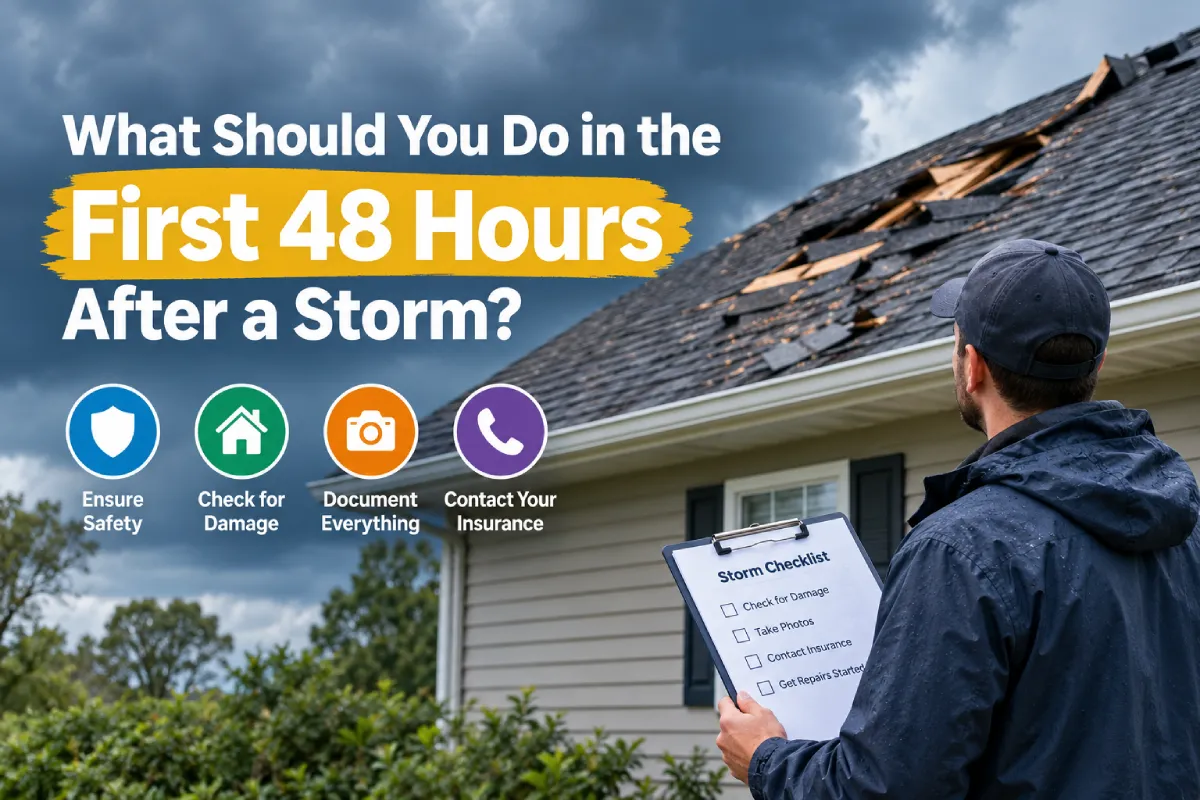
The Storm Damage Checklist is a printable version of the same steps, so nothing gets missed while you are dealing with the aftermath.
Keep every receipt. Temporary repairs, a dehumidifier, emergency accommodation if the house is uninhabitable: these are frequently recoverable, and only if you can evidence them.
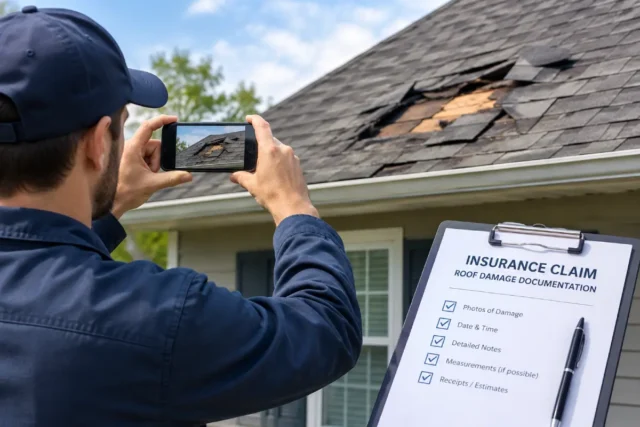
Document everything while it is still there
This is the part that pays for itself, and it has a short window because debris gets tidied and interior damage gets cleaned up.
- Wide shots of every elevation of the house, establishing context, before anything is moved.
- Close shots of specific damage, with something for scale where useful.
- Debris on the ground, in place, before you clear it.
- Dented soft metal: gutters, vent caps, air conditioning fins, garage doors.
- Interior damage as it develops, dated, rather than one photograph at the end.
- The attic, if you can access it safely, looking for daylight and wet timber.
- The date and time of the storm, plus any weather warning or local report.
Do not throw damaged material away until it has been seen. A bag of shingle fragments is evidence.
There is a fuller walk-round routine in what to check on your roof after a storm, and detail on separating real damage from ordinary wear in how to tell if a storm damaged your roof.
Notify, then slow down
Contact your insurer within the period your policy specifies, which can be short and is not always well advertised. Notification is not the same as committing to a claim, and it protects your position while you work out whether claiming is worthwhile.
Ask three things when you call: what the notification deadline is, how your policy settles a roof claim, and what your deductible is for this type of event, since wind and hail deductibles are often a percentage rather than a flat sum. How insurance treats roof claims covers why those answers matter.
Then arrange your own inspection, from a contractor you found rather than one who found you.
What not to do in the first 48 hours
Storms bring people to the door, and they arrive precisely when judgement is worst.
Do not sign anything on the doorstep, including paperwork described as authorizing an inspection, which is sometimes a contract or an assignment of your claim. Do not let a stranger onto your roof on the day they knocked. Do not pay a deposit to somebody you have not verified. And treat any offer to waive, cover or absorb your deductible as disqualifying, because it is misrepresentation to an insurer and illegal in many places.
None of this requires a decision within 48 hours. The damage will still be there. Whether to hire a roofer who knocks covers the pattern in full.
Conclusion
Safety, then containment, then photographs, then notification. Do those four in order within two days and you have protected both the house and the claim.
Everything after that benefits from slowing down. The only genuine deadlines in the first 48 hours are your insurer’s notification window and the day or two before wet material starts growing mold. Every other clock you are shown belongs to somebody trying to sell you something.