What Do You Do About Animals Nesting in a Roof?
Scratching overhead at dawn, a stain spreading on a bedroom ceiling, a smell that arrives and does not leave. Something has moved into the roof, and the instinct is to find the hole and block it up immediately.
That instinct is wrong, and acting on it causes most of the serious damage in this situation. Sealing an entry point while animals are still inside traps them, and what follows is worse than what you started with. There is an order to this, and the blocking comes last.
How they get in
Roofs offer a great many openings, and most of them were put there deliberately. Soffit and gable vents are covered with mesh that perishes. Ridge vents have end caps that work loose. Gaps open where the fascia meets the roof edge, particularly at corners where two runs of board meet. Loose or missing shingles leave the deck exposed. Chimneys without a cap are simply open pipes.
Nothing needs a large opening. A mouse manages a gap the width of a pencil, a bat needs less than half an inch, and a squirrel that finds a small hole will make it a large one, because chewing is what squirrels do.
Overhanging branches are the other half of the problem. They are the bridge that gets an animal onto the roof in the first place, which is why cutting them back is part of preparing a roof for winter.
Working out what is up there
The right response depends entirely on the species, so identification comes first, and you can usually do it from inside the house.
- Timing tells you most of it. Noise at dawn and during the day, with heavy scampering and the sound of things being rolled or dropped, points to squirrels. Noise starting at dusk and continuing through the night suggests rats, mice, or raccoons. A soft fluttering or chittering at dusk, with animals emerging in numbers around sunset, indicates bats.
- Volume tells you size. Light skittering is rodents. Something that sounds like a person walking about is a raccoon or a possum, and it will be near the access point.
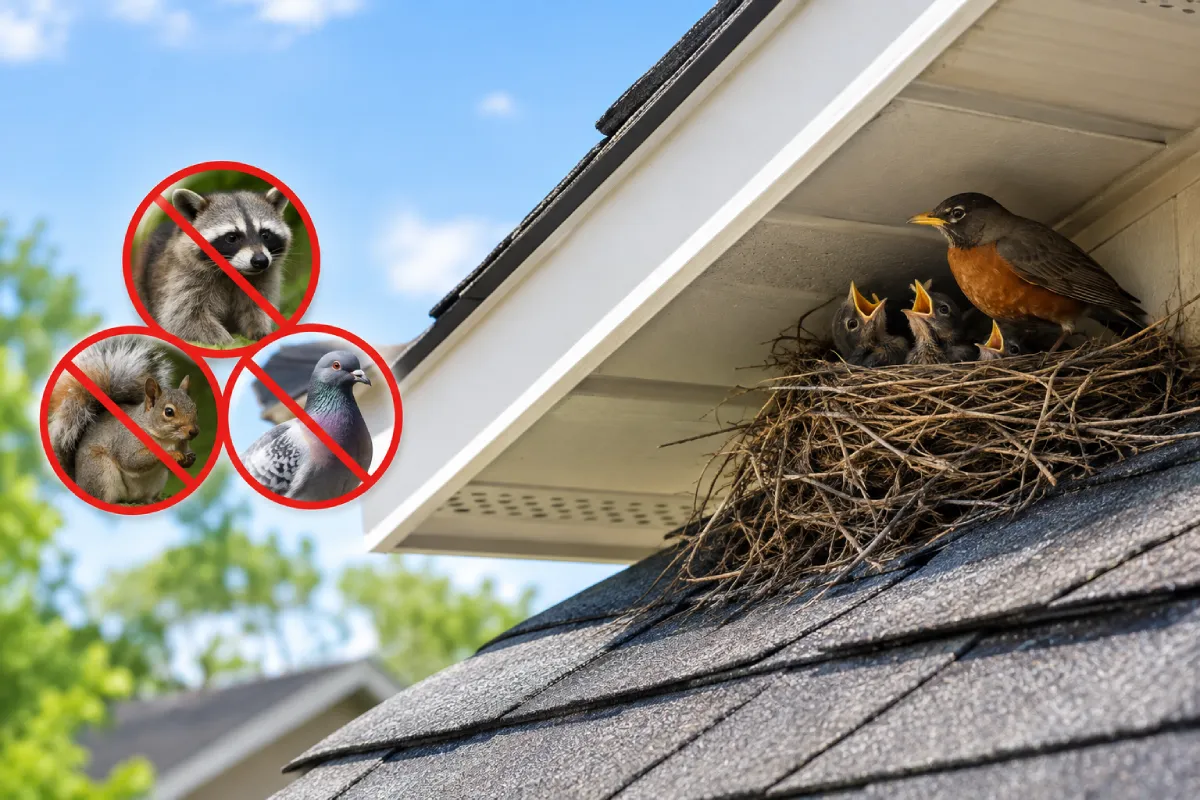
- Birds are usually obvious from outside: repeated trips to the same point under the eaves, and chirping from within during the day.
Look from the ground with binoculars for the entry itself. It is often visible as a dark gap, a torn vent screen, chewed timber, or staining and worn material around a hole where an animal has passed in and out many times.
The legal part, which comes before anything else
This surprises people, and it matters more than any other point here.
Bats are protected in many jurisdictions, and in some the protection is strict enough that disturbing a roost, sealing it, or carrying out roof work near one without the right advice is an offence. Most native bird species are protected while nesting, and an active nest with eggs or chicks generally cannot be removed until the young have fledged. Some other species have seasonal restrictions.
The rules vary by country, state and species, so the honest advice is not a list of what is allowed but a clear instruction to find out before you act. If you suspect bats, stop and get specialist advice. Do not seal, do not spray, and do not begin roof work over the roost.
This is not a technicality. Penalties can be significant, and a roofing contractor who proceeds regardless is creating a liability that lands on you as the property owner.
Never seal them in
The single most common mistake is to find the hole and close it while the animals are inside.
Blocking the entry is the final step, and it happens only once you know everything is out.
The damage they do
The noise is the reason people act. The damage is the reason it is urgent.
- Chewed wiring. Rodents gnaw cable insulation, and this is a genuine fire risk. It is the most serious item on this list by a considerable margin.
- Compressed and contaminated insulation. Animals flatten it to make runs and nests, and urine and droppings ruin it. Insulation that has been matted down has lost most of its value, which shows up as heat loss.
- Blocked ventilation. Nesting material packed into soffit vents stops the airflow a roof depends on, and that leads to condensation problems that get mistaken for leaks.
- Structural chewing. Squirrels widen openings, damage fascia and soffit, and will work on roof decking at the edges.
- Water entry. A hole made by an animal is a hole, and it lets rain in like any other.
- Health risks. Accumulated droppings, parasites, and mites are a real consideration, and they are the reason clearance work needs protective equipment rather than a dustpan.
The right order of operations
Four steps, and the sequence is the important part.
1. Identify
Identify the species and find every entry point, not just the obvious one. Animals commonly use more than one.
2. Get them out
Get them out, legally and completely. The standard method is a one-way exclusion device fitted over the entry, which lets animals leave and prevents them from returning. It takes days rather than minutes, and it must not be used during a breeding season when dependent young may be inside, because that traps them. This is the step where professional wildlife control earns its fee.
3. Clear and repair
Remove nesting material and contaminated insulation, check wiring carefully for chewing damage, and have an electrician look at anything suspect. Then repair the structural damage.
4. Exclude permanently
Now seal the entries with materials that resist chewing. Steel mesh, metal flashing and repaired timber rather than expanding foam or plastic, which a determined squirrel treats as a mild inconvenience. Fit vent covers and a chimney cap, and cut back the branches that provided the route.
Who to call?
This is a two-trade job, and trying to do it with one is why it often fails.
A wildlife control specialist handles identification, legal compliance, and removal. A roofer handles the repair and the permanent exclusion. Some firms do both, and where they do that is simpler, but check that the roofing side is properly qualified rather than incidental. Pest control aimed at killing rather than excluding is the wrong approach in a roof, because it produces exactly the dead animal in an inaccessible void that you want to avoid, and it does nothing about the hole.
When you get quotations, make sure the repair covers every entry point found rather than the one that was reported, and that it specifies chew-resistant materials. The usual questions worth asking a contractor apply here as much as anywhere.
Conclusion
Animals in a roof are a sequencing problem more than a difficult repair. Identify what is there, check the legal position before touching anything, get them out alive and voluntarily, then repair and seal properly with materials that will not be chewed through by spring.
The two mistakes that cost real money are sealing the hole too early and repairing only the entrance you happened to find. Do neither, and this becomes a one-off job rather than an annual event. A seasonal check of vents, fascia, and overhanging branches keeps it that way.