Do Gutter Guards Actually Work?

They reduce the work rather than remove it, and how much depends on the type you fit and what is growing above your house. The claim worth being sceptical of is not that guards help, because they generally do. It is the suggestion that gutters will never need clearing again.
Every guard has the same fundamental problem. Anything with openings large enough to let water through quickly also lets fine material through, and anything fine enough to stop all debris eventually blocks on the surface.
What they genuinely do
Guards keep out the large material that causes complete blockages: leaves, twigs, seed cases, and nesting attempts. On a house under deciduous trees, that is most of the problem, and a good guard turns four visits a year into one.
They also keep birds and rodents out of the gutter line, and they reduce the amount of standing water available to freeze in winter, though they do not prevent ice.
What they do not do
Fine material still gets through on most designs. Roof grit, shingle granules, pollen, pine needles, and windborne dust settle as silt in the bottom of the trough, and silt is what eventually blocks an outlet.
Debris also collects on top of the guard rather than in the gutter. That matters more than it sounds: a mat of wet leaves sitting on a guard is sitting against the roof edge, and it stops water entering the gutter at all. During heavy rain, the water then runs straight past the gutter and lands where it would if there were no gutter there.
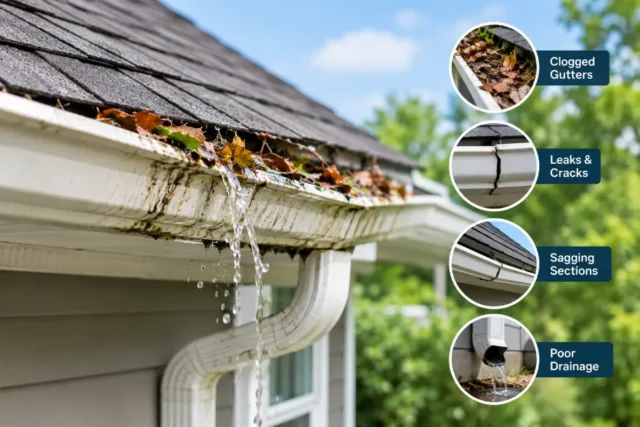
Guards do nothing about a downspout that is already blocked, and nothing about a gutter that has sagged or lost its fall.
The main types, briefly
1. Mesh and micromesh
Mesh and micromesh screens sit over the gutter and let water through a fine grid. They handle leaves well and are the most effective at keeping needles out. Micromesh clogs on the surface with pollen and fine grit, and needs cleaning off rather than out.
2. Perforated and slotted covers
Perforated and slotted covers are cheaper and let more through. They stop leaves and pass a good deal of small debris into the gutter.
3. Reverse curve or surface tension
Reverse curve or surface tension designs let water follow the curve into a slot while debris carries on over the edge. They work well in moderate rain and can overshoot in very heavy rain, which is exactly when you need the gutter.
4. Brush and foam inserts
Brush and foam inserts sit inside the gutter. They are inexpensive and easy to fit, and they trap debris within themselves, so they need removing and cleaning fairly often. Foam degrades and can hold moisture against the gutter.
The cost people do not anticipate
A guard makes the eventual clean harder, because it has to come off first and go back on afterwards. That converts a straightforward job into a longer one, and some contractors charge accordingly or decline to work on guarded gutters at all.
Poorly fitted guards cause their own problems. Anything that lifts the bottom course of shingles to slide underneath is interfering with the roof covering, which can affect a manufacturer’s warranty. Anything that adds weight to a gutter already fixed into tired fascia accelerates the sag.
Before you agree to install
Ask three questions. How does the guard attach, and specifically, does anything go under the shingles, since that can affect the roof warranty? What is the cleaning procedure, and does the guard have to be removed? And what happens in the heaviest rain your area gets, because surface tension designs can shed water past the gutter entirely in a downpour. A supplier who answers all three plainly is selling a product. One who says the gutters will never need touching again is selling something else.
When they are worth fitting
Guards make most sense where clearing is difficult or dangerous rather than merely tedious: a two- or three-story house, awkward access, steep ground below the eaves, or an owner who should not be on a ladder.
They also make sense under heavy deciduous cover, where the alternative is several visits a year, and where the trees themselves cannot reasonably be cut back.
They make least sense on a single-story house with easy access and few trees, where the job is twenty minutes once a year, and the guard costs considerably more than a decade of doing it.
Conclusion
Gutter guards work in the sense that matters: they cut the frequency of clearing substantially, and they stop the blockages that cause overflow. They do not eliminate maintenance; they add a step to the maintenance they do not eliminate, and the marketing routinely overstates both.
Treat them as a way of turning a frequent job into an occasional one, particularly where access is difficult. Then keep checking during heavy rain, because a guarded gutter that has stopped taking water looks exactly like one that is working.