Where Should Roof Water Go After the Downspout?
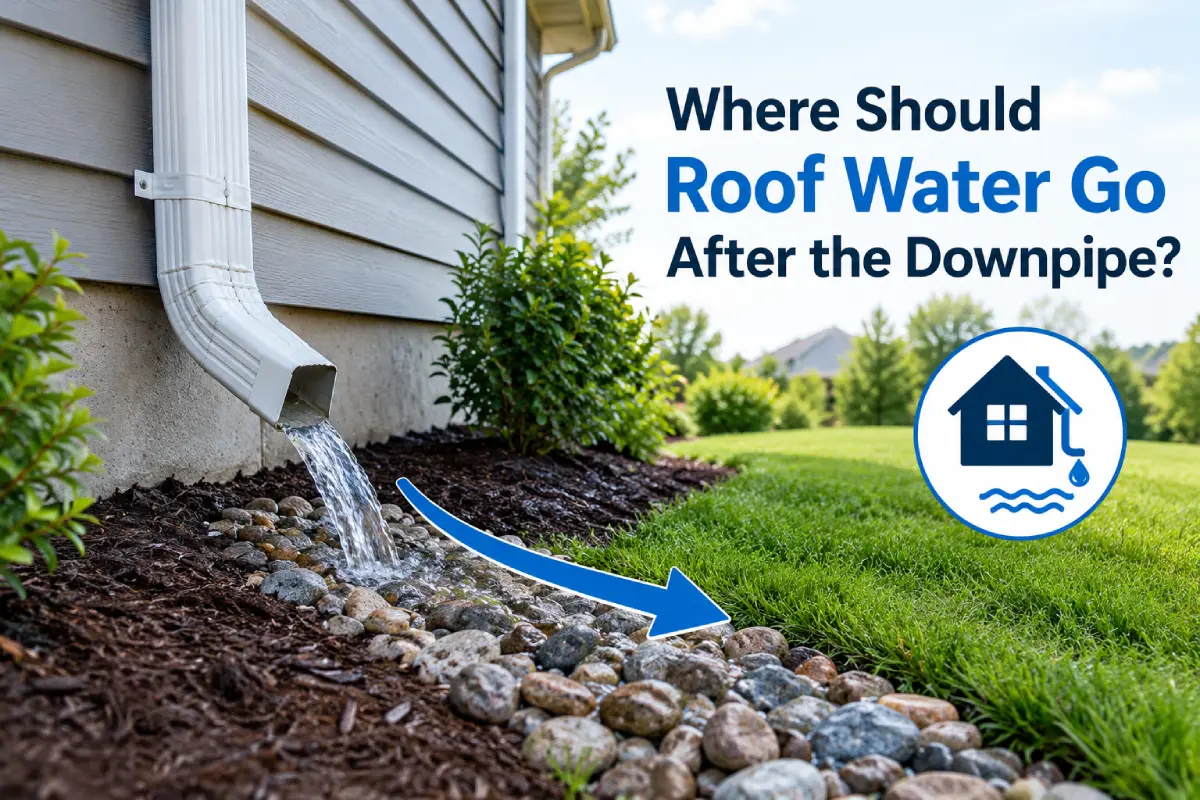
Away from the house, and further away than most downspouts actually manage. A great deal of effort goes into getting water off the roof and into the gutters, and then it is discharged onto the ground a few inches from the wall it just came off.
A roof sheds a substantial volume of water in a heavy shower, and concentrating all of it at one point beside the foundation is the origin of a surprising number of damp problems that get blamed on the walls.
To see how much water your roof actually sheds in a storm, the Roof Rainwater Runoff Calculator turns roof area and rainfall into gallons.
Why the discharge point matters
Water repeatedly soaking the ground against a foundation causes several problems at once.
It saturates the soil, which raises the moisture level in the wall above it and shows up as damp inside. It erodes the ground, undermining paving and washing out planting beds. In clay soils, it contributes to seasonal ground movement, since the soil swells when wet and shrinks when dry. And in cold climates, saturated ground against the wall freezes and expands.
Damp basements and cellars are frequently a drainage problem rather than a structural one, and the fix is often outside rather than inside.
The options, roughly in order of cost
- An extension or shoe at the base is the simplest improvement. A length of pipe or a hinged extension carries water further out before releasing it. It costs very little, and it is better than nothing, though it puts a concentrated discharge at a slightly more distant point rather than solving it.
- A splash block is a shaped block placed under the outlet to spread the flow and stop it from scouring a hole. Cheap and worth having wherever water discharges onto soil, though it does not move the water away.
- A gully connected to a drain takes water into an underground system. Where one exists, the main job is keeping it clear, since gullies block with leaves and silt readily.
- An underground pipe to a soakaway carries water well away from the building and releases it into a pit filled with rubble or a purpose-made crate. This is the proper solution for most houses without a surface water drain, and it is the one that actually addresses the problem.
- A water butt collects roof water for garden use. Useful, and it needs an overflow that goes somewhere sensible, because a full butt in a downpour simply discharges at the base of the wall again.
Soakaways, and where they go wrong
A soakaway needs to be far enough from the building that water dispersing into the ground does not find its way back to the foundation, and building regulations in most places set a minimum distance. Check the local requirement rather than guessing.
They also need ground that actually drains. Heavy clay disperses water very slowly, and a soakaway in clay fills and stays full, which returns you to a saturated area of ground. A percolation test establishes whether the ground is suitable, and it is worth doing before digging rather than after.
Size matters as well, since the pit has to hold the volume arriving during a storm while it disperses. This is a calculation a drainage contractor should be doing rather than estimating.
Two things not to do
Do not connect roof water into a foul drain that carries waste from the house. It is prohibited in most jurisdictions; it overloads treatment systems during storms, and it can cause sewage to back up into the property. Foul and surface water systems are separate for good reason. And do not simply discharge onto a neighboring property or into a shared boundary, which causes both damage and disputes, and is generally actionable. If you are unsure which drain is which, ask the water authority rather than guessing from the cover.
The ground itself
Where the water lands matters as much as how far out it is discharged.
The ground should fall away from the building for a reasonable distance rather than towards it. Ground that has settled over the years, or a flower bed built up against the wall, can direct discharged water straight back. Paving laid to fall towards the house does the same thing more efficiently.
This is worth checking during heavy rain, when the answer is visible rather than theoretical.
What to check on your own house:
- Where each downspout actually discharges, and how far from the wall.
- Whether there is erosion, splashing or standing water at the base.
- Whether gullies are clear, and whether they take water away or back up.
- Whether the ground falls away from the building at that point.
- Whether any water butt has a working overflow that goes somewhere sensible.
- Whether damp inside corresponds to a downspout position outside.
Conclusion
Getting water into the gutter is only half the system, and it assumes the gutter itself is actually taking the water away. Where it goes afterwards decides whether all that drainage achieves anything, and the common failure is discharging a roof’s worth of water directly against the foundation.
Walk round during the next heavy shower and look at the base of each downspout. Erosion, splashing, or a puddle against the wall is a sign that this needs attention, and an extension and a splash block are cheap places to start before anybody digs anything; they belong in the same seasonal routine as clearing the gutters above them.