Why Do Gutters Overflow Even When They Are Clean?
An overflowing gutter that has just been cleared is a common and genuinely confusing situation. The debris is gone, the trough is clear, and water still comes over the front edge in every heavy shower.
When that happens, the blockage was never the problem, or was not the only one. There are six other causes, and they are all diagnosable from the ground.
The downspout, which is the usual answer
A clear gutter feeding a blocked downspout overflows exactly like a blocked gutter, and this is the most common explanation by a wide margin.
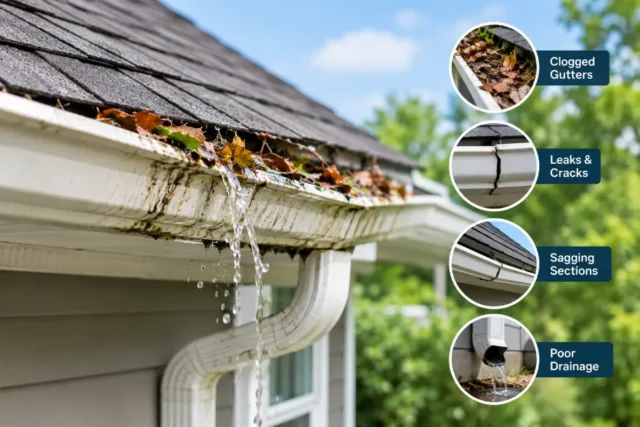
Debris washed along the trough collects at the outlet, in the swan neck at the top, or at the bend where the pipe reaches the drain. None of that is visible when you look into the gutter, which is why it survives a clean.
The test is simple: during heavy rain, look at the bottom of the downspout. If the gutter is overflowing and the downspout is running weakly or not at all, you have found it.
The fall is wrong
A gutter needs a slight continuous slope towards the outlet. Too little and water sits and backs up; too much and it can run past the outlet in heavy flow.
Falls go wrong over time. Brackets loosen, fascia softens, and a section sags, or a repair refixed a run at the wrong height. The evidence is standing water: check a few hours after rain has stopped, and any section still holding water is not draining.
A gutter line that visibly dips in the middle has lost its fall, and cleaning it will not restore it.
The gutter is too small for the roof
Gutter size should be matched to the roof area draining into it, the pitch of that roof, and the intensity of rainfall where you live. Undersized gutters are common, particularly on additions and on houses where a roof was replaced with a steeper pitch or a larger area.
If you are not sure the gutters are big enough for the roof, the Gutter and Downspout Calculator works out gutter size and the number of downspouts from your roof area and local rainfall.
Steep roofs deliver water faster than shallow ones, so the same area needs more capacity. Long runs with a single downspout are another frequent cause, since all the water has to reach one outlet.
If a gutter only overflows in genuinely heavy rain and behaves normally otherwise, capacity is the likely explanation rather than a fault.
Water overshooting the gutter
Sometimes the water never enters the gutter at all, which looks identical from the ground.
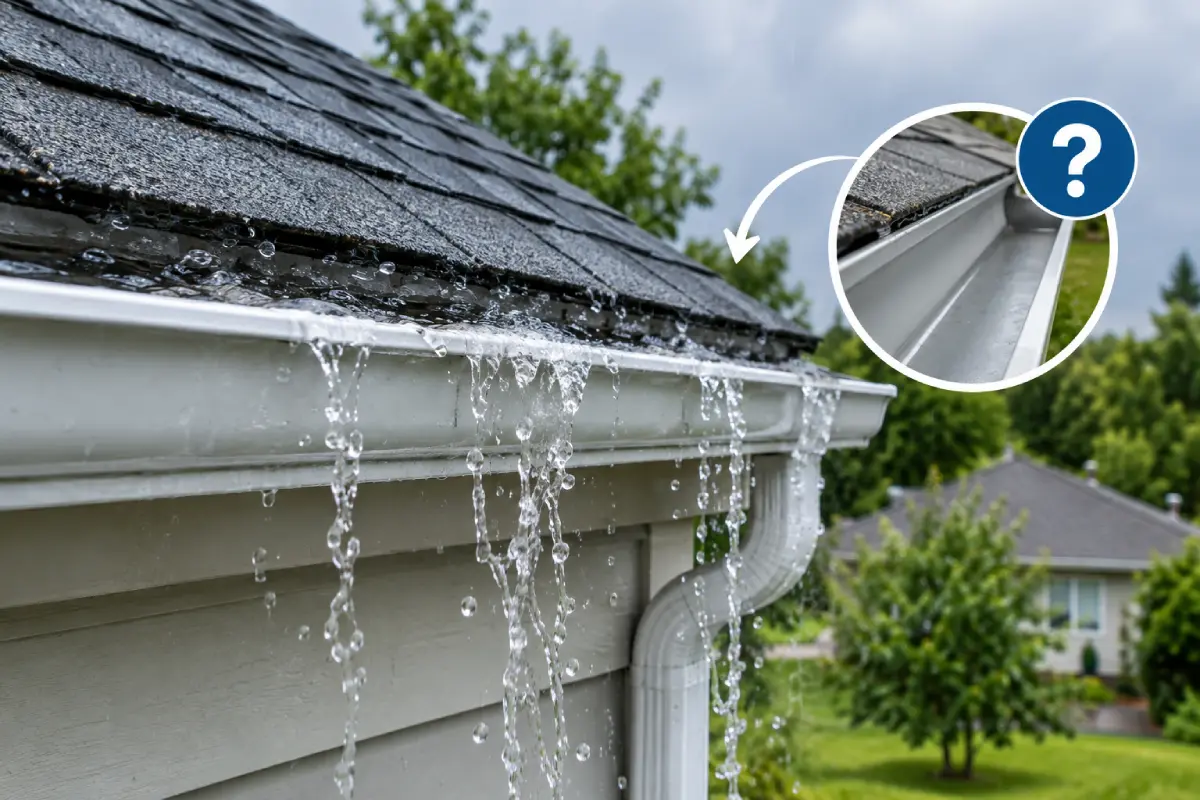
On a steep roof in heavy rain, water can leave the edge with enough velocity to clear the front lip. A missing or incorrectly set drip edge is a common contributor, since its job is to direct water off the roof edge and into the trough rather than letting it run back or shoot past.
A gutter set too low, or set out too far from the fascia after a repair, produces the same effect. So does a valley discharging directly into a length of gutter, which concentrates a large volume into a short section.
The five-minute diagnosis
Watch it during heavy rain, from a window, and note exactly where the water goes. Over the front edge along a whole run points to capacity or fall. Over the edge at one specific point points to a local sag or a valley discharging there. Water appearing behind the gutter, running down the fascia, points to a drip edge or a gutter set too low. And a dry downspout while the gutter overflows points to a blockage below the outlet. Each of those has a different fix, and guessing between them is how people pay to replace gutters that were the wrong size rather than faulty.
Water getting behind the gutter
If water is running down the fascia rather than over the front lip, the problem is at the roof edge rather than in the gutter.
Usually this is a missing or badly fitted drip edge, or a gutter fitted too low relative to the roof line, so water leaving the shingles passes behind the back of the trough. It is worth catching early because this is the version that rots fascia fastest, and it produces the same damage as a blockage without the gutter ever being full.
The winter version
In cold weather, a clean gutter can still overflow because it is full of ice rather than water. Meltwater running off the roof reaches the coldest part of the assembly and freezes, and once the trough is solid, there is nowhere for the next melt to go.
That is a heat problem in the attic rather than a gutter problem, and it is worth understanding as an ice dam question rather than a drainage one.
Conclusion
If a clean gutter overflows, check the downspout first, then look for standing water a few hours after rain, then consider whether the gutter is large enough for the roof draining into it.
Watch it happen once during heavy rain rather than inspecting it afterwards. Where the water goes tells you which of the six causes you have, and that is the difference between a cleared downspout and an unnecessary replacement.