How Much Wind Does It Take to Lift Shingles?
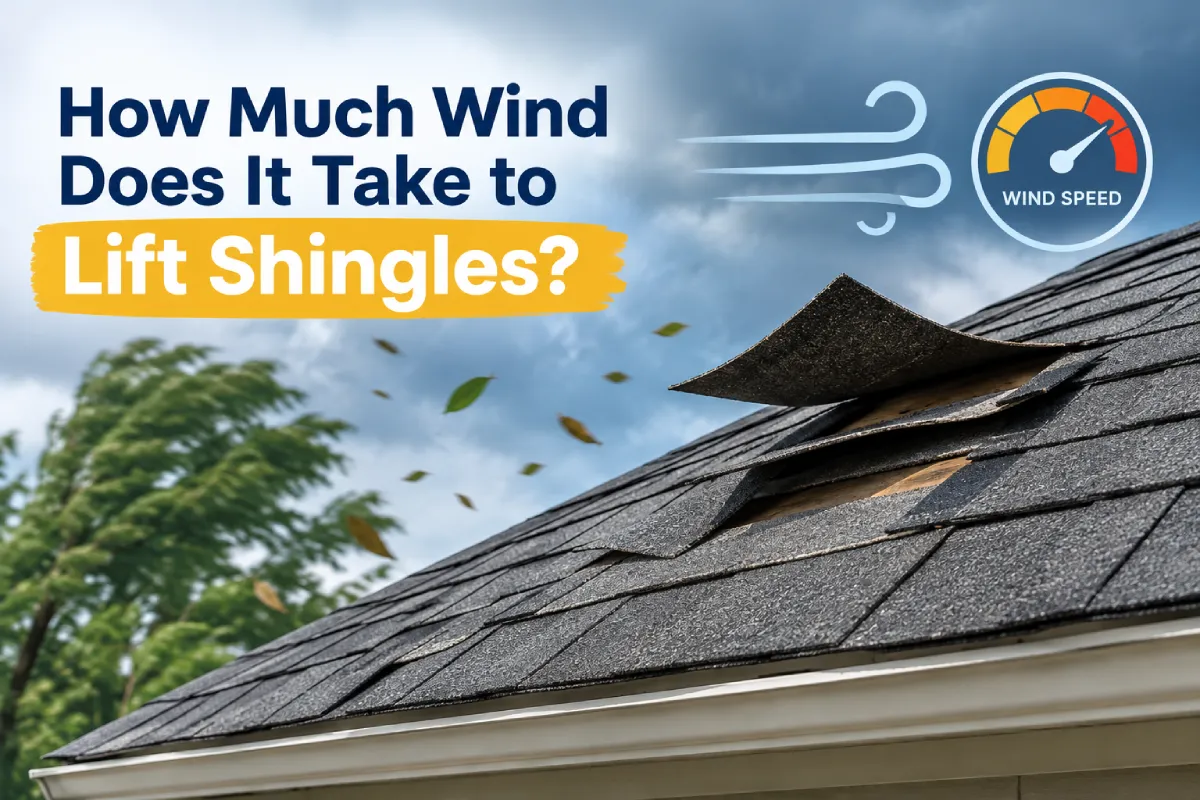
Less than the rating on the packet suggests, and the number that matters is not the one printed on the bundle. Shingles are commonly rated to resist wind speeds well above what most storms produce, and shingles come off roofs at speeds well below those ratings all the time.
The gap between the two is explained by three things: how the shingle was fastened, whether the adhesive strip has sealed, and where on the roof it sits. Wind does not treat a roof as one surface.
How a shingle is supposed to hold
An asphalt shingle relies on two mechanisms. Nails hold it to the deck, and a strip of adhesive on the surface bonds each course to the one above it once the sun has warmed it enough to activate.
That seal is what stops wind from getting underneath. A nailed but unsealed shingle is a flap, and wind lifts flaps easily. This is why roofs installed in cold weather sometimes fail in their first winter: the adhesive never activated, and nothing held the tabs down when the first storm arrived.
Manufacturer wind ratings assume correct nailing, correct nail placement, and a sealed bond. Remove any of those and the rating stops describing the roof you actually have.
Why the rated figure is not a promise
Wind ratings are established under controlled test conditions on correctly installed material. Real roofs differ in ways that matter.
Nailing is the biggest variable. Nails driven too high miss the reinforced nailing strip and hold far less. Nails driven at an angle, overdriven so the head cuts into the mat, or underdriven so the head stands proud, all reduce holding power substantially. Too few nails per shingle does the same, and it is the most common shortcut on a fast job.
Age is the second. Asphalt becomes brittle as it loses volatiles, adhesive bonds weaken, and a roof that held comfortably in its first few years holds noticeably less at fifteen. This is one of the ways poor ventilation shortens a roof: heat accelerates the ageing that reduces wind resistance.
Wind does not hit a roof evenly
Air flowing over a building accelerates around edges and corners, and the pressures there are considerably higher than in the middle of a slope.
That is why failures start in predictable places: along the rake edges, at the eaves, at corners, and along the ridge and hips. It is also why a roof can lose a strip of shingles along one edge and be untouched elsewhere. Once the first shingle goes, the one above it is exposed to wind from underneath, and failure spreads uphill from the gap.
Roof geometry matters too. Steeper pitches, wide overhangs, and complex shapes with many edges all give wind more to work with.
The damage that is not obvious
The important point about wind damage is that most of it leaves the shingle on the roof.
Wind lifts a shingle, breaks the adhesive seal, and drops it back down. From the ground, the roof looks untouched. What has actually happened is that the bond is gone and the shingle is now a flap waiting for the next storm.
The signature to look for is a crease: a horizontal line across the shingle where it was bent back on itself. A creased shingle has failed even though it is still in place. Look also for shingles sitting slightly out of line with their neighbours, corners that no longer lie flat, and tabs that move in a light breeze.
Why this matters for a claim
Creased and unsealed shingles are genuine wind damage, and they are routinely missed because an inspection carried out from the ground finds missing shingles and nothing else. If a claim is being assessed, this is the category most often under-recorded, and it is worth having your own roofer present at the adjuster inspection to point it out. Damage recorded at that stage is far easier to include than damage raised afterwards.
What to do after a windy night
Walk the ground first. Shingle fragments, whole tabs and pieces of ridge cap on the lawn tell you which slope to examine and give you material to photograph.
Then work slope by slope with binoculars, looking for gaps, creases, lifted corners and displaced ridge caps. Check the flashing at chimneys and wall junctions, which lifts in the same conditions. Then look inside for new staining, and in the roof space for daylight.
Photograph everything the same day. There is more on reading that evidence in how to tell if a storm damaged your roof.
Reducing the risk
Most of this is decided at installation rather than afterwards. Correct nail count and placement, and material appropriate to the exposure of the site, are what determine how a roof performs in wind.
Where a roof is being replaced, this is a reasonable thing to raise. Ask how many nails per shingle are specified and whether hand nailing or a nail gun set correctly is being used. Enhanced edge treatments and starter strips at eaves and rakes are inexpensive at the time and are exactly where failures begin. It belongs on the list of things to settle in the contract rather than assumed.
Conclusion
There is no single wind speed at which shingles lift, because the answer depends on nailing, on whether the seal ever formed, on the age of the material and on which part of the roof you are asking about. Edges, corners and ridges go first, and they go at speeds well below any rating.
After a storm, look for creases rather than gaps. A roof that has lost no shingles at all can still have lost the bond holding half of them down, and that is the damage that turns into a missing slope next winter.