Is Synthetic Slate as Good as the Real Thing?
For most houses, and for most owners, synthetic slate is the more sensible choice. It is not as good as natural slate in the ways that matter to a purist, but it is better in almost every way that matters for a budget and a roof structure.
Whether that trade is worth making depends on one question more than any other: how long you intend to own the house. Natural slate rewards ownership measured in generations. Synthetic slate rewards ownership measured in decades.
What synthetic slate actually is
The term covers several different products, which is the first source of confusion when comparing quotes.
Most are composite tiles molded from polymer, often with mineral or rubber content, and colored to resemble split stone. Some are made largely from recycled material. Others are fiber cement, which is a different material with different behavior. They are not one product, and the differences in lifespan and warranty between manufacturers are substantial.
Ask specifically what the product is made from and who makes it, rather than accepting synthetic slate as a description. It is roughly as informative as being told a roof is metal.
Weight, which decides most cases
This is where the comparison is usually settled before any aesthetic question arises.
Natural slate is heavy, and many roof structures cannot carry it without strengthening. When reinforcement is needed, that cost belongs in the comparison from the start, and it often removes real slate from consideration. The full picture is in how long a slate roof lasts and what it costs.
Synthetic products weigh a fraction of that. They generally go onto a conventional structure with no strengthening, which removes both a high cost and an engineering assessment. For a house that was never built for stone, this is the whole argument.
To estimate quantities for either product, the Roof Tile, Slate and Shake Calculator works from your roof area and exposure.
Lifespan and the warranty question
Natural slate is the longest-lived roofing material in common use, comfortably passing a century where the fasteners and the structure keep up. Nothing synthetic matches that, and no manufacturer claims it does.
Synthetic products are typically warranted for a long period, often fifty years, and that is where care is needed. These warranties are usually prorated, so the recoverable amount falls steadily with age, and they cover the material rather than the labor to fit a replacement. A fifty-year warranty is a claim about the product, not a promise of fifty years of a cost-free roof.
They are also, in the main, warranties on products without a full service history behind them. Natural slate has a hundred and fifty years of evidence. Composite roofing has a few decades, and the earliest generations did not all perform as promised.
The question that settles it
How long will you own the house?
Natural slate is bought by people who intend to hand the building on, because the cost per year only works over a span longer than most ownerships. If you expect to move within a decade or two, you will pay for lifespan you never use, and the resale market rarely returns the premium. On that timescale, synthetic slate delivers most of the appearance for a fraction of the cost and none of the structural argument.
How they look
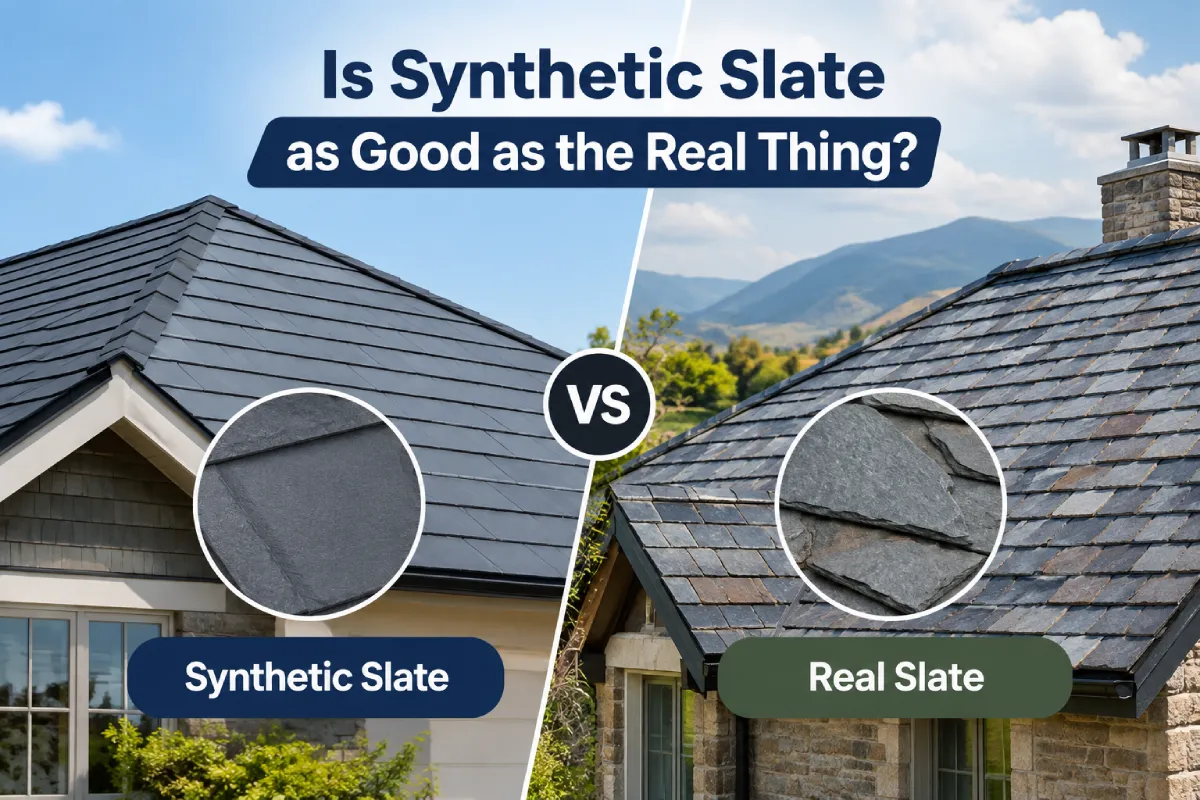
Modern synthetic slate is convincing from the ground and less convincing close up. The pattern is the giveaway: molded tiles are made from a limited number of molds, so a repeating texture becomes visible across a large slope once you know to look for it.
Natural slate varies piece by piece, and it weathers. Color and surface change over decades in a way that manufactured products approximate rather than reproduce.
For a period property, particularly one in a conservation area, this matters practically as well as aesthetically. Planning authorities frequently require natural materials on historic buildings, and that decision may be made for you. Check before you specify anything.
The practical differences
Installation is easier and faster with synthetic. It cuts with ordinary tools, it is lighter to move, and it does not require the specific skill set that slating demands. That widens the pool of contractors considerably, which matters both for the original cost and for every future repair.
Both are fragile underfoot in different ways. Natural slate cracks under concentrated weight and needs somebody who knows how to move on it. Synthetic is more forgiving but can be marked or deformed, and some products become brittle in extreme cold.
Repairs favor synthetic on availability and natural slate on matching. Reclaimed slate can be sourced and blended; a discontinued composite profile may be impossible to match at all in fifteen years.
If you go synthetic
Choose the manufacturer more carefully than the profile. Ask how long the product has been on the market, and ask to see an installation locally that is at least ten years old rather than a sample board.
Read the warranty for the proration schedule, the labor position, and the transfer terms. Ask whether the installer is certified by that manufacturer, since enhanced cover often depends on it, and confirm that the ventilation requirements are being met, because inadequate ventilation is a standard exclusion.
Conclusion
Synthetic slate is not as good as natural slate. It is lighter, cheaper, easier to fit and easier to repair, and for a house that cannot carry stone or an owner who will not be there in eighty years, those advantages decide it.
Choose natural slate for a period building, where the planning position requires it, or where you are genuinely building for the long term, and the structure allows. Choose synthetic for the appearance at a workable cost, and spend the effort on picking a manufacturer with a track record rather than on the profile.