Which Roofing Material Costs Least Over Time?
The cheapest roof to buy is rarely the cheapest roof to own, and the gap between those two things is where most roofing money is actually decided. A covering that costs half as much and lasts a third as long is not a saving.
The honest comparison is cost per year of service, and it is easy to work out. Take the installed price, divide it by the realistic lifespan in your climate, and add what the roof needs spending on while it is up there. That last term is the one most comparisons leave out.
To run the comparison with your own prices, the Roof Lifetime Cost Calculator divides installed cost by expected lifespan for each material.
How to do the sum properly
Installed cost divided by expected years gives you a first number. It is useful, and it is incomplete, because it treats every roof as maintenance-free and assumes you will be there for the whole life of it.
Three adjustments make it honest. Add lifetime maintenance, which varies enormously between materials. Add the cost of the structure if the covering needs one, which applies to the heavy materials. And be realistic about the lifespan for your climate rather than the number on the packet, because published expectations assume competent installation and adequate ventilation, and a roof that cannot breathe will not reach them.
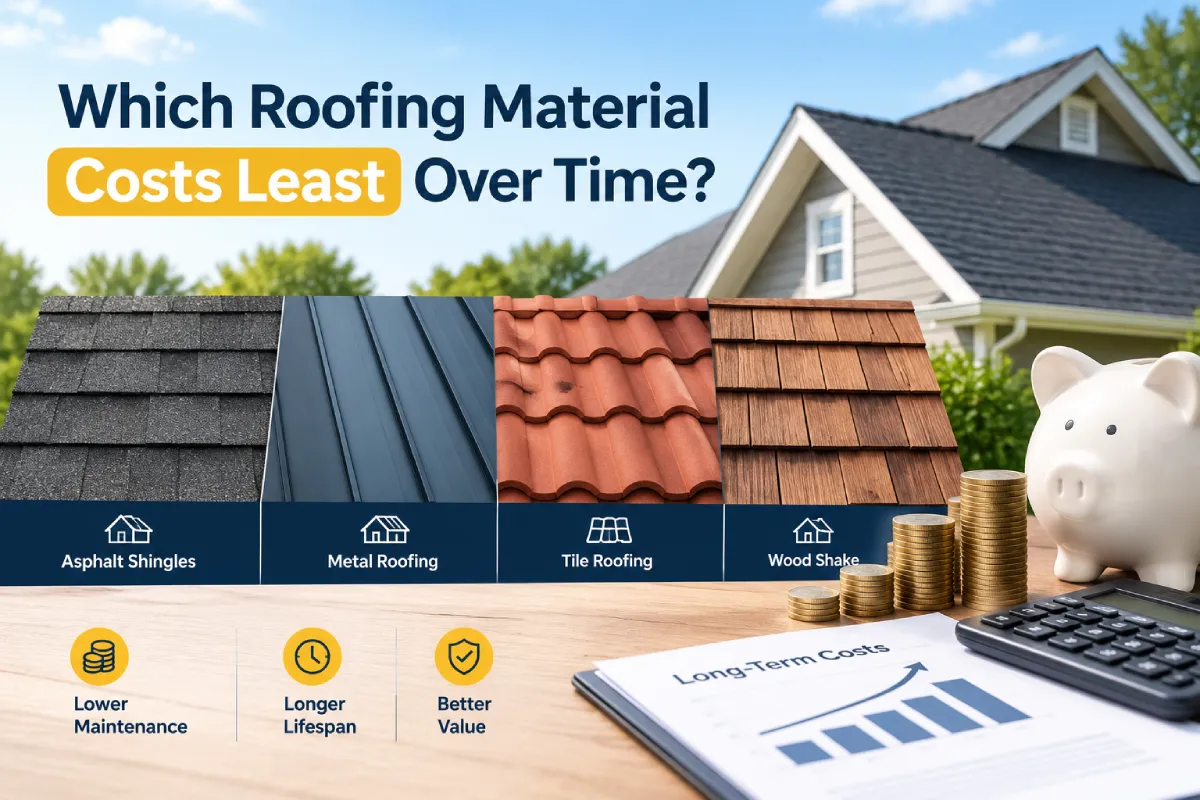
Asphalt shingles
The lowest entry price and the shortest life. Basic three-tab products sit at the bottom of both scales, architectural shingles cost more and last longer, and premium grades last longer still.
On cost per year, mid-range architectural shingles are usually competitive rather than obviously the worst, because the purchase price is so much lower. Maintenance is modest. The weakness is that asphalt is the material most sensitive to heat and ventilation, so the difference between a well-ventilated roof and a poorly ventilated one can be many years of life. There is more detail in how long asphalt shingles last.
Asphalt also carries a hidden advantage: it is the cheapest to repair, and repairs are done by anybody. That matters more than it sounds over thirty years.
Metal
Two to three times the price of asphalt and commonly quoted at forty to seventy years of life. On cost per year, that usually lands well, and it is the material that most often wins a straightforward lifetime comparison.
The caveats are real though. Standing seam with concealed fasteners is a genuinely long-life system; exposed-fastener corrugated panels rely on rubber washers that degrade and need periodic refastening, which is a maintenance cost the headline lifespan ignores. The difference between the two is set out in standing seam against corrugated.
Repairs also need somebody who works in metal, and that is a smaller pool of contractors in most areas.
Clay, concrete and slate
These are the materials that win the arithmetic and lose the practical argument for many houses.
Clay and concrete tiles frequently exceed fifty years, and natural slate can pass a century. Divided over that span, the cost per year is low, sometimes the lowest available. Both are covered further in clay against concrete tiles and slate lifespan and cost.
The problem is weight. If the existing structure cannot carry the load, strengthening it belongs in the comparison from the beginning, and it is often the cost that removes these materials from consideration. All three are also fragile underfoot, so every future job on the roof costs more, and all three need somebody experienced with the material.
Cedar
Middling on price, middling on life, and the highest maintenance requirement of the common materials. Cost per year looks reasonable until the upkeep is included, and cedar is the material where skipping the upkeep shortens the life fastest. It also faces fire restrictions in some jurisdictions. Worth choosing for the appearance rather than the economics.
The number that changes the answer
How long you intend to stay. A material that pays for itself in year thirty is a poor choice if you move in year eight, because the resale market rarely returns the premium in full. Lifetime cost per year is the right measure for a house you will keep. For a house you expect to sell within a decade, the relevant numbers are the purchase price and what a buyer will actually credit you for, and those are different questions.
What moves lifetime cost more than the material
Three factors routinely outweigh the choice of covering, which is why the material comparison should not be made in isolation.
Installation quality is first. A premium material fitted badly will underperform a basic material fitted well, and nailing errors alone can take years off a roof.
Ventilation is second, and it is the one homeowners have most control over at the point of re-roofing. It costs comparatively little, and it decides how fast everything above it ages.
Complexity is third. Valleys, dormers, and a cut-up roof shape cost more on every covering and give water more places to find, so the same material costs more per year on a complicated roof than a simple one. The full picture is in what affects the cost of a replacement.
Conclusion
On pure arithmetic, the long-life materials usually win, with metal the most broadly practical and tile or slate the lowest cost per year where the structure allows them. Asphalt wins on entry price and on ease of repair, and mid-range architectural shingles are more competitive over time than their reputation suggests.
Run the sum for your own house with your own timescale, and include ventilation and installation quality in the comparison rather than treating them as extras. Those two decide whether any material reaches the lifespan you paid for.