Should You Get on Your Own Roof to Check It?

Almost certainly not, and the reason is not liability language. Roofing is consistently among the most dangerous occupations, and falls from height are the reason. Professionals who do this every day, with harnesses and staging and the habit of it, still fall.
The more useful point is that climbing up rarely tells you much. Nearly everything a homeowner needs to know about a roof can be established from the ground, from a window, or from inside the attic. Going up adds risk without adding information.
What you actually gain by going up
Very little, unless you already know what you are looking at.
Standing on a roof gives you a close view of the covering. It does not let you see under the shingles, inside the flashing detail, or at the condition of the deck, which is where most consequential problems live. A homeowner on a roof typically confirms what was already visible with binoculars and misses the things a roofer would notice.
Meanwhile, you are adding a load the roof was not designed to carry in that spot, on a covering that damages under foot traffic. Walking on tile cracks it. Walking on cold asphalt shingles breaks the seal between courses and can crack them outright. Walking on an aged roof loosens granules. It is genuinely possible to create the problem you climbed up to look for.
What makes it dangerous
The pitch is the obvious factor and not the only one. Anything above a moderate slope is difficult to stand on and impossible to recover on once you start moving.
- Morning dew, which makes a dry-looking roof slick and catches people out constantly.
- Moss and algae, which are slippery even when they look dry.
- Loose granules, which behave like ball bearings underfoot.
- Frost, snow or ice, which put a roof out of bounds entirely.
- Soft or rotten decking, which gives way without warning and is invisible from above.
- Skylights and fragile plastic roof panels, which do not carry weight.
- Electrical service cables, which usually enter the house near the roofline.
- The ladder, which is where a large share of falls actually begin.
The height matters less than people assume. A fall from single-story height onto a patio or driveway is enough to cause life-changing injury.
If you go up anyway
Never go up alone, and tell somebody before you do. Do not go up on a wet, frosty, windy, or hot day, when softened shingles damage underfoot. Set the ladder on firm, level ground at roughly a one-in-four angle, extend it three rungs above the roof edge, and tie it off. Wear soft-soled shoes with grip. Stay off anything steep, and never step on a skylight or near a service cable. If at any point you are working out how to get back down, you should not have gone up.
What to do instead, which works better
A pair of binoculars and a slow walk round the house is the single most productive roof inspection available to a homeowner, and it is the basis of every seasonal check worth doing.
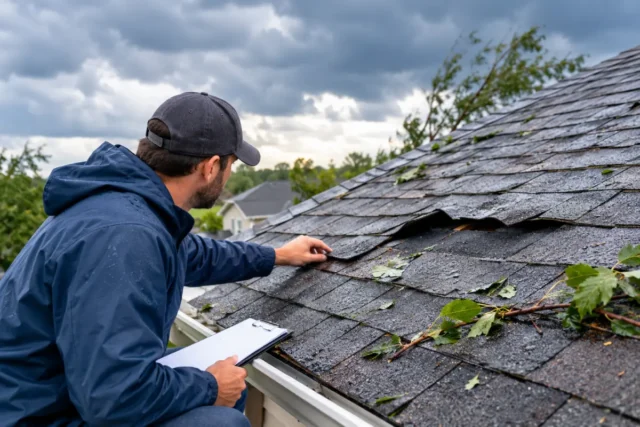
Work one slope at a time rather than scanning. Look for missing shingles, units out of line, lifted corners, a horizontal crease across a shingle, damage to ridge and hip caps, lifted or rippled flashing at chimneys and wall junctions, and perished collars around vent pipes.
Then look from upstairs windows, which often give a better angle on the lower slopes than the ground does. A phone camera on a pole, or a drone if you have one, covers the rest. Photographs are more useful than a live look anyway, because you can enlarge them.
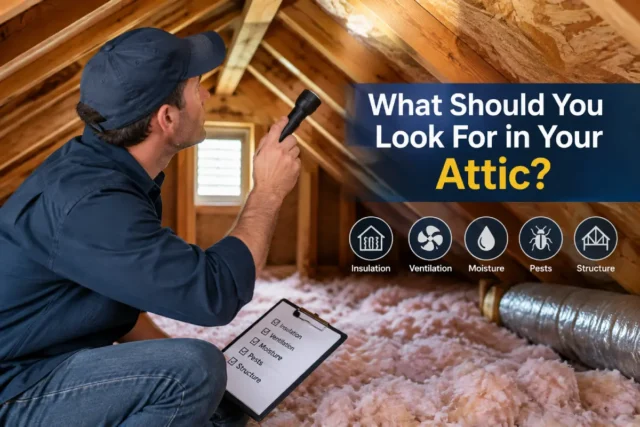
Finally, and most usefully, go into the attic. That is the one place a homeowner can safely get close to the structure, and it tells you more about the next twenty years than the shingles do.
The gutter question
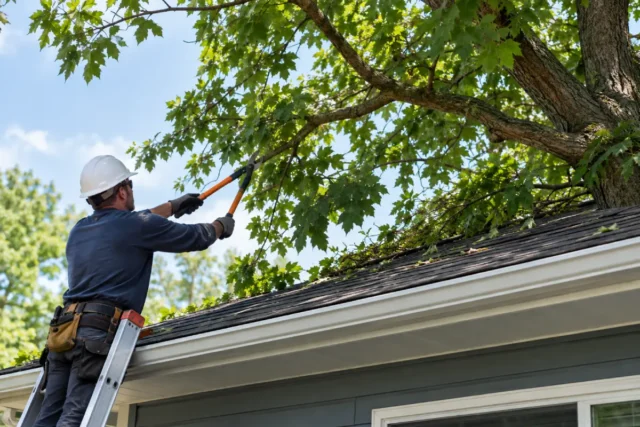
Clearing gutters is the job that most often puts a homeowner on a ladder, and it is worth separating from getting onto the roof itself.
Working from a properly set ladder at single-story height, with somebody else present, is a different proposition from standing on a slope. It is still where a great many household injuries happen, largely because people overreach sideways rather than moving the ladder. Move the ladder. If the gutters are above single-story, or the ground is soft or sloping, pay somebody.
When to call somebody instead
Call a professional when you can see damage but not its extent, when there is an active leak, after any significant storm, when the roof is steep or above single-story, when you suspect the deck is soft, or when you are being asked to sign off on work you cannot verify.
An inspection is inexpensive relative to the roof, and a roofer brings a trained eye rather than just access. If you are choosing somebody for this, the same care applies as for larger work, and it is worth knowing what to ask before hiring and how to check they are insured.
Conclusion
The honest answer is no, and not as a formality. The information is available from the ground and from the attic; the risk of the alternative is serious and permanent, and an untrained eye at close range still misses what matters.
Buy binoculars, learn what your roof normally looks like, and go up into the attic on a cold morning instead. That is the inspection that catches problems early, and nobody has ever fallen off it.