Should You Cut Back Trees Hanging Over Your Roof?
Almost always, yes, though rarely for the reason people expect. The worry is usually a branch coming down in a storm. The damage that actually happens is slower and quieter than that, and it happens every day the tree is there.
A branch over a roof does four things: it drops debris into the gutters, it keeps a section of roof permanently damp and shaded, it abrades the covering whenever the wind blows, and it gives wildlife a bridge onto the house. Only the fourth is obvious, and only the first is easy to reverse.
Shade is the real problem
A slope that never dries stays biologically active. Moss, algae and lichen establish on damp shaded roofs and struggle on ones that get sun and airflow.
Moss is not merely cosmetic. It holds water directly against the covering, and as it thickens it works between the courses and lifts the edges of shingles or tiles, which opens a path for water. By the time moss is visibly thick, removing it is a careful job rather than a quick one, and doing it wrongly damages the roof more than the moss did.
The pattern is easy to recognize. If one slope of your roof looks green and tired while the others look fine, look up and see what is shading it.
Branches sand the roof
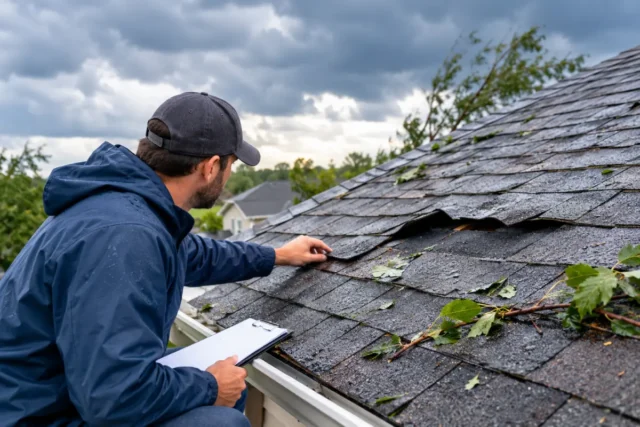
A branch that touches the roof does not need a storm to cause damage. Ordinary wind moves it back and forth across the surface constantly.
On asphalt shingles this scours away the granules, which are the layer protecting the asphalt from ultraviolet light. The result is a bare patch that ages far faster than the roof around it. On metal it removes coating and starts corrosion. On tile and slate it chips edges.
The giveaway is a clean arc of wear on the roof, matching the reach of the branch above it.
Debris, gutters and what follows
Leaves, needles and seed cases fill gutters, and a full gutter holds water against the fascia and the roof edge. Conifers are worse than they look, because needles drop year-round and pack tightly.
Debris also collects in valleys, where two slopes meet and water concentrates. A valley holding a wet mat of leaves is a slow leak waiting for the right storm.
The bridge onto the roof
Squirrels are the main reason to care. They do not usually climb a wall, they run along a branch. Cutting the branch back removes the route, which is far more effective than dealing with what happens after they find a gap in the soffit.
Most guidance suggests keeping branches several feet clear of the roof surface. The precise number matters less than the principle, which is that nothing should be able to touch the roof when the wind blows, and nothing should offer a short jump.
When cutting is the wrong answer
There are real reasons to pause before ordering work.
Mature trees are often protected, particularly in conservation areas or where a preservation order applies, and unauthorized work on a protected tree carries serious penalties. Boundary trees may not be yours to cut beyond your own airspace. Nesting birds are protected during the season in most jurisdictions, and that restricts when work can be done.
Heavy reduction can also destabilise a tree or kill it slowly, which trades a roof problem for a larger one. A tree surgeon will tell you what the tree can take; a general handyman with a chainsaw will not.
This is not a do-it-yourself job
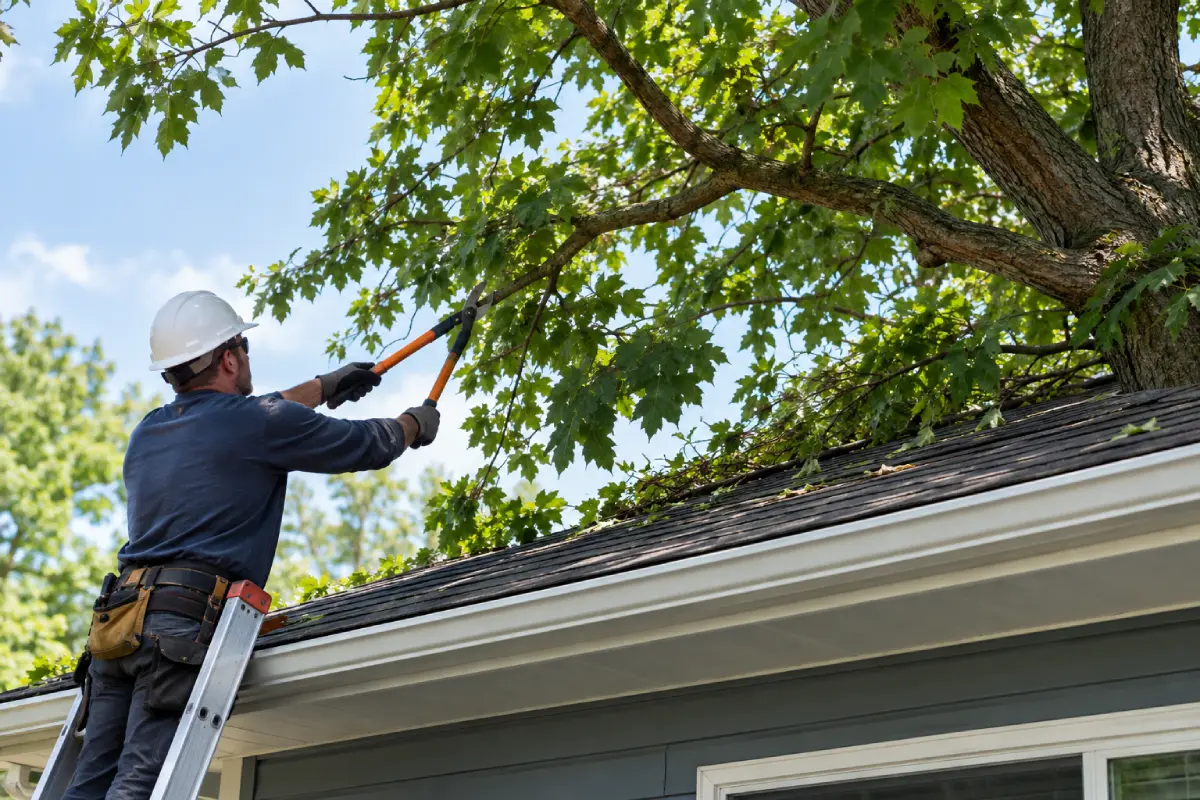
Cutting branches above a roof means working at height with a saw, over a hard surface, with the cut section falling towards the thing you are trying to protect. Add proximity to electrical service cables, which usually enter the house near the roofline, and the risk is serious. Tree work near a roof or near power lines belongs to a qualified arborist with the right insurance. Check what protections apply to the tree before anybody starts, because that liability lands on you as the property owner.
What good work looks like
The aim is clearance, not removal. A competent arborist will thin and shorten the limbs that overhang, keep the tree balanced, and leave it looking like a tree rather than a post.
Ask for the branches over the roof to be taken back so nothing can touch the covering in wind, and for the debris and any resulting gutter mess to be cleared as part of the job. Late autumn or winter is usually the sensible timing, outside nesting season and after the leaves have dropped, though species vary and the arborist should advise.
Afterwards, clear the gutters. A reduction job puts a season of debris into them in an afternoon.
Conclusion
The falling branch is the dramatic risk and the least likely one. The shading, the constant abrasion, the blocked gutters and the route for wildlife are the everyday costs, and they shorten the life of the roof quietly.
Keep branches clear of the roof surface, get the work done properly by somebody insured to do it, and check what protections apply to the tree first. Then clear the gutters and add both to the same seasonal routine, because they are the same problem seen from two ends.