How Do You Tell If a Storm Damaged Your Roof?

Most storm damage is not a hole in the roof. It is a shingle that has been lifted and dropped back down, looking normal; a seal that has broken; or a scatter of impact marks that mean nothing to the eye and a great deal to an insurer. The visible damage is the easy part. The damage that decides whether your roof lasts another fifteen years is usually the part you cannot see from the sidewalk.
That matters because there is a clock running. Insurance claims have deadlines that vary by policy and by state, and the longer damage sits undocumented, the easier it is to attribute to age rather than to a storm.
Start from the ground, not the ladder
Do not go up. A roof after a storm may have hidden structural damage, wet surfaces, and debris, and the great majority of what you need can be seen from below with a pair of binoculars.
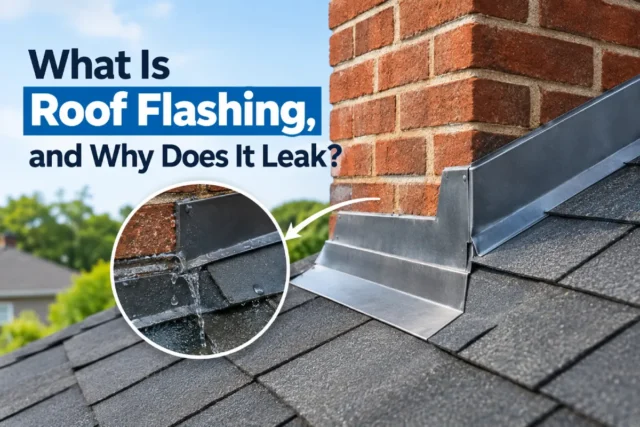
Walk the full perimeter of the house and look at every slope. Then walk the yard and the surrounding ground. Shingle fragments, granule accumulation at the bottom of downspouts, torn metal, and pieces of vent or flashing on the lawn are all evidence, and they are evidence you can photograph without leaving the ground.
What wind damage looks like
Wind does not usually tear shingles off cleanly. It lifts them, breaks the adhesive seal that holds each course to the one below, and lets them fall back into place. From the ground, the roof looks untouched. In the next storm, wind gets underneath, and the shingle is gone.
The signature to look for is creasing: a horizontal line across a shingle where it was bent back on itself. Creased shingles have failed even though they are still on the roof. Look also for shingles sitting slightly out of line with their neighbors, corners lifted or curled, and obvious gaps where tabs have gone.
Wind damage concentrates at edges and corners, along rakes and ridges, and on whichever slope faced the wind. A roof that has lost shingles along one edge and nowhere else has almost certainly had a wind event rather than age-related shingle failure, which appears across whole slopes fairly evenly.
What hail damage looks like
Hail is the harder one, because functional hail damage is genuinely difficult to see and easy to confuse with other things.
What an adjuster is looking for is bruising: a round mark where a hailstone has driven the granules down into the asphalt and cracked the reinforcing mat underneath. The tell is that it feels soft, slightly spongy, when pressed, because there is give in the damaged mat. Alongside it, there is usually granule loss at the point of impact, showing as a darker circle where the asphalt beneath is exposed.
Two features distinguish hail from most other marks. It has no pattern related to heat or sun, and it is directional, concentrated on the slopes that faced the storm. Hail also leaves evidence on things that are not the roof, which is the easiest check available to you from the ground. Look at soft metal: gutters, downspouts, vent caps, flashing, the air conditioning condenser fins, mailboxes, and any painted metal. Dents there confirm hail fell hard enough to matter, and they are far easier to photograph than a bruise on a shingle.
What is not storm damage
This is worth knowing before you make a claim, because a claim built on the wrong evidence damages your position.
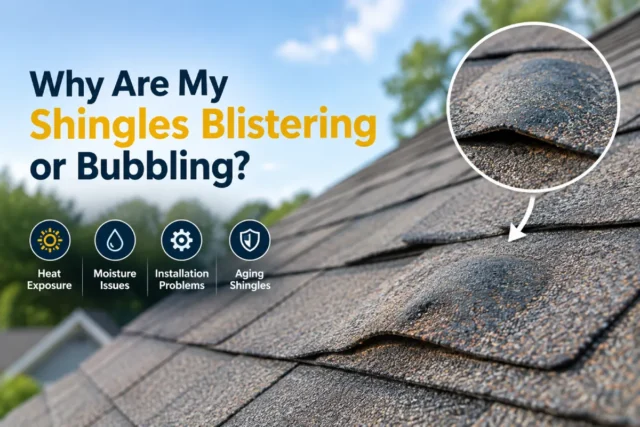
Blistering produces raised bubbles on shingles that are often mistaken for hail. The differences are consistent. Blisters are raised; hail bruises are depressed. Blisters feel firm; bruises feel soft. Blisters are scattered randomly and follow heat, so they are worse on sun-facing slopes, while hail follows the direction the storm came from. Blistering is generally treated as wear, manufacturing, or a ventilation issue rather than a covered peril, so presenting it as hail rarely ends well.
Ordinary granule loss from age, moss, and mechanical scuffing from a previous repair all get mistaken for storm damage too. So does foot traffic. If you are unsure which you are looking at, that uncertainty is itself a reason to get an independent inspection before filing.
Check inside as well
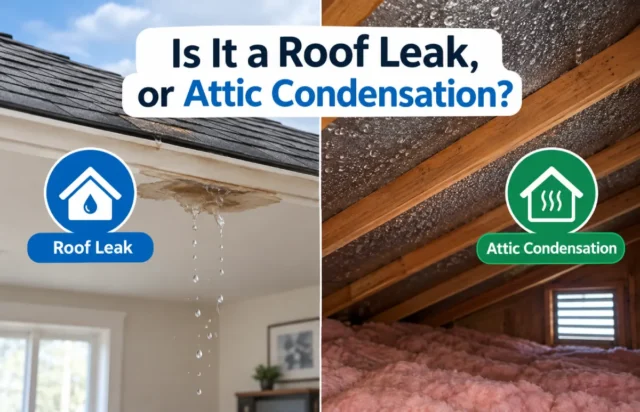
The interior tells you whether the covering has actually been breached, and it is the fastest check in the house. Look at upstairs ceilings and the tops of exterior walls for new staining. Then look in the roof space with a flashlight, on a dry day, for daylight visible through the deck, damp patches, or water tracking down a rafter.
Be careful about interpretation here. A stain that appears in cold weather with no rain is more likely to be condensation rather than a leak, and it will have nothing to do with the storm.
Document it properly and quickly
What you record in the first days after a storm carries most of the weight in a claim.
Document this in the first days
- Photograph everything from the ground, wide shots first to establish the whole house, then closer views of specific damage.
- Photograph the dented soft metal, which corroborates that hail fell.
- Photograph debris on the ground before you clean it up.
- Note the date and time of the storm, and keep any local weather reports or warnings.
- Photograph interior damage as it develops, with dates.
- Make reasonable temporary repairs to prevent further damage, and keep the receipts, because most policies expect you to mitigate.
- Do not throw away damaged material until it has been seen.
The contractor who knocks on your door
After a significant storm, people arrive. Some of them are competent local firms working hard. Some of them followed the weather in from three states away and will be gone before the first winter tests their work.
The pattern to be wary of is consistent: unsolicited door knocking, a free inspection that always finds damage, pressure to sign something immediately, an offer to handle the entire claim for you, and a suggestion that your deductible can be waived or absorbed, which is at best a misrepresentation and in many places illegal.
Slow it down. Get the roof inspected by somebody you chose rather than somebody who chose you, check that they are licensed and insured, and read the warning signs before you sign anything. Nothing about a storm claim requires a decision in the next hour, whatever you are told.
How claims usually work
Insurers distinguish between cosmetic damage and functional damage. Marks that do not affect how the roof sheds water are often excluded. Bruising that has cracked the mat is functional, and where enough of it is found within a given area, insurers commonly approve replacement rather than repair, on the basis that spot repairs cannot restore a roof uniformly.
Claim deadlines vary by policy and by jurisdiction, and they are not always generous. Read your own policy for the notification period rather than assuming, and file within it even if you are still gathering evidence. Check the deductible as well. According to the Insurance Information Institute, 19 states and Washington, D.C. have hurricane deductibles, and percentage deductibles typically run from 1 to 5 percent of the home’s insured value rather than a flat amount. On a home insured for $300,000, a 2 percent deductible is $6,000.
One thing worth understanding before you decide: making a claim for damage that turns out to be minor is not always the right move, and the calculation depends on your deductible against the likely cost of the repair.
Conclusion
After a storm, look from the ground, look at the soft metal, look inside, and photograph all of it the same day. Creasing is the wind signature and soft round bruising is the hail signature, and neither is obvious from a distance.
Then choose your own inspector rather than accepting the one on your doorstep. The damage will still be there next week. The pressure to decide immediately is the part that is not real.