What Size Gutters Does a Roof Need?
Bigger than most houses have, in a lot of cases. Gutter size is one of the few roofing decisions made almost entirely by default: whatever was there before gets replaced with the same, and whatever the developer fitted originally was chosen based on cost.
Size matters because a gutter has a maximum flow rate. Exceed it, and the water goes over the edge regardless of how clean the trough is, which is why an undersized gutter behaves like a blocked one every time there is a downpour.
To check your own numbers, the Gutter and Downspout Calculator takes roof area, pitch and local rainfall and suggests a gutter size and downspout count.
What determines the size needed?
Four factors, and most conversations only mention the first.
- Roof area draining into that run. Not the footprint of the house, but the area of roof whose water arrives in that particular gutter. A long run collecting from a large slope needs more than a short one under a small dormer.
- Roof pitch. A steep roof delivers the same volume of water faster, and it also catches more wind-driven rain. Steeper roofs therefore need more capacity for the same plan area, which is the factor most often ignored.
- Rainfall intensity where you live. Sizing is based on a short-duration peak rate rather than annual totals. Two places with similar yearly rainfall can need very different gutters if one gets it in sustained drizzle and the other in violent bursts.
- Number and position of downspouts. Capacity is a system property. A larger gutter with one outlet at the end of a long run may still overflow, because the water has to travel too far to leave.
The common sizes
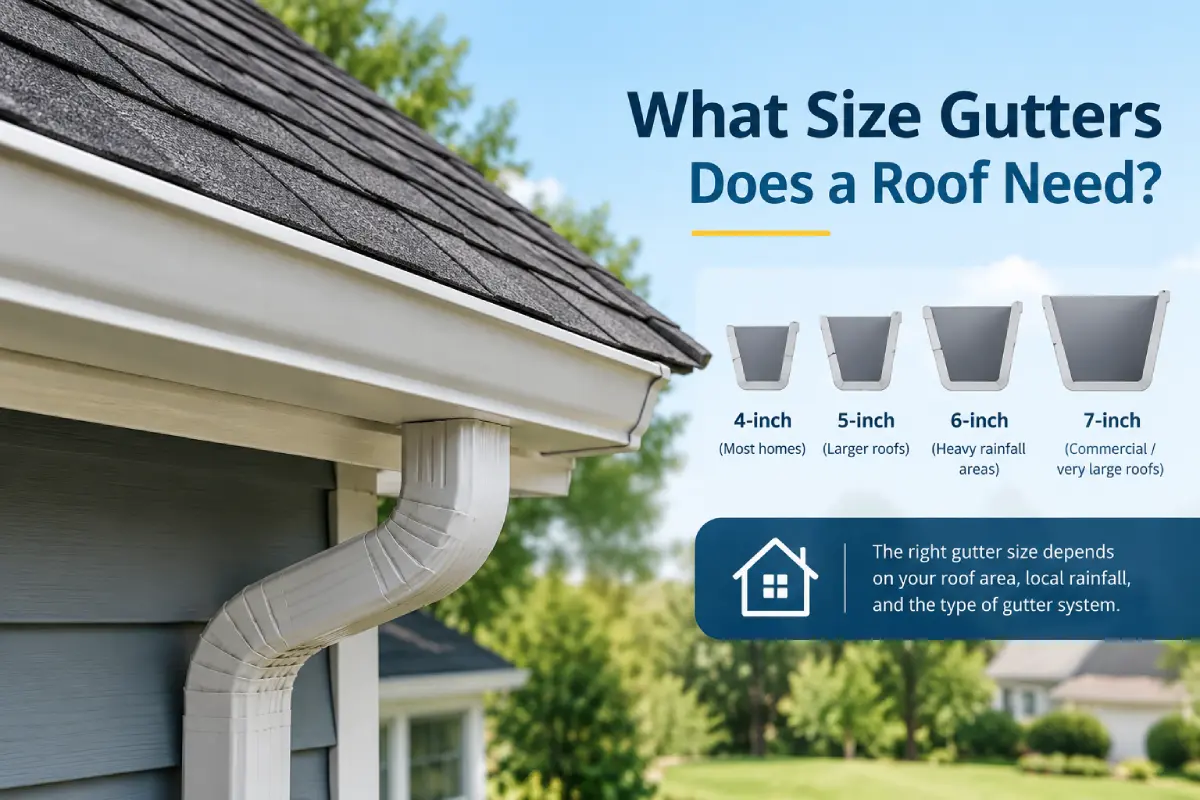
Domestic gutters mostly come in a small number of standard profiles, and the step up between them is significant rather than marginal.
The smaller standard sizes suit modest roofs and moderate rainfall, and they are what most houses have. The next size up carries substantially more, and the increase in capacity is greater than the increase in dimension suggests, because cross-sectional area rises faster than width.
Profile matters too. A deeper section carries more than a shallow one of the same width, and a square or box profile generally carries more than a rounded one of the same nominal size. When comparing quotes, compare the actual profile rather than the size in inches or millimeters.
Downspouts are half the system
Upgrading gutters without upgrading outlets is a common and expensive mistake. The gutter can only discharge as fast as the pipe takes it away.
As a general principle, adding a second downspout to a long run does more than increasing the gutter size, because it halves the distance water has to travel and doubles the outlet capacity. Where a run currently drains to one end, a mid-run or additional outlet is often the cheaper and more effective fix.
Before you pay for larger gutters
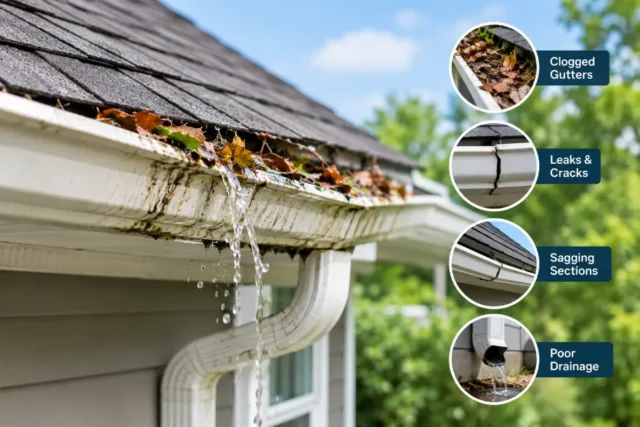
Establish first that size is actually the problem. A gutter that overflows in every shower is usually blocked, sagging or feeding a blocked downspout. A gutter that copes normally and only overflows in genuinely heavy rain is the one that is undersized. Watch it during a downpour and note whether it fills along the whole run or only at one point, because a local overflow is a fall or blockage problem and replacing the whole system will not fix it.
When upsizing is the right answer
Consider it when the roof area draining into a run has increased, which happens after an addition or an attic conversion with a new dormer. Consider it when the roof pitch has changed during a replacement. Consider it if rainfall in your area has become more intense, which is a real and increasingly common reason.
Consider it also where a valley discharges into a length of gutter, because valleys concentrate the water from two slopes into a short section, and that section frequently needs more capacity or its own outlet.
Getting it specified properly
This is a calculation rather than a judgement, and a contractor who is fitting gutters should be able to explain their sizing.
Ask what roof area they have allowed for each run, what rainfall figure they have used, and how many downspouts they are proposing and where. An answer along the lines of matching what is there already is not a calculation, and it reproduces whatever the original builder chose on cost.
If you are re-roofing, this is the moment to fix it. Gutters come off during the work, the fascia and drip edge are accessible, and adding an outlet now is far cheaper than doing it as a separate job later. It belongs on the list of things to settle before work starts, alongside the other items that get left out of a competitive quote.
Conclusion
Gutter size should be calculated from the roof area draining into each run, the pitch, local rainfall intensity, and the number of outlets. Most houses have what the original builder fitted, which was chosen for cost rather than for the roof.
Before replacing anything, confirm that capacity is genuinely the problem rather than blockage or fall. Then remember that an extra downspout often achieves more than a larger gutter, and costs considerably less.