How Do You Know If a Downspout Is Blocked?
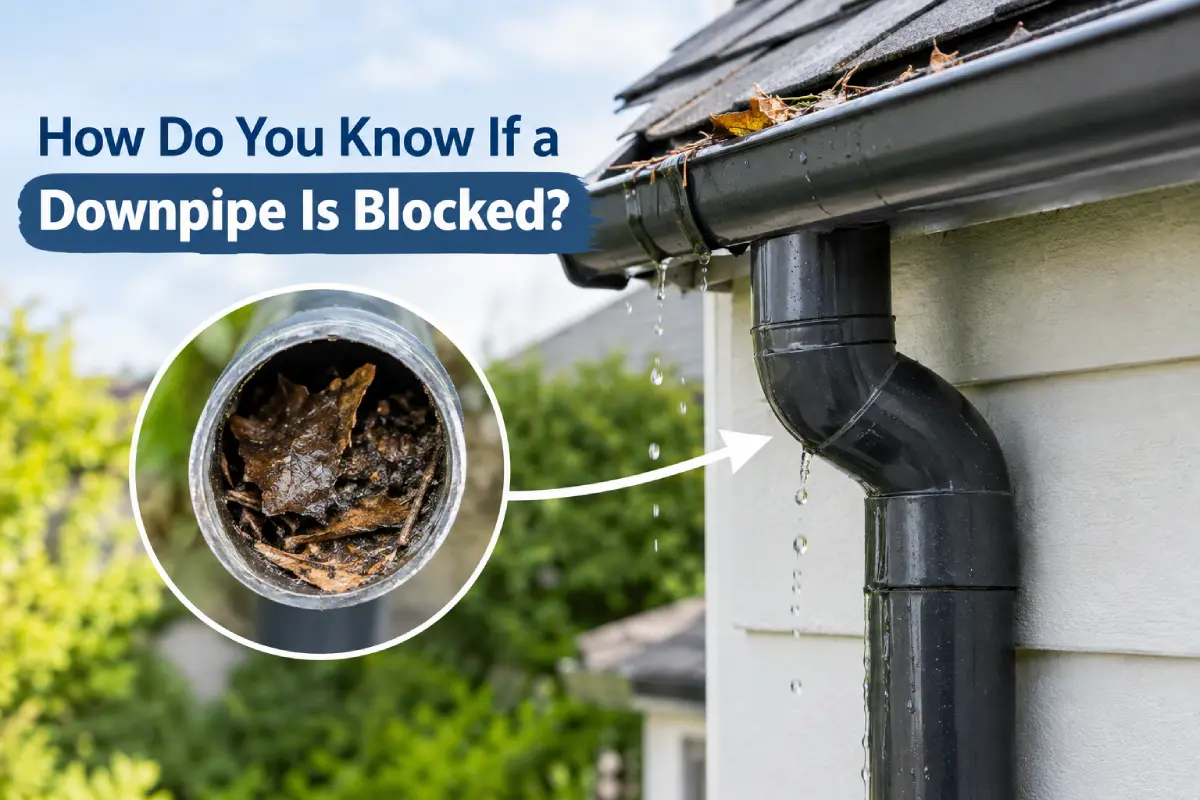
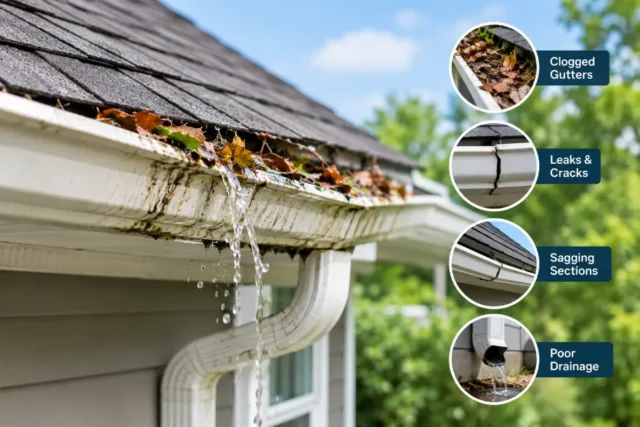
A blocked downspout is the most commonly missed cause of an overflowing gutter, because everything visible from the ground looks fine. The gutter is clear, the trough is empty when you look into it, and water still comes over the edge every time it rains hard.
The blockage is inside a pipe nobody can see into, usually at one of three predictable points.
Where blockages actually form
Debris rarely stops in the straight vertical section. It stops where the pipe changes direction or narrows.
Outlet
The outlet where the gutter meets the pipe is the first. Leaves and silt washed along the trough collect at the opening and form a mat, and this is invisible unless you look straight down into it.
Swan neck
The swan neck at the top, the offset that brings the pipe back to the wall, is the second and the most common. It is a double bend near the top of the run, and debris settles in it readily.
Bottom bend, or shoe
The bottom bend, or shoe, where the pipe meets a drain or discharges at ground level, is the third. Blockages here are often from below rather than above: leaves washed against the outlet, silt, or a drain that has itself blocked.
How to tell, without dismantling anything
Several checks are available, and none of them requires a ladder.
Watch during heavy rain
The definitive test. If the gutter is overflowing while the bottom of the downspout runs weakly or stays dry, the blockage is in the pipe. If the downspout is running hard and the gutter still overflows, the problem is capacity or fall rather than a blockage.
Tap down the pipe
Knock along the length with your knuckles. A clear pipe sounds hollow and consistent. A dull, solid section marks where the debris is sitting, and this works surprisingly well.
Run a hose into the gutter near the outlet on a dry day and watch the bottom. Water that takes a long time to appear, appears in dribbles, or backs up in the gutter confirms a restriction.
Look for staining
Water escaping at a joint above a blockage leaves a mark on the pipe and on the wall behind it. A stain that starts partway down the run brackets the problem.
Other things worth noticing
- Damp on an interior wall in the same position as a downspout, which means water has been escaping the pipe for some time.
- Green algae or moss on the wall beside the pipe rather than below the gutter.
- Plants growing out of the top of the pipe or at a joint.
- A pool of water at the base after rain has stopped, where there should be none.
- Erosion or splashing at ground level beside the pipe rather than at the drain.
- A gurgling sound during rain, which means water is passing a restriction.
Clearing it
Start at the bottom, because that is reachable from the ground and it is where a surprising number of blockages sit.
Remove the shoe or the bottom section if it is a push fit, clear it by hand, and check whether the drain below is itself blocked. Then try flushing from the top with a hose. If water backs up, feed a drain rod or a length of flexible rod down from the outlet, working gently rather than forcing, since old plastic and cast pipes both split.
Where a swan neck is the culprit, the joint usually has to come apart. On plastic systems, that is straightforward. On cast iron it is not, and it is worth paying somebody.
Where this stops being a homeowner job
Anything at the top of the pipe means working at height on a ladder, which is where most household injuries of this kind happen. Do not lean sideways to reach a swan neck, and do not brace yourself against the downspout: it is fixed to the wall with light brackets, and it will not hold you. Cast iron sections are heavy enough to cause serious injury if one comes free while you are working on it. If the blockage is above single-story height, or the pipe is cast iron, or the drain below appears to be the problem, this is worth paying for rather than improvising.
When the drain is the problem
If the pipe is clear and water still backs up, the blockage is below ground.
Drain inlets at the base of a downspout block with leaves and silt and are worth clearing as routine. Beyond that, a blocked underground drain is a drainage contractor’s job rather than a roofing one, and it is worth establishing which you have before calling anybody, because the two trades are separate.
Keeping them clear
Most downspout blockages start as gutter debris, so clearing the gutters properly and flushing through with a hose afterwards prevents most of them. That flush is the step most often skipped and it is the one that confirms the whole system works.
Outlet guards, small cages fitted at the gutter outlet, catch the material that would otherwise enter the pipe, and they are cheap. They need checking, since they block on the surface, but a blocked guard you can see beats a blocked pipe you cannot.
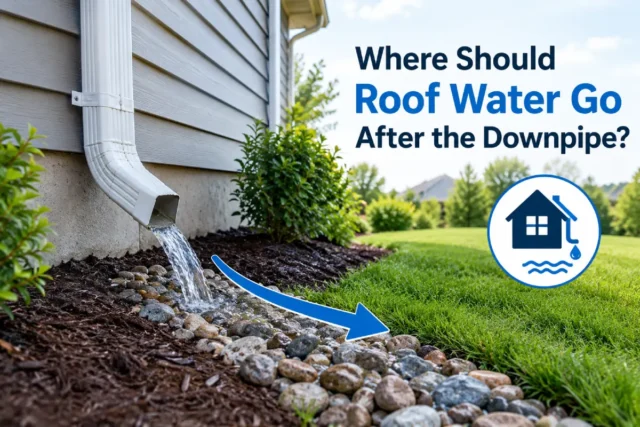
Once the water is out of the downspout, where it goes next matters just as much; see where roof water should go after the downspout.
Conclusion
Watch during heavy rain and compare the gutter with the bottom of the downspout. That single observation separates a blocked pipe from the other reasons a clean gutter overflows.
Then tap down the pipe to locate it, clear from the bottom first, and finish every gutter clean by running water through and watching it leave. A gutter clean that does not include that check is only half done.