How Often Should You Clean Your Gutters?

Twice a year is the standard answer, and it is a starting point rather than a rule. The right frequency for your house depends almost entirely on what is growing near it, and the range in practice runs from once a year to four or five times.
The better question is not how often but when, because timing matters more than frequency. A gutter cleared at the wrong point in the year fills again before it is needed.
The twice-a-year baseline
The two visits that matter are late autumn and spring.
1. Late autumn
Late autumn, once the leaves are actually down rather than while they are still falling, is the important one. It clears the gutters before winter, when a blocked gutter freezes solid, becomes heavy enough to pull brackets loose, and gives meltwater nowhere to go. It belongs on the same list as the rest of your winter preparation.
2. Spring
Spring clears what winter deposited: the last of the leaves, seed cases, blossoms, grit washed down from the roof, and any nesting material.
Doing the autumn clear too early is the most common mistake. Clearing in September and then watching the trees empty in November means going into winter with full gutters and a job you believe is done.
What moves the number
Trees are the main variable, and species matters more than proximity.
Deciduous trees overhanging the roof mean three or four visits, with at least two in autumn. Conifers are worse than they look: needles drop year-round rather than in one season, and they pack into a dense mat that water cannot pass. Pine, spruce and cedar nearby usually mean quarterly attention.
Houses with no trees within reach can often manage on one thorough visit a year, dealing mostly with grit, moss fragments and airborne debris rather than leaves.
Two other factors matter. A roof with heavy moss sheds fragments continuously, and an aging asphalt roof sheds granules that settle as silt in the bottom of the gutter. Both fill gutters without a tree in sight.
Let the gutter set the schedule
Rather than working to a calendar, watch what happens during heavy rain. It is the most reliable diagnostic available, and it requires nothing but a window.
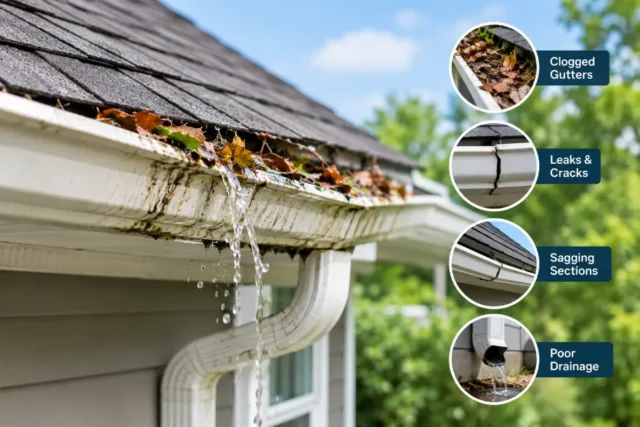
Water should run along the gutter and leave through the downspout. If it is sheeting over the front edge, running down the wall, or the downspout stays dry while it is raining hard, the gutter needs attention regardless of when it was last done.
Plants growing in the gutter mean silt has built up enough to hold roots, which is well past due. So is a gutter line that is no longer straight, since standing water is heavy.
This is where people get hurt
Gutter clearing puts more homeowners in hospital than any other roof-related job. The work happens on a ladder, at height, usually while reaching sideways to save moving it. Move the ladder instead. Set it on firm, level ground, have somebody with you, and never lean out past your belt buckle. If the gutters are above single-story height, if the ground below is soft or sloping, or if you would be working near the electrical service cable that enters the house at the roofline, pay somebody. It is inexpensive work, and the alternative is a fall onto a hard surface.
What a proper clean involves
Scooping the leaves out is half the job and the half most people stop at.
The silt in the bottom matters as much, because it holds water and it is what eventually stops the fall along the gutter. The downspouts need checking separately, since a clear gutter feeding a blocked downspout still overflows. And the brackets and joints are worth looking at while you are there, because that is when problems are cheap to fix.
Finish by running water through with a hose and watching where it goes. That is the only real confirmation the job worked.
If you have gutter guards
Guards reduce the frequency; they do not remove the need. They keep leaves out and let fine silt and grit through, so guarded gutters still accumulate a layer in the bottom that eventually blocks the outlet.
Some designs also collect debris on top, which then sits against the roof edge, and some make the eventual clean considerably harder because the guard has to come off first. Expect to check them annually rather than to forget about them.
If you are not sure the gutters are big enough for the roof, the Gutter and Downspout Calculator works out gutter size and the number of downspouts from your roof area and local rainfall.
Conclusion
Twice a year suits a house with moderate tree cover, once a year suits an open site, and three or four times suits anything under deciduous trees or conifers. Late autumn is the visit that matters most, and it should happen after the leaves have finished falling rather than while they are still coming down.
Then stop working to a schedule and watch the gutters during heavy rain instead. They will tell you when they need doing, and the cost of ignoring them is rotten fascia, soft decking at the eaves, and water against the foundation.