Does a New Roof Increase Your Home’s Value?

It increases what your house will sell for, and it usually does not return what it cost. Both statements are true at once, and holding them together is the only way to make a sensible decision about timing a replacement around a sale.
A new roof is better understood as removing an obstacle than as adding value. It rarely persuades anybody to pay a premium. It reliably stops people deducting, hesitating, or walking away.
What you get back
Industry cost and value studies consistently place roof replacement partway rather than wholly recouped at resale, and the figure moves with the market, the material and the region. It is one of the better-performing exterior projects, and it is still not a full return.
Treat any single percentage you read with caution, including in this article. These figures are averages across large regions and different housing markets, and the number for your street is not knowable from a national study.
The effect that matters more than the percentage
An old roof does not reduce an offer by the cost of a new roof. It reduces it by more, and it does so through several channels at once.
Buyers price risk conservatively, so a roof described as near the end of its life invites a deduction larger than the actual quote. Surveys and inspections flag it in writing, which converts a vague worry into a negotiating instrument. Some lenders and insurers are wary of older roofs, which can narrow the pool of buyers able to proceed. And a visibly tired roof shapes the impression of the whole property before anybody is through the door.
The result is that a house with an obviously failing roof often sells slowly, then sells with a reduction, and sometimes loses a buyer entirely at the survey stage.
The distinction worth holding on to
A new roof is not an investment that pays a return. It is the removal of a deduction. If your roof has years of life left, replacing it to improve a sale price is generally a poor use of money. If it is visibly failing, replacing it usually costs less than the discount and delay it would otherwise cause. The decision turns on the condition of the roof, not on the percentage recouped.
When replacing before a sale makes sense
Do it when the roof is visibly failing, when a leak has stained a ceiling, when a survey has already raised it, when the market is slow enough that buyers can afford to be fussy, or when local buyers are unusually sensitive to roof condition, which is common in areas with severe weather.
Do it also when the alternative is negotiating in the dark. A buyer with a quote in hand and an emotional investment in the discount will usually extract more than the work would have cost you.
When it does not make sense
Do not replace a sound roof with meaningful life left in it in the hope of a premium. Buyers do not pay extra for a roof that was already fine.
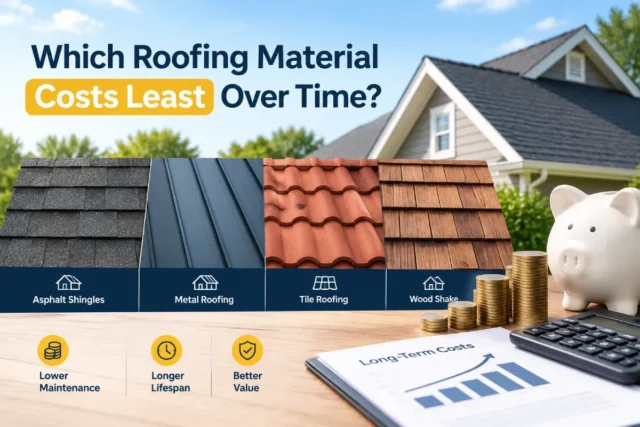
Do not upgrade the material for resale either. A premium covering on a modest house rarely returns the difference, and the market seldom credits the upgrade at anything like its cost. This is the same point made in the case for and against slate: long-life materials reward owners who stay, not sellers.
And in a fast market where buyers are competing, a tired roof is less likely to be the deciding factor.
The option between the two
There is a third route that suits many sellers better than either extreme.
Get the roof inspected, get a written quote for the work, make any small repairs that address active problems, and disclose the condition honestly with the quote attached. That gives buyers a defined number instead of an open-ended worry, which is what actually drives large deductions.
Some sellers offer a credit at closing instead, which achieves a similar effect and lets the buyer choose their own material. It costs less than doing the work, and it removes the uncertainty, which is most of the problem.
Documentation is worth more than people expect
If you have had a roof replaced, keep everything: the contract, the invoice, the permit and final inspection sign-off, the material specification and the warranty paperwork, along with any transfer terms.
A folder that proves the roof is eight years old, professionally installed, permitted, and still under a transferable warranty removes the doubt that causes deductions. An undocumented roof of unknown age is treated by buyers as older than it probably is. This is one reason permitted work matters at the point of sale rather than at the point of installation.
Conclusion
A new roof will not return its cost as a premium, and a failing one will cost you more than its replacement price in deductions, delay, and lost buyers.
Judge it on the condition of the roof rather than on a recoup percentage. If it is sound, keep the money and keep the paperwork. If it is failing, replacing it before listing is usually the cheaper of the two ways to pay for it, because the other way is called negotiation.