How Much Attic Insulation Do You Need?
Most US attics should have between R-38 and R-60 of insulation, which is roughly 13 to 18 inches of loose-fill or batts. Energy Star’s rule of thumb is a minimum of R-38 (about 13 to 14 inches) in the South and R-49 (about 16 to 18 inches) in the North. The exact target depends on your climate zone and on what is already up there.
Target R-value by climate zone
| Climate zones | Where | Target for an uninsulated attic |
|---|---|---|
| 1 to 3 | The warmest parts of the country | R-30 to R-49 |
| 4 to 8 | Mixed and cold climates | R-38 to R-60 |
These are Energy Star’s recommended levels for adding insulation. Energy Star publishes the zone map and the current table, so check your county there before you buy, because a local energy code can set its own minimum. An attic that already has a few inches needs less added than the table shows.
Find out what you have
Push a ruler into the insulation and note the depth, then identify the type. Most common insulation types give about R-3 to R-3.5 per inch, so 6 inches of fiberglass is somewhere around R-18 to R-21. If you can see the tops of the joists, the attic is almost certainly under-insulated. Energy Star suggests adding more when the level is more than 4 to 6 inches below the recommended depth.
The attic insulation calculator turns your existing depth and a target R-value into the depth to add and the number of bags. Step only on the joists while you measure, and wear a mask and eye protection around loose-fill.
Seal the air leaks before you add
Insulation slows heat, but it does little against moving air. Before adding any, seal the gaps where warm air from the house reaches the attic: the attic hatch, pipe and wire penetrations, and light fixtures. The same leaks are what feed ice dams in cold climates, since heat escaping into the attic melts the snow above it.
Leave the roof room to breathe
New insulation pushed into the eaves blocks the soffit vents, which are the intake half of the ventilation system and the part that most often fails. Fit baffles at the eaves to keep an air channel open, and keep insulation clear of recessed lights that are not rated for contact. Why a roof needs ventilation, and how much explains the airflow, and leak or condensation shows what a poorly ventilated attic does in winter.
How much to buy
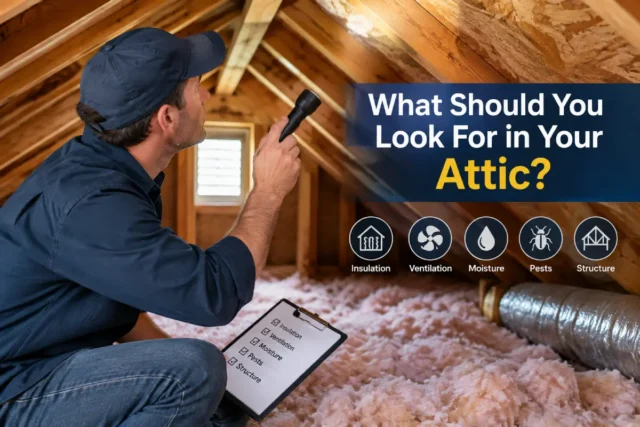
Multiply the attic floor area by the depth to add. For a 1,000 square foot attic with 4 inches of loose-fill fiberglass (about R-10) aiming for R-49, the shortfall is R-39. Loose-fill cellulose at about R-3.5 per inch needs roughly 11.1 more inches, for a total depth of about 15.1 inches, and at 40 square feet per bag that is about 25 bags. Bag labels give the coverage at each R-value, and that is the figure to use. While you are up there, what to look for in your attic lists the other signs worth checking.
More attic and ventilation guides
- Why a roof needs ventilation
- What to look for in your attic
- Roof leak or attic condensation
- What causes ice dams
The attic ventilation calculator and attic insulation calculator work from your own measurements.
Conclusion
The right amount of attic insulation is the Energy Star level for your climate zone, measured against the depth you already have, added after the air leaks are sealed and with the soffit vents kept open. Run your numbers through the calculator, and check the zone table before you buy.